Forgotten Diaconal Functions of the Alexandrian Tradition

In Orthodoxy, the Divine Liturgy is regarded as being Heaven on Earth. This is because Jesus Christ, truly and actuality, becomes present on the Altar in the Sacrament of the Holy Eucharist.

“When we see the Lord as a sacrifice placed on the altar, the priest praying over the sacrifice, and the congregation being cleansed by the precious blood, can you say that you are still standing with men on earth? … Did you not ascend directly to heaven?”

—  St. John Chrysostom, Homilies on Ephesians 3.

Because of this, the various Liturgical Families of the Orthodox Church (Armenian, Coptic, Syriac, Tewahedo, etc.) use symbols in various forms to direct our attention to this mystical reality. Hence, the use of incense, candles, iconography, vestments, chanting, and the like to capture our senses.

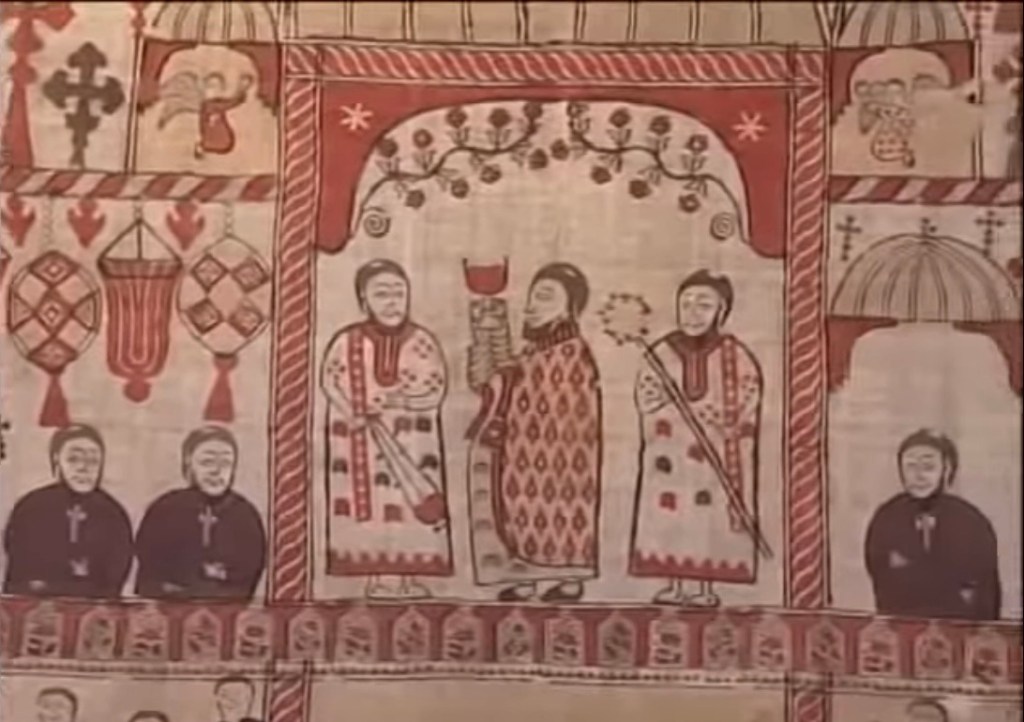
An ancient custom from the 1st – 4th century that was preserved amongst our sister churches the Armenians, Syrians, and Jacobites that we lost within the Coptic and Tewahedo tradition is the use of the Ripidion in the Altar (Though some Coptic Churches do process with them and currently use either a lefafa or a small flag as their substitute). The Ripidion is a liturgical fan usually made of metal and decorated with an image of the seraphim or cherubim to symbolize their presence since, again, Jesus is truly present in the Holy Eucharist on the altar. In some traditions, such as the Armenian, Syrian, and Malankara; small bells encircle the fan and are manipulated to swiftly ring during certain portions of the liturgy to symbolize the sound of the wings of the said heavenly beings (Ez 1:24).

Continue reading “Forgotten Diaconal Functions of the Alexandrian Tradition”

The Diaconate: Servanthood, Character, and Apostolic Order — Pt. 1.

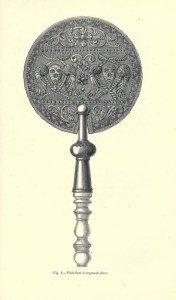
Illustration of Armenian Deacon and Subdeacon by Joseph Pitton de Tournefort (1656-1708)

Considering that there is a lack of understanding amongst many of the faithful regarding what the office of the Deacon entails, and what his responsibilities are, I’ve discerned to write on this matter for clarification. This is for both my own reflection as a Deacon and for the potential benefit of my readers; though my understanding of this great office is limited and fallible.

The Diaconate is understood by the Church as being the first rank of the Major Orders of the Clergy. The word Deacon (Greek: διάκονος / diakonos) means ‘an attendant, a minister, a servant’. More explicitly does the word ‘Diakonos’ properly mean, per linguistic scholars: “‘to kick up dust,’ as one running an errand.” (1) Thereby, the Deacon is ordained to serve the Church – the Body of Christ.

The tasks of the Diaconate to minister to the people was at first the responsibility of the Apostles. But to alleviate a workload that was interfering with their mission to “give ourselves continually to prayer and to the ministry of the word” (Acts 6:4) as “It is not desirable that we should leave the word of God and serve tables” (Acts 6:2), the Apostles commanded the faithful to “seek out from among you seven men of good reputation, full of the Holy Spirit and wisdom, whom we may appoint over this business” (Acts 6:3) as there was a conflict between the Hellenists and the Hebrews regarding the daily distribution of food (Acts 6:1), given that the faithful of the Church lived in common (Acts 2:44; c.f. Acts 4:32).

Continue reading “The Diaconate: Servanthood, Character, and Apostolic Order — Pt. 1.”

The Hebraic and Apostolic Origins of the Eucharist: Liturgical Development in the Early Church

Tombs within the Roman Catacombs: The early Christians within Rome used the stone tombs of the martyrs as altars. This custom is thought to trace to the first quarter of the 2nd century. Marble tops were placed upon the tombs for the Mass to be celebrated upon. [SOURCE]

Holy writ tells us that on the night of Passover, Jesus had instituted the sacrament of the Holy Eucharist:

… took bread, blessed and broke it, and gave it to the disciples and said, ‘Take eat; this is My Body.’ Then He took the cup, and gave thanks, and gave it to them, saying, “Drink from it, all of you. For this is My blood of the new covenant, which is shed for many for the remission of sins.’

— Matthew 26:26-28.

Being that our Lord and the Apostles were Hebrews, the elements and customs used were Hebraic in nature. More elaborately, the ancient Hebrews would consider meals to be joyful occasions, which would be celebrated within their homes. Church historian Roger T. Beckwith stated that in accordance to the Mishnah:

“grace was said several times at meals, over each main dish, over bread, and over wine; and when people were eating together, most benedictions were said by one person for all, and a responsive grace was added at the end of the meal.”

— Jones, Cheslyn , Geoffrey Wainwright, Edward Yarnold SJ, and Paul Bradshaw, eds. 1992. The Study of Liturgy. Revised. Oxford University Press. Pg. 72. 

The Liturgist and scholar C.P.M. Jones is also in agreement, and even suggested that the singularity of the cup could have been something which originated with Christ Himself: 

The action and words concerning the bread precede the meal; those concerning the cup follow it. This pattern accords well with Jewish meal customs on solemn occasions. The bread-words accompany the normal action over the bread; the wine-words accompany the thanksgiving over the cup. The single, common cup, so essential to the symbolism, may not have been contemporary custom, but Jesus’ own idea.

— Jones, Cheslyn , Geoffrey Wainwright, Edward Yarnold SJ, and Paul Bradshaw. Pg. 195. 

The use of bread and wine in worship is also evident when examining the Old Testament scriptures that were reverenced by the Hebrews. This can be seen in the case of Melchizedek (Genesis 14:18) as well as within the Levitical sacrifices (Leviticus 23:13-37).

Continue reading “The Hebraic and Apostolic Origins of the Eucharist: Liturgical Development in the Early Church”