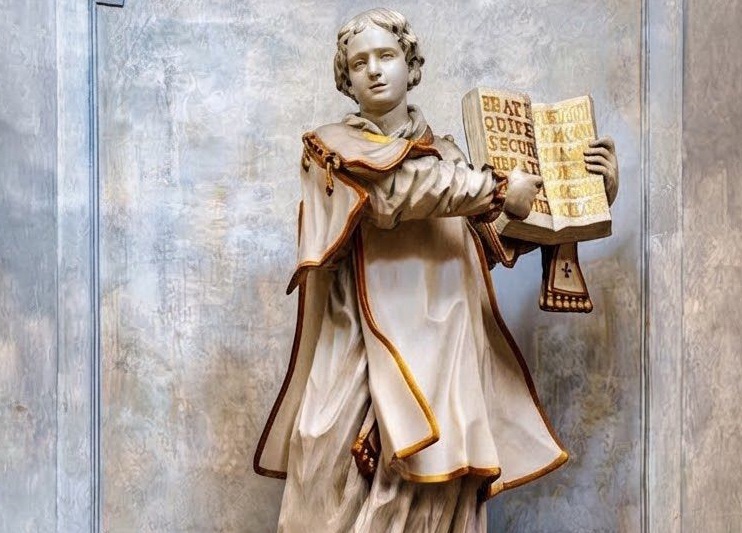
‘I am a Christian!’ — St. Euplius the Deacon, Preacher, and Martyr: A Witness of Steadfastness Against Idolatry and Heresy.

Some may be unaware of the vitalizing story of the early Christian martyr St. Euplius (304 A.D.). Tradition is silent about his early life, age, and background. Yet, we know that he was of a mature age since the Acts of Euplius testify to him as being both a ‘man’ and a Deacon (1) within Catalina, Sicily during the time of Diocletian. He was a bold preacher, evangelist, and firm defender of truth against false religion and idolatry; always keeping the four gospels on his person. This is what cost him his earthly life; but attainment of eternal glory. 

The Oxford Classic ‘The Acts of the Christian Martyrs’ explains that there are two recensions to his story: one Greek (GR) and the other Latin (LR). Both editions complement one another; as they provide details and clues which lack in the other. The examples are many; which will not be covered in its entirety in this article. 

Both versions are silent in respect to his life prior to his martyrdom; but instead immediately describe the epoch in which he openly detested Diocletian’s regime and abominable edict – that by the threat of death all should worship the idols of the state. Historical complications arise given that both versions disagree in respect to when he began challenging the governor Calvisianus outside of his council – chamber (2). Nevertheless, both agree that he willed to suffer and die for Christ. 

Continue reading “‘I am a Christian!’ — St. Euplius the Deacon, Preacher, and Martyr: A Witness of Steadfastness Against Idolatry and Heresy.”
When Carnal Reason Ends, Divine Revelation Speaks: The Folly of Chance and the Glory of Creation Out of Nothing

Throughout time, man has vainly attempted to explain the origin of all things without accrediting creation to an Intelligent Mind. Though often believed to be only a modern phenomenon, philosophers of antiquity had a variety of opinions on this matter. An idea believed by some of those from ancient Greece was one which suggested that everything came into existence by mere chance. Addressing this error, St. Basil wrote:

“Deceived by their inherent atheism it appeared to them that nothing governed or ruled the universe, and that was all was given up to chance.”

– Basil of Caesarea, Hexaemeron, Hom. 1.1.2. 

Man had invented a plurality of other ideas to explain creation as well — too many which would expand beyond this article to cover. But as most are aware, science is constantly evolving. It is almost certain that the latest recent discovery will triumph over that of what preceded them. Not ignorant to this, St. Basil adds:

 “The philosophers of Greece have made much ado to explain nature, and not one of their systems has remained firm and unshaken, each being overturned by its successor.”

– Basil of Caesarea, Hexaemeron, Hom. 1.1.2. 

Despite the inconsistencies of scientific hypotheses, some have proven to be in favor of what was already revealed in Scripture, which we will cover momentarily.

Continue reading “When Carnal Reason Ends, Divine Revelation Speaks: The Folly of Chance and the Glory of Creation Out of Nothing”

The Superiority of Biblical Cosmology over Pagan Creation Myths

Throughout history, man has made attempts to explain the origin of all things. This is evident when examining the various cosmological stories of antiquity, such as in the case of the ancient Egyptians and Babylonians who attributed the birth of existence to various deities. These deities had fallen human characteristics, ambitions, and interests.

To cite Holmon’s Quicksource:

“Egyptian and Babylonian (as well as the earlier Sumerian) creation myths were inherently polytheistic, with teeming masses of powerful but flawed gods competing for the spotlight… cohabitations, base motives, and warring between the chief gods led to the incidental creation of other gods as well as the earth, sky, sea, and all living things”

– Whorton, Mark S, and Hill Roberts. Holman Quicksource Guide to Understanding Creation. Nashville, Tennessee, Holman Reference, 2008, 41-42.

These deities of the said groups were not only limited, as they wrestled “with eternal matter to fashion heaven and earth” (Whorton, 37) but were unjust and grudging against the human race. For instance, the Babylonian Enuma Elish tells that the human race was created from the blood of the defeated Kingu, who was seen as being the commander of demons, from the underworld, and an enemy to “superior” deities. Consequently, a personal and loving relationship between humanity and the gods was lacking; as they were created not only as a result of conflict, but to perform difficult labors of the gods such as building, digging, etc.

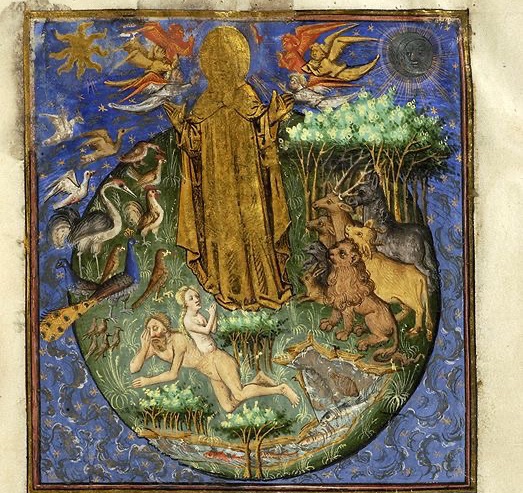
On the contrary, the Holy Scriptures speak of there being One God that is completely good, just, eternal, omnipotent, sovereign, unlimited, and sacred. As such, He was not in need of any other assistance, nor in need of pre-existent matter to create; as He made all things out of nothing by His Word. The idea of a deity needing pre-existent matter was one shared with, and perhaps adopted, by Plato.

Continue reading “The Superiority of Biblical Cosmology over Pagan Creation Myths”