The Hebraic and Apostolic Origins of the Eucharist: Liturgical Development in the Early Church

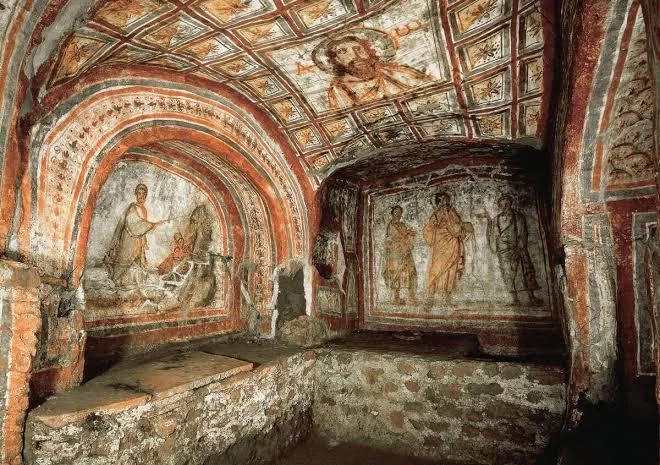
Tombs within the Roman Catacombs: The early Christians within Rome used the stone tombs of the martyrs as altars. This custom is thought to trace to the first quarter of the 2nd century. Marble tops were placed upon the tombs for the Mass to be celebrated upon. [SOURCE]

Holy writ tells us that on the night of Passover, Jesus had instituted the sacrament of the Holy Eucharist:

… took bread, blessed and broke it, and gave it to the disciples and said, ‘Take eat; this is My Body.’ Then He took the cup, and gave thanks, and gave it to them, saying, “Drink from it, all of you. For this is My blood of the new covenant, which is shed for many for the remission of sins.’

— Matthew 26:26-28.

Being that our Lord and the Apostles were Hebrews, the elements and customs used were Hebraic in nature. More elaborately, the ancient Hebrews would consider meals to be joyful occasions, which would be celebrated within their homes. Church historian Roger T. Beckwith stated that in accordance to the Mishnah:

“grace was said several times at meals, over each main dish, over bread, and over wine; and when people were eating together, most benedictions were said by one person for all, and a responsive grace was added at the end of the meal.”

— Jones, Cheslyn , Geoffrey Wainwright, Edward Yarnold SJ, and Paul Bradshaw, eds. 1992. The Study of Liturgy. Revised. Oxford University Press. Pg. 72. 

The Liturgist and scholar C.P.M. Jones is also in agreement, and even suggested that the singularity of the cup could have been something which originated with Christ Himself: 

The action and words concerning the bread precede the meal; those concerning the cup follow it. This pattern accords well with Jewish meal customs on solemn occasions. The bread-words accompany the normal action over the bread; the wine-words accompany the thanksgiving over the cup. The single, common cup, so essential to the symbolism, may not have been contemporary custom, but Jesus’ own idea.

— Jones, Cheslyn , Geoffrey Wainwright, Edward Yarnold SJ, and Paul Bradshaw. Pg. 195. 

The use of bread and wine in worship is also evident when examining the Old Testament scriptures that were reverenced by the Hebrews. This can be seen in the case of Melchizedek (Genesis 14:18) as well as within the Levitical sacrifices (Leviticus 23:13-37).

Continue reading “The Hebraic and Apostolic Origins of the Eucharist: Liturgical Development in the Early Church”
The Dormition & Assumption of the Holy Theotokos: Is It Biblical?

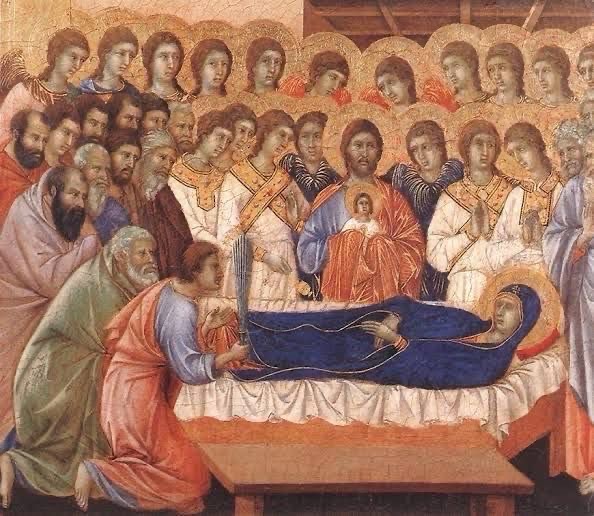
Today is the 21st day of the month of Tir. In the Tewahedo and Coptic Orthodox Churches, we celebrate the feast of St. Mary’s Dormition (Latin: dormitio; viz., a falling asleep).

The Orthodox Church teaches that at the very end of St. Mary’s life, and after many years of praying before the empty tomb of her beloved Son and God Jesus Christ, she was promised a glorious death. This eventually took place in the presence of Our Lord, His Angels, and the Apostles in her 60th year with the exception of St. Thomas who was preaching in India. The apostles who were present buried her body in Gethsemane, per the command of what they heard from the Holy Spirit. By the Divine intervention, St. Thomas was transported on a cloud before her deceased body in Gethsemane. He later saw the angels of God carrying St. Mary’s Body into heaven; placing her under the Tree of Life in the Eternal Garden of Paradise (c.f. Rev 22:1-5) that it may be united with her soul that was clothed in a veil of light by her Son. When he revealed what he saw to the rest of the apostles, they opened her tomb to not find her body; but to only smell a sweet fragrance. They rejoiced in this as this confirmed their faith in the Christ’s Resurrection by which we will all share in per the promise of our Lord. This is what the Apostles prayed for, hoped in, and preached to the world; despite the persecutions which came with it as they took comfort in what is to come.

But where is this event of the Assumption in the Holy Bible? Some hold to the opinion that perhaps the four gospels and the epistles were completed prior to this event. I happen to agree with this theory, especially given the Church’s Tradition which references the deaths of certain apostles — who were resurrected following their martyrdoms just to be present with the Theotokos for this moment.

Continue reading “The Dormition & Assumption of the Holy Theotokos: Is It Biblical?”

When Carnal Reason Ends, Divine Revelation Speaks: The Folly of Chance and the Glory of Creation Out of Nothing

Throughout time, man has vainly attempted to explain the origin of all things without accrediting creation to an Intelligent Mind. Though often believed to be only a modern phenomenon, philosophers of antiquity had a variety of opinions on this matter. An idea believed by some of those from ancient Greece was one which suggested that everything came into existence by mere chance. Addressing this error, St. Basil wrote:

“Deceived by their inherent atheism it appeared to them that nothing governed or ruled the universe, and that was all was given up to chance.”

– Basil of Caesarea, Hexaemeron, Hom. 1.1.2. 

Man had invented a plurality of other ideas to explain creation as well — too many which would expand beyond this article to cover. But as most are aware, science is constantly evolving. It is almost certain that the latest recent discovery will triumph over that of what preceded them. Not ignorant to this, St. Basil adds:

 “The philosophers of Greece have made much ado to explain nature, and not one of their systems has remained firm and unshaken, each being overturned by its successor.”

– Basil of Caesarea, Hexaemeron, Hom. 1.1.2. 

Despite the inconsistencies of scientific hypotheses, some have proven to be in favor of what was already revealed in Scripture, which we will cover momentarily.

Continue reading “When Carnal Reason Ends, Divine Revelation Speaks: The Folly of Chance and the Glory of Creation Out of Nothing”