Forgotten Diaconal Functions of the Alexandrian Tradition

In Orthodoxy, the Divine Liturgy is regarded as being Heaven on Earth. This is because Jesus Christ, truly and actuality, becomes present on the Altar in the Sacrament of the Holy Eucharist.

“When we see the Lord as a sacrifice placed on the altar, the priest praying over the sacrifice, and the congregation being cleansed by the precious blood, can you say that you are still standing with men on earth? … Did you not ascend directly to heaven?”

—  St. John Chrysostom, Homilies on Ephesians 3.

Because of this, the various Liturgical Families of the Orthodox Church (Armenian, Coptic, Syriac, Tewahedo, etc.) use symbols in various forms to direct our attention to this mystical reality. Hence, the use of incense, candles, iconography, vestments, chanting, and the like to capture our senses.

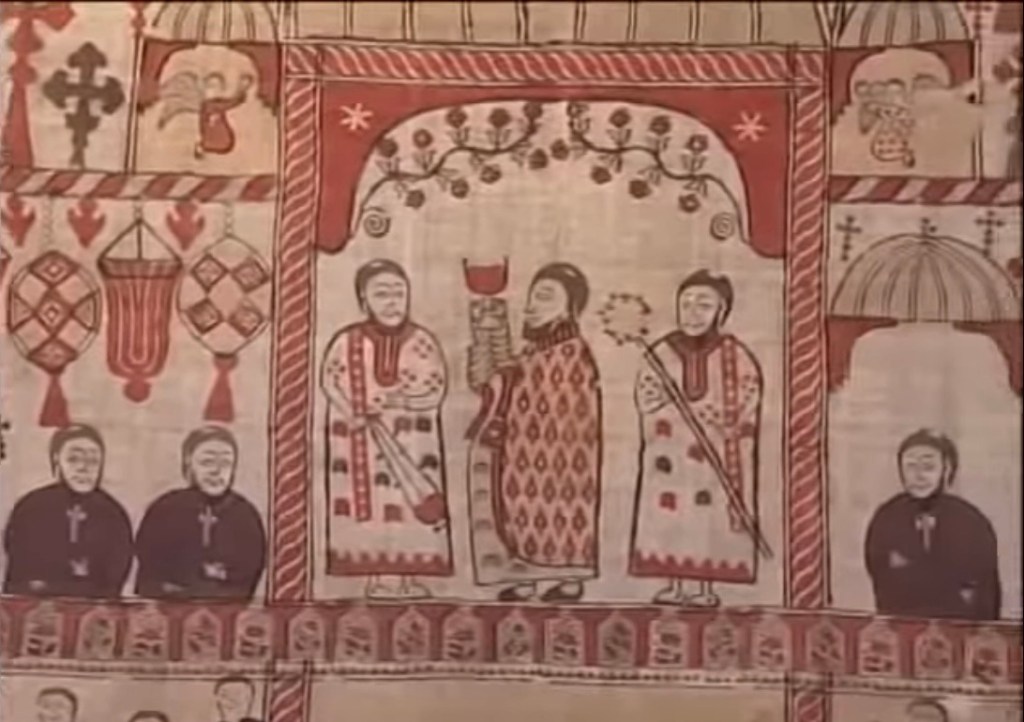
An ancient custom from the 1st – 4th century that was preserved amongst our sister churches the Armenians, Syrians, and Jacobites that we lost within the Coptic and Tewahedo tradition is the use of the Ripidion in the Altar (Though some Coptic Churches do process with them and currently use either a lefafa or a small flag as their substitute). The Ripidion is a liturgical fan usually made of metal and decorated with an image of the seraphim or cherubim to symbolize their presence since, again, Jesus is truly present in the Holy Eucharist on the altar. In some traditions, such as the Armenian, Syrian, and Malankara; small bells encircle the fan and are manipulated to swiftly ring during certain portions of the liturgy to symbolize the sound of the wings of the said heavenly beings (Ez 1:24).

Continue reading “Forgotten Diaconal Functions of the Alexandrian Tradition”

The Diaconate: Servanthood, Character, and Apostolic Order

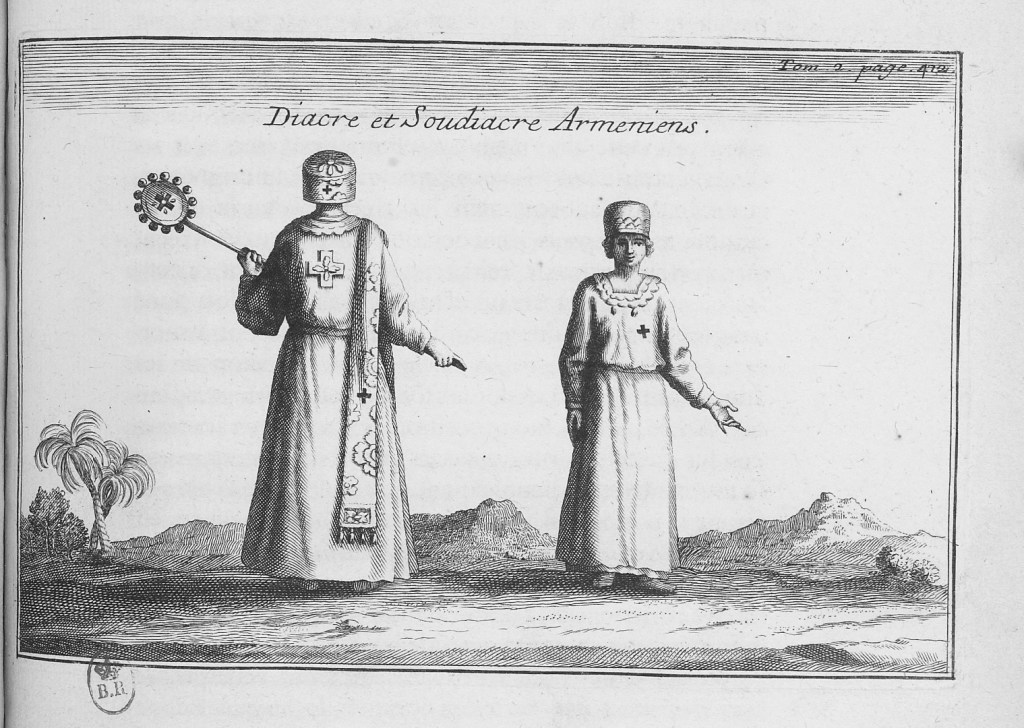
Illustration of Armenian Deacon and Subdeacon by Joseph Pitton de Tournefort (1656-1708)

Considering that there is a lack of understanding amongst many of the faithful regarding what the office of the Deacon entails, and what his responsibilities are, I’ve discerned to write on this matter for clarification. This is for both my own reflection as a Deacon and for the potential benefit of my readers; though my understanding of this great office is limited and fallible.

The Diaconate is understood by the Church as being the first rank of the Major Orders of the Clergy. The word Deacon (Greek: διάκονος / diakonos) means ‘an attendant, a minister, a servant’. More explicitly does the word ‘Diakonos’ properly mean, per linguistic scholars: “‘to kick up dust,’ as one running an errand.” (1) Thereby, the Deacon is ordained to serve the Church – the Body of Christ.

The tasks of the Diaconate to minister to the people was at first the responsibility of the Apostles. But to alleviate a workload that was interfering with their mission to “give ourselves continually to prayer and to the ministry of the word” (Acts 6:4) as “It is not desirable that we should leave the word of God and serve tables” (Acts 6:2), the Apostles commanded the faithful to “seek out from among you seven men of good reputation, full of the Holy Spirit and wisdom, whom we may appoint over this business” (Acts 6:3) as there was a conflict between the Hellenists and the Hebrews regarding the daily distribution of food (Acts 6:1), given that the faithful of the Church lived in common (Acts 2:44; c.f. Acts 4:32).

Continue reading “The Diaconate: Servanthood, Character, and Apostolic Order”

The Dormition & Assumption of the Holy Theotokos: Is It Biblical?

Today is the 21st day of the month of Tir. In the Tewahedo and Coptic Orthodox Churches, we celebrate the feast of St. Mary’s Dormition (Latin: dormitio; viz., a falling asleep).

The Orthodox Church teaches that at the very end of St. Mary’s life, and after many years of praying before the empty tomb of her beloved Son and God Jesus Christ, she was promised a glorious death. This eventually took place in the presence of Our Lord, His Angels, and the Apostles in her 60th year with the exception of St. Thomas who was preaching in India. The apostles who were present buried her body in Gethsemane, per the command of what they heard from the Holy Spirit. By the Divine intervention, St. Thomas was transported on a cloud before her deceased body in Gethsemane. He later saw the angels of God carrying St. Mary’s Body into heaven; placing her under the Tree of Life in the Eternal Garden of Paradise (c.f. Rev 22:1-5) that it may be united with her soul that was clothed in a veil of light by her Son. When he revealed what he saw to the rest of the apostles, they opened her tomb to not find her body; but to only smell a sweet fragrance. They rejoiced in this as this confirmed their faith in the Christ’s Resurrection by which we will all share in per the promise of our Lord. This is what the Apostles prayed for, hoped in, and preached to the world; despite the persecutions which came with it as they took comfort in what is to come.

But where is this event of the Assumption in the Holy Bible? Some hold to the opinion that perhaps the four gospels and the epistles were completed prior to this event. I happen to agree with this theory, especially given the Church’s Tradition which references the deaths of certain apostles — who were resurrected following their martyrdoms just to be present with the Theotokos for this moment.

Continue reading “The Dormition & Assumption of the Holy Theotokos: Is It Biblical?”