Considering that there is a lack of understanding amongst many of the faithful regarding what the office of the Deacon entails, and what his responsibilities are, I’ve discerned to write on this matter for clarification. This is for both my own reflection as a Deacon and for the potential benefit of my readers; though my understanding of this great office is limited and fallible.
The Diaconate is understood by the Church as being the first rank of the Major Orders of the Clergy. The word Deacon (Greek: διάκονος / diakonos) means ‘an attendant, a minister, a servant’. More explicitly does the word ‘Diakonos’ properly mean, per linguistic scholars: “‘to kick up dust,’ as one running an errand.” (1) Thereby, the Deacon is ordained to serve the Church – the Body of Christ.
The tasks of the Diaconate to minister to the people was at first the responsibility of the Apostles. But to alleviate a workload that was interfering with their mission to “give ourselves continually to prayer and to the ministry of the word” (Acts 6:4) as “It is not desirable that we should leave the word of God and serve tables” (Acts 6:2), the Apostles commanded the faithful to “seek out from among you seven men of good reputation, full of the Holy Spirit and wisdom, whom we may appoint over this business” (Acts 6:3) as there was a conflict between the Hellenists and the Hebrews regarding the daily distribution of food (Acts 6:1), given that the faithful of the Church lived in common (Acts 2:44; c.f. Acts 4:32).
Ergo, because of the high demands and responsibilities of those that were to possess this office, the qualifications to obtain it were extensive. From what we have already gathered, the qualifications for candidates to the Diaconate were: “good reputation, full of the Holy Spirit, [and] wisdom”.
In his first Epistle to St. Timothy, the Apostle Paul expands on this further:
Likewise deacons must be reverent, not double-tongued, not given to much wine, not greedy for money, holding the mystery of the faith with a pure conscience. But let these also first be tested; then let them serve as deacons, being found blameless. Likewise, their wives must be reverent, not slanderers, temperate, faithful in all things. Let deacons be the husbands of one wife, ruling their children and their own houses well. For those who have served well as deacons obtain for themselves a good standing and great boldness in the faith which is in Christ Jesus.
— 1 Timothy 3:8-13
It is relevant to examine these qualifications in detail for clarification and context.
Reverent: The Greek word used is ‘σεμνός’ (semnos), meaning ‘venerable / honorable’. The root word is ‘σέβω’ (sebó), i.e. God fearing, worshiper (of God), devout, and religious. The Deacon, therefore, is to possess a dignified and godly moral character as ecclesial authority is never rooted in the office alone. External respectability alone is not sufficient, but must be accompanied by internal piety.
Not Double Tongued: ‘Double Tongued’ in Greek translates to δίλογος (dilogos), essentially; equivocal, i.e. telling a different story or being deceitful by saying one thing but meaning another. Hence, it means literally, “two-sayings”. As explained in the Topical Lexicon: “The term highlights a pattern of speech that is inconsistent or duplicitous—saying one thing to one person and another to someone else. In the context of church leadership, a single instance of such behavior could undermine trust, fracture fellowship, and tarnish the witness of the gospel.” (2)
Not Given To Much Wine: This is not a prohibition of wine by default, but to excess. For even St. Paul commanded Timothy: “No longer drink only water, but use a little wine for your stomach’s sake and your frequent infirmities” (1 Timothy 5:23). Hence, discretion, temperance, and self control are in need of being exercised. This is because drunkenness blinds prudence, causes sin and scandal, and conflicts with the virtue of wisdom needed of the Deacon. “Therefore do not be unwise, but understand what the will of the Lord is. And do not be drunk with wine, in which is dissipation; but be filled with the Spirit.” – Ephesians 5:17-18.
“We note how much is required of us. The minister of the Lord should abstain from wine, so that he may be upheld by the good witness not only of the faithful but also by those who are without. For it is right that the witness to our acts and works should be the opinion of the public at large, that the office be not disgraced. Thus he who sees the minister of the altar adorned with suitable virtues may praise their Author, and reverence the Lord Who has such servants. The praise of the Lord sounds forth where there is a pure possession and an innocent rule at home.”
— St. Ambrose , On the Duties of the Clergy, Chapter L.
Not Greedy For Money: The Greek use is ‘αἰσχροκερδής’ (aischrokerdés), lit. ‘Greedy for dishonest gain’. In respect to the fact that the Deacon is to be the servant of the poor, he must detach himself from the love of money that he may distribute the Church’s alms. Attachments to money and worldly comforts can produce immunity to empathy for those in need, and can even be the peril to which one compromises the faith for error. Such was the case with Judas who compromised Christ for his lust of material gain (Mt 26:14-16). As St. Paul warned: “But those who desire to be rich fall into temptation and a snare, and into many foolish and harmful lusts which drown men in destruction and perdition. For the love of money is a root of all kinds of evil, for which some have strayed from the faith in their greediness, and pierced themselves through with many sorrows.” – 1 Timothy 6:9-10.
St. Ambrose:
If, then, in the Gospel of the Lord the people themselves were taught and led to despise riches, how much more ought ye Levites no longer to be bound down by earthly desires. For your portion is God. For when their earthly possessions were portioned out by Moses to the people of our fathers, the Lord suffered not the Levites to have a share in that earthly possession, for He Himself would be the strength of their inheritance. Wherefore David says: “The Lord is the portion of mine inheritance and of my cup.” Whence we get the name “Levite,” which means: “Himself is mine,” or “Himself for me.” Great, then, is his honour, that God should say of him: Himself is Mine. Or, as was said to Peter about the piece of money found in the fish’s mouth: “Give to them for Me and for thee.”
(Ibid).
The Didache:
Therefore, appoint for yourselves bishops and deacons worthy of the Lord, men meek, and not lovers of money, and truthful and proven; for they also render to you the service of prophets and teachers. Despise them not therefore, for they are your honoured ones, together with the prophets and teachers.
— Chapter 15.
Holding the Mystery of the Faith / Pure Conscience: The word used for “holding” in Greek is ‘ἔχοντας’ (echontas), coming from the root word ‘ἔχω’, which means to have, possess, to grip, and hold. Interestingly, it can be applied in some contexts as to wearing a garment (ἔχων ἔνδυμα γάμου; ‘having garment of wedding’; c.f. Gk. Mt. 22:12). Meditatively, the faith of the Church is something that the Deacon, and all clerics, must ‘wear’. In other words, in order to serve effectively, the cleric must be clothed with Christ as an icon of His ministry.
Notice how St. Paul also used the words ‘Mystery’. The surface level explanation would be in reference to the faith of the Church as revealed by God. The Catechism of the Coptic Orthodox Church, Vol 1. explains:
In Christianity, the term “mystery” does not mean that the believer blindly accepts doctrines without understanding, or that these doctrines make no sense. When we speak of divine mysteries concerning the essence of God and His nature and work, we mean that God reveals these matters to us as rational beings, granting us divine enlightenment that reveals to us this divine knowledge which is truly surpassingly sublime.
— Faith in God and Our Knowledge of Him, 146.
Additionally, Mystery could be understood as the Sacraments of the Church; which is what ‘Sacrament’ means. The Deacon, like the other clergy ranks above him, are called to be ‘stewards of the mysteries of God’ (1 Cor 4:1). We can see this word being used in this context through the Early Church Fathers. For instance, St. Cyril of Jerusalem says:
Keep these traditions inviolate, and preserve yourselves from offenses. Do not cut yourselves off from Communion, do not deprive yourselves, through the pollution of sins, of these Holy and Spiritual Mysteries.
— Catechetical Lectures, 23 On the Mysteries 5, 23 [A.D. 350]).
As we have covered, the Deacon is to be clothed with Christ. Elaborately, they are to have a sacramental life; especially centered around the worthy reception of the Blessed Sacrament.
St. John Chrysostom:
“Awesome in truth are the Mysteries of the Church, awesome in truth is the Altar… They who share this blood stand with Angels and Archangels and the Powers that are above, clothed in Christ’s own kingly robe, and having the armor of the Spirit. Nay, I have not as yet said any great thing: they are clothed with the King Himself.”
— Homilies on John 46.4
And as Scripture alarms, one is to not partake of the Sacrament without examination of oneself (1 Cor 11:28-29). Thus, the clergy, as the laity, are called to examine their conscience and repent prior to serving and partaking. For what is it to dispense the Sacrament of the Holy Eucharist, Jesus Christ Himself, that others may have Christ truly abiding in them; yet the cleric doesn’t have Christ abiding in themselves? (cf. Mt. 7:3-5).
Reverent Wives: Prior to marriage, there must be discernment regarding who the Deacon marries. Depending on the local tradition; some deacons are permitted to marry after ordination due to Oikonomia and the necessity of deacons (such as in the case of the Armenians, Ethiopians, and Eritreans) while the majority of the apostolic churches forbid it. Nevertheless, the wife of the Deacon is to possess good spiritual characteristics and mannerism; lest she be a stumbling block to her husband’s ministry or the peril of church division due to the lack of self control and bad example. Hence: ‘must be reverent, not slanderers, temperate, faithful in all things’. Notice how St. Paul demonstrates virtues that both the deacon and his wife are to equally possess; as they’re identical. This is because they are to be equally yoked as they are one flesh.
The Apostolic Canons of the Church outlined the type of wives forbidden for clergy:
He who has taken a widow, or a divorced woman, or an harlot, or a servant, or one belonging to the theatre, cannot be either a bishop, priest, or deacon, or indeed any one of the sacerdotal catalogue. He who has married two sisters, or his brother’s or sister’s daughter, cannot be a clergyman.
The Ecclesiastical Canons of the Holy Apostles, canons 18-19.
Maintaining Order: As we saw, St. Paul said that the deacon must be able to rule both their children and their houses well. This means that the Deacon must possess fortitude, maturity, and efficiency. Hence, they are to be adults, and at least 25 per Church law (though this is not the common practice amongst the Ethiopian and Eritrean Churches respectively). When speaking about bishops, he explained that he must be “one who rules his own house well, having his children in submission with all reverence (for if a man does not know how to rule his own house, how will he take care of the church of God?); (1 Timothy 3:4-5). This is a qualification that was also given for Bishops since within the earliest centuries of the Church, bishops were permitted to marry, as evidenced in the Apostolic Canon above.
The maintenance of order by the Deacon is evident in the use of commands given throughout the liturgy; i.e. ‘Stand up for prayers’, ‘Look towards the East’, ‘Let us attend!’ Etc. These are fossils of commands which the Deacon would give during the earliest celebrations of the Eucharist to maintain order amongst the faithful and make sure that everybody was in their proper places.
The Early Church Historian Fr. Herbert Thurston accurately summarizes and explains:
They saw that the faithful occupied their proper places, that none gossiped or slept. They were to welcome the poor and aged and to take care that they were not at a disadvantage as to their position in church. They were to stand at the men’s gate as janitors to see that during the Liturgy none came in or went out, and as St. Chrysostom says in general terms: “if anyone misbehave let the deacon be summoned” (Hom. xxiv, in Act. Apost.).
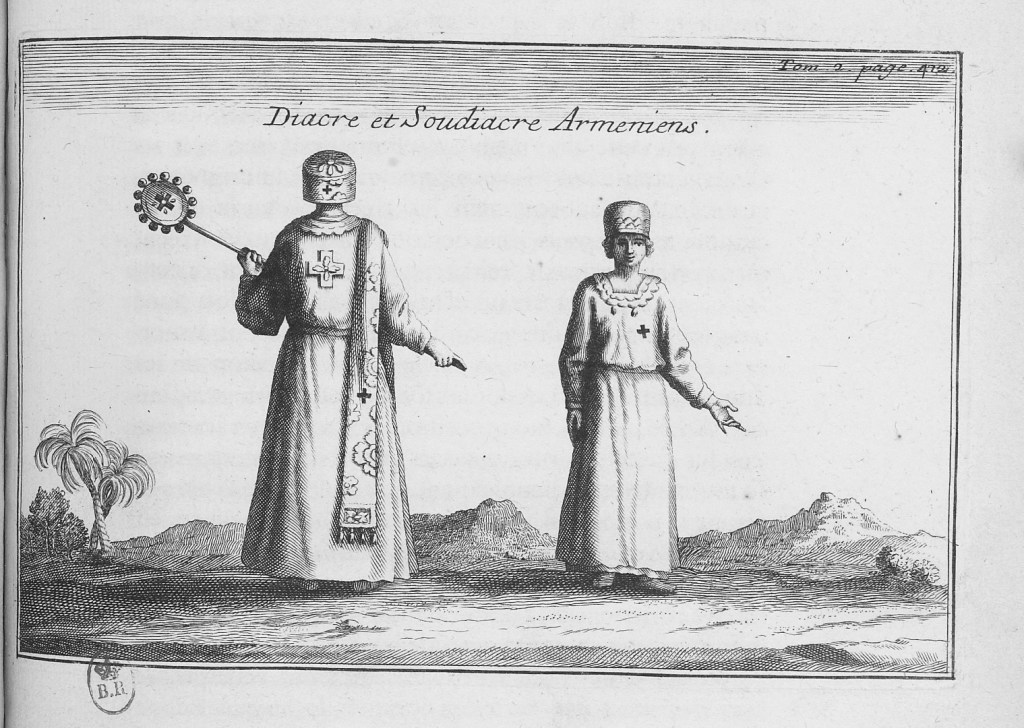
The Deacon’s Companion – The Sub-Deacon: Just as the Deacon is to possess the said virtues, qualifications, and characteristics; the Church has the understanding that this is to also be the case for the Sub-Deacon. The Sub Deacon is the greatest of the ‘Minor Orders’, responsible for assisting the Deacon in his duties: be it within the altar or even without. Services outside of the liturgical setting included ministering to the poor, needy, the orphans, imprisoned, and the sick; and notifying the Bishop so that alms may be dispensed.
Each of the deacons and sub-deacons shall serve the bishop. The bishop shall be told who are the sick, so that if it seems good to him, he may visit them. For the sick are greatly comforted that the high priest remembers them.
— The Apostolic Tradition of Hippolytus of Rome, Canon 34.
The deacon as a servant of God serves the priests and the bishop in everything (meaning serves with them) not only during the liturgy but also serves the sick of the people those who have no one to care for them and lets the bishop know so he can pray for them or gives him what covers their need to give it to them not only that but serves the widows and orphans and completes every service because this is the way a true deacon should be those about whom Christ said those who serve me will receive honor from my Father.
Al Magmou Al-Safawy Le Ibn Al-Assal (Fetha Nagest), Chapter 7, Concerning Deacons, Canon 11.
Most importantly; the office of the Diaconate is to be one which is exercised with love for God and neighbor and inebriated with acts of humility. Haughtiness and the like are alien to the office; since the Deacon is ordained to be a servant; more particularly; Christ the Servant who washed the feet of His Apostles, including the one who would betray Him (John 13). This is why the Apostles ordained that candidates for the diaconate be ‘men of good reputation, full of the Holy Spirit and wisdom’ (Acts 6:3). And what are the fruits of the Spirit? “But the fruit of the Spirit is love, joy, peace, longsuffering, kindness, goodness, faithfulness, gentleness, self-control. Against such there is no law.”(Galatians 5:22-23).
This concludes Part 1. Please stay tuned for Part 2. which will be released by Deacon Nathanel.
(1) – A. T. Robertson, HELPS Word – studies. Quoted in: Strong’s Greek: 1249. διάκονος (Diakonos) — a Servant, Minister.” Biblehub.com, biblehub.com/greek/1249.htm.
(2) – Strong’s Greek: 1351. δίλογος (Dilogos) — Double-Tongued, Deceitful. Biblehub.com/greek/1351.htm.

