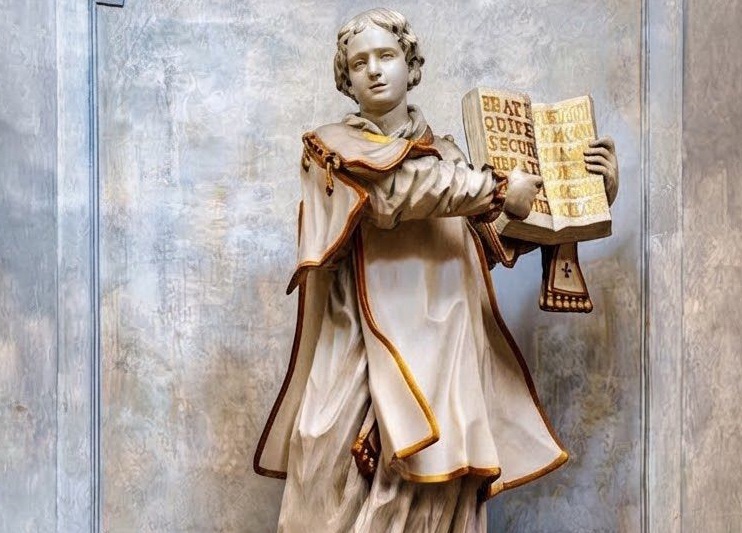
‘I am a Christian!’ — St. Euplius the Deacon, Preacher, and Martyr: A Witness of Steadfastness Against Idolatry and Heresy.

Some may be unaware of the vitalizing story of the early Christian martyr St. Euplius (304 A.D.). Tradition is silent about his early life, age, and background. Yet, we know that he was of a mature age since the Acts of Euplius testify to him as being both a ‘man’ and a Deacon (1) within Catalina, Sicily during the time of Diocletian. He was a bold preacher, evangelist, and firm defender of truth against false religion and idolatry; always keeping the four gospels on his person. This is what cost him his earthly life; but attainment of eternal glory. 

The Oxford Classic ‘The Acts of the Christian Martyrs’ explains that there are two recensions to his story: one Greek (GR) and the other Latin (LR). Both editions complement one another; as they provide details and clues which lack in the other. The examples are many; which will not be covered in its entirety in this article. 

Both versions are silent in respect to his life prior to his martyrdom; but instead immediately describe the epoch in which he openly detested Diocletian’s regime and abominable edict – that by the threat of death all should worship the idols of the state. Historical complications arise given that both versions disagree in respect to when he began challenging the governor Calvisianus outside of his council – chamber (2). Nevertheless, both agree that he willed to suffer and die for Christ. 

Continue reading “‘I am a Christian!’ — St. Euplius the Deacon, Preacher, and Martyr: A Witness of Steadfastness Against Idolatry and Heresy.”
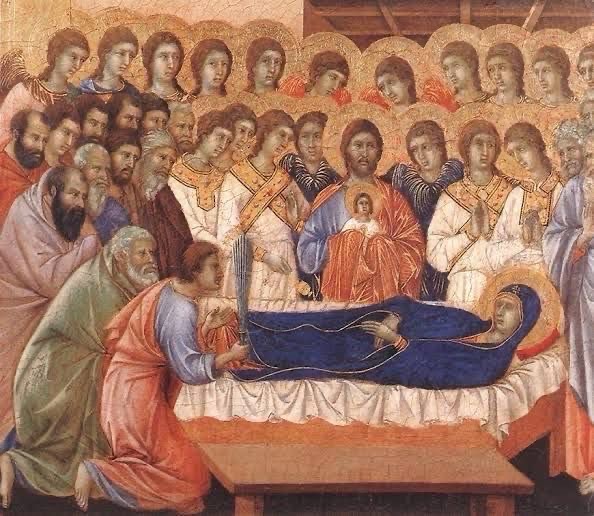
The Dormition & Assumption of the Holy Theotokos: Is It Biblical?

Today is the 21st day of the month of Tir. In the Tewahedo and Coptic Orthodox Churches, we celebrate the feast of St. Mary’s Dormition (Latin: dormitio; viz., a falling asleep).

The Orthodox Church teaches that at the very end of St. Mary’s life, and after many years of praying before the empty tomb of her beloved Son and God Jesus Christ, she was promised a glorious death. This eventually took place in the presence of Our Lord, His Angels, and the Apostles in her 60th year with the exception of St. Thomas who was preaching in India. The apostles who were present buried her body in Gethsemane, per the command of what they heard from the Holy Spirit. By the Divine intervention, St. Thomas was transported on a cloud before her deceased body in Gethsemane. He later saw the angels of God carrying St. Mary’s Body into heaven; placing her under the Tree of Life in the Eternal Garden of Paradise (c.f. Rev 22:1-5) that it may be united with her soul that was clothed in a veil of light by her Son. When he revealed what he saw to the rest of the apostles, they opened her tomb to not find her body; but to only smell a sweet fragrance. They rejoiced in this as this confirmed their faith in the Christ’s Resurrection by which we will all share in per the promise of our Lord. This is what the Apostles prayed for, hoped in, and preached to the world; despite the persecutions which came with it as they took comfort in what is to come.

But where is this event of the Assumption in the Holy Bible? Some hold to the opinion that perhaps the four gospels and the epistles were completed prior to this event. I happen to agree with this theory, especially given the Church’s Tradition which references the deaths of certain apostles — who were resurrected following their martyrdoms just to be present with the Theotokos for this moment.

Continue reading “The Dormition & Assumption of the Holy Theotokos: Is It Biblical?”

The Virtue of Purity: A Warning to Young Men – St. Polycarp

In an age where sexual immorality, impurity, licentiousness, and the like are glorified, idolized, and praised, which has ensnared and effeminized many of our youth, especially the young men, our holy father St. Polycarp warns in his epistle to the Philippians the following:

“If we please Him in this present world, we shall receive also the future world, according as He has promised to us that He will raise us again from the dead, and that if we live worthily of Him, “we shall also reign together with Him,” provided only we believe.

In like manner, let the young men also be blameless in all things, being especially careful to preserve purity, and keeping themselves in, as with a bridle, from every kind of evil. For it is well that they should be cut off from the lusts that are in the world, since “every lust warreth against the spirit;” and “neither fornicators, nor effeminate, nor abusers of themselves with mankind, shall inherit the kingdom of God,” nor those who do things inconsistent and unbecoming.”

– The Epistle of Polycarp to the Philippians, Chapter 5.