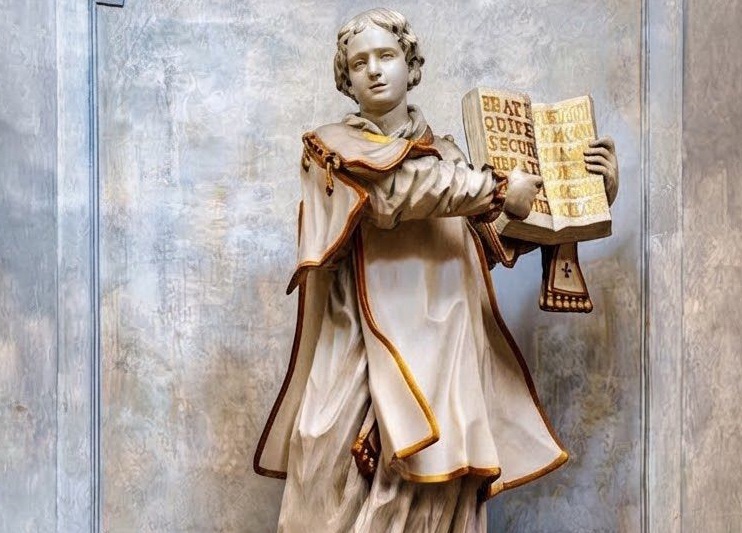
Some may be unaware of the vitalizing story of the early Christian martyr St. Euplius (304 A.D.). Tradition is silent about his early life, age, and background. Yet, we know that he was of a mature age since the Acts of Euplius testify to him as being both a ‘man’ and a Deacon (1) within Catalina, Sicily during the time of Diocletian. He was a bold preacher, evangelist, and firm defender of truth against false religion and idolatry; always keeping the four gospels on his person. This is what cost him his earthly life; but attainment of eternal glory.
The Oxford Classic ‘The Acts of the Christian Martyrs’ explains that there are two recensions to his story: one Greek (GR) and the other Latin (LR). Both editions complement one another; as they provide details and clues which lack in the other. The examples are many; which will not be covered in its entirety in this article.
Both versions are silent in respect to his life prior to his martyrdom; but instead immediately describe the epoch in which he openly detested Diocletian’s regime and abominable edict – that by the threat of death all should worship the idols of the state. Historical complications arise given that both versions disagree in respect to when he began challenging the governor Calvisianus outside of his council – chamber (2). Nevertheless, both agree that he willed to suffer and die for Christ.
This is indisputable given his words;
– Greek Recension: “I want to die; I am a Christian!”
– Latin Recension: “I am a Christian and I want to die for the name of Christ.”
This cry echos that of St. Paul:
“For to me, to live is Christ, and to die is gain; For I am hard-pressed between the two, having a desire to depart and be with Christ, which is far better.
— Philippians 1:21, 23.
By shouting these words outside the court chamber, he captured the attention of those within; the aforementioned Calvisianus and his companion Maximus (3). Perplexed; Calvisianus responded: “Let the man who shouted come in” (LR). Both recensions explain that the chamber had been preceded by a veil; indicating that the public was prohibited from witnessing the hearings.
Yet, we see that he who had the right to exceed beyond the sacerdotal veil of the Church (i.e. the sanctuary) had also obtained the right to pass beyond the ‘holy’ veil of the court — leading to his martyrdom. In both places did the saint find peace, tranquility, joy, love, and hope; for in both he, having faith, found Christ his Master. And knowing that Christ is superior to all worldly powers — for all of their authority comes from heaven (John 19:11) — he stood courageously against the licentious temporal rulers just as St. John the Baptist despite the temporal consequences (Cf. Mt 14:1-12). Ridiculing the Saint; Calvisianus suggested that Euplius had a case of insanity for not worshiping the idols Mars, Apollo, and Aesculapius, (4) and later had him racked, beaten, and beheaded after fastening the book of the four gospels to his neck; thus dying in the same manner as the Forerunner.
As the account tells us:
“Then the book of the Gospels with which he was arrested was fastened to his neck, and the herald made this proclamation: ‘Behold Euplius the Christian, an enemy of our emperors and our gods!’ Euplius was joyful and kept repeating, ‘Thanks be to Christ my God! When he was brought to the place of execution, he knelt down and prayed for a long time. And once again giving thanks, he offered his neck and was beheaded by the executioner. Afterwards his body was carried away by the Christians and was covered with spices and buried” (LR).
“The governor Calvisianus said: ‘Let Euplus be racked and beaten until he promises to sacrifice to the gods.’ After long torture, then, he finally endured the contest of martyrdom and received the crown of orthodox belief” (GR).
And so, he that fastened the Gospel to his person had also been fastened with it to his death; for he first had it fastened to his heart. In the literal sense was he, as St. Paul wrote: “holding fast the word of life, so that I may rejoice in the day of Christ that I have not run in vain or labored in vain.” (Philippians 2:16).
Lesson for us:
What loss is there in sparing time to meditate on some essential points in relation to this saint’s life? St. Paul challenges us with the following:
“Finally, brethren, whatever things are true, whatever things are noble, whatever things are just, whatever things are pure, whatever things are lovely, whatever things are of good report, if there is any virtue and if there is anything praiseworthy; meditate on these things.” — Philippians 4:8.
The saint deemed it better to die to this temporal world than to enjoy its vanities, lies, concupiscence, pleasures, and honors; for he understood that it was better to renounce all to gain all; Jesus Christ. Likewise, though we are not all called to a martyrdom of blood; we are called to die to ourselves through subjecting our will to that of God’s for our very salvation through repentance, prayer, and fasting (Cf. Gal 2:20).
Additionally, we see in the words of the blessed Euplius a burning love for truth and fidelity to Jesus Christ. In confidence, he trusted in our Lord’s words:
“Blessed are they who suffer persecution for justice sake, for theirs is the kingdom of heaven” (Mt. 5:10), and “Whoever wishes to come after me, let him take up his cross and follow me” ( Mk. 8:34).
In fact, per the Latin Recension, these were the words from holy writ by which he cited to Calvisianus per his request to read from them — that he might have evidence to charge him with resistance to the state laws and their blasphemous demand to adhere to the cult worship of demons.
“Little children, keep yourselves from idols. Amen.”
— 1 John 5:21.
Speaking to the Deacon Euplius, he asked regarding the said words of our Lord: “What does this mean?”
Like St. Phillip the Deacon, he gave the sense (Cf. Acts 8:31-35), and said: “It is the law of my Lord that has been handed down to me” (LR). With great wisdom from on high, as required of deacons (Acts 6:3) did he understand the meaning of the scriptures; for he had a love of reading them.
“I am a Christian and I read the divine Scriptures” (LR).
What a great reminder to us as Christians to also have a love for reading them! What example of Diaconal holiness to us that have obtained the office to also fashion ourselves! What greater evidence than the fact that he kept the four gospels on his person; to even die for the infallible truths that they contain? For he said:
“Better is it to die than surrender them. In them is eternal life. Whoever gives them up, loses eternal life. I give up my own life that I may not lose it” (LR).
Evidently, he not only had a hunger and thirst to save his own soul; but that of others:
“Calvisianus interrupted and said: ‘Whereas Euplius has not surrendered the Scriptures according to the imperial edict, but reads them to the people, let him be tortured’” (LR).
In this did he give thanks to God; standing firm for the uncompromising truths of the One, Holy, Catholic, and Apostolic Orthodox Faith.
With the pious and angelic Deacon let us say: “I adore Christ. I detest the demons… I worship the Father, the Son, and the Holy Spirit. I adore the holy Trinity, besides whom there is no god. Perish the gods who did not make the heaven, the earthy and all that is in them. I am a Christian!’ (LR).
What do these words tell us? There is only one true God; the Holy Trinity — The Father, the Son, and the Holy Spirit. The Son was Incarnate; and became Man for our sake. He established One Church for the salvation of the souls of men (The Orthodox Church); by which we must enter by baptism, embrace the anointing, encounter Christ in the Eucharist, and protected from errors of false religion by the Church’s true and holy doctrines and dogmas — sparing us from the deception of demons.
As the Apostle warns: “Let no one deceive you with empty words; for it is because of these things that the wrath of God comes upon the sons of disobedience. Therefore do not associate with them; for once you were darkness, but now you are light in the Lord … take no part in unfruitful works of darkness, but instead expose them” (Ephesians 5:6-7;11).
When warning of heretics that refuse to accept the truths of the Orthodox Faith, he also said: “Beware of dogs, beware of evil workers, beware of the mutilation! For we are the true circumcision, who worship God in the Spirit” — Philippians 3:2-3. (Cf. Greek word – Orthodoxus – Right/Correct Worship / Belief).
Thus: “Only let us hold true to that what we have attained” (Philippians 3:16).
In where? The One Church: “There is one body and one Spirit, just as you were called in one hope of your calling; one Lord, one faith, one baptism; one God and Father of all, who is above all, and through all, and in you all.” —Ephesians 4:4-6.
And another: “Christ is the Head of the Church, His Body, and is Himself its Savior … the Church is subject to Christ … Christ loved the Church and gave Himself up for her, that He might sanctify her, having cleansed her by the washing of water with the word, that He might present the Church to Himself in splendor, without spot or wrinkle or any such thing, that she might be holy and without blemish… no man ever hates his own flesh, but nourishes and cherishes it, as Christ does the Church; because we are members of His Body” (Ephesians 5:23-30).
Notice the singularity of the One Church; which is exemplified in His One Body. Dare we say there is more than one Body of Christ? God Forbid! How dare one argue, then, that there are multiple ‘churches’ of Christ; with differing ‘truths’? Are not the plurality of conflicting doctrines the product of confusion? Is not the peril of confusion Satan? (Cf. 1 Cor 14:33). Did not the Lord call for there to be unity under One Shepard (John 10:16)? And are not those of His fold called to have the same mind? (Philippians 2:1-2). Let all ideas of ecumenism, universalism, pluralism, syncretism, omnism, perennialism, gnosticism; and the abominable, pernicious, and wicked sects of the heretics and Freemasons therefore be put to nought.
May we hold firm to the infallible truths of the Holy Apostolic Orthodox Faith until our final breath; and may Christ’s Church and her spotless dogmas be preserved and her sacraments administered until His Glorious Second Coming.
St. Euplius, pray for us!
— Dn. Christian Azarias
(1). The Church Law was that only adult males could be Deacons. Acts 6:3: ‘seek out from among you seven men’; 1 Timothy 3:12: ‘Let deacons be the husbands of one wife, ruling their children and their own houses well.’ Didache: Appoint, therefore, for yourselves, bishops and deacons worthy of the Lord, men meek…” (80-140 A.D.).
(2). The Greek Recension says: “It was the twenty-ninth day of April in the ninth consulate of Diocletian and the eighth of Maximian… The Latin: On the twelfth day of August in the ninth consulship of Diocletian and the eighth of Maximian…”
(3). Only the Latin Recension describes Maximum as the ‘friend’ of Calvisianus.
(4). “Euplius, desist from this madness. Worship the gods and you will be set free” (LR); “Accordingly, since Euplus the malefactor has uttered insane words against us in our most righteous chamber of justice, he is to be subject to dread penalties and executed by the verdict of the sword” (GR). Note: The saint would have been deemed insane because the Romans had a plurality of ancestral cults that were permitted to co-exist as long as incense was burned to the idols of the state. Christianity was outlawed due to their refusal to do so, and their fidelity to one God. Cf. Green, EECh, 206–207.

