I have recently written an article addressing an important issue within the Orthodox Tewahedo Church regarding rhetoric towards the other sister Churches by certain clergy and laity; and argued that such babble is vain provided that the Oriental Orthodox Church is the Bride of Christ cannot fail in sanctifying her children through her pure doctrines, dogmas, ancient traditions, and sacraments despite the locality and diversity of each particular autocephalous and apostolic church.
Though I could have expanded on several other points; which would take more than one essay to address, and for the sake of sparing my reader’s attention span; one significant matter that I have explained is that the Church is the very Body of Christ (Colossians 1:18).
Jesus is the Head of the Body; and has commissioned that His Limbs, the members of the Church, be governed by Him accordingly within the Church’s proper ecclesial structure. In other words, the members of the Church are to remain within their proper order, rank, and place by which they have been appointed; be it if they are catechumens, laity, readers, sub deacons, deacons, priests, Bishops, etc.
So for instance, just as the catechumen does not have the right to approach the Holy Communion without full entry into the Church through Baptism and Chrismation; neither does one who is not ordained have the right to exercise an office by which they have not been canonically and licitly granted by Christ through His Church; i.e. the governing hierarchy (The Bishops) who are the successors of the Apostles.
This is because we have a God of order. For what does Divine Inspiration tell us?
“For God is not the author of confusion but of peace, as in all the churches of the saints… Let all things be done decently and in order.”
— (1 Corinthians 14:33;40, OSB).
And what do St. Paul’s letters to Titus say?
“For this reason I left you in Crete, that you should set in order the things that are lacking, and appoint elders in every city as I commanded you” — (Titus 1:5).
So what does this mean?
Order is biblical.
Order is righteousness.
Order is Godly.
Order is Apostolic.
Order is Traditional.
Order is Orthodox.
‘But Deacon, what is your point?’ Some may ask. This may be one of many posts, God willing, where I will be speaking about order in the Church. After all, preserving order is a function and responsibility entrusted to the Deacon per Canon Law, which we will examine later.
Nevertheless, permit me to demonstrate where I am seeing a lack of order in some churches. It is with regard to certain vestments worn by lay choir members (Mezemuran) of the Church which are not appropriate, namely; the wearing of Diaconal vestments. Which ones? The tunic, orarion (stole), and crown (Aklil). All of these, historically and canonically, were strictly reserved for ordained clergy and forbidden to be worn by the laity in the Universal (Catholic) and Orthodox Church.
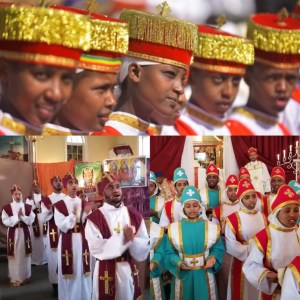
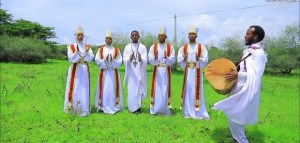
This was not to discriminate against the laity by any means, or to suggest clerical entitlement and superiority; but rather to maintain order and reverence for their proper use and function. We will survey the evidence together by examining scripture and church law on this matter. But first, let us hear the common excuses to justify their use by the laity:
“But they are beautiful.”
“They look nice.”
“Though once worn by Deacons; their meaning has evolved and are no longer worn by them.”
“Times have changed.”
“They are just costumes.”
“This is only a rule for the sister churches.”
“To strictly apply this to clergy is legalism.”
“But this is economia.”
“But we have always done this.”
I must stress that many of the statements come from well intended people. Ironically, similar statements come from those who self-identify as ‘Traditional’ or strict adherents of church law. Yet, canon law and history are in formal disagreement. Again, charity is essential; as many just happen to be innocently ignorant of the facts pertaining to this subject. Hence, individual Mezemuran should not be targeted; nor do I encourage so, as the custom has been for too long enabled by authorities who may have been, to be candid, imprudent or lax on the matter.
Let’s now briefly define the aforementioned liturgical vestments and examine their purpose together.
Definitions of Liturgical Vestments
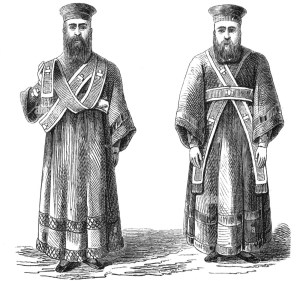
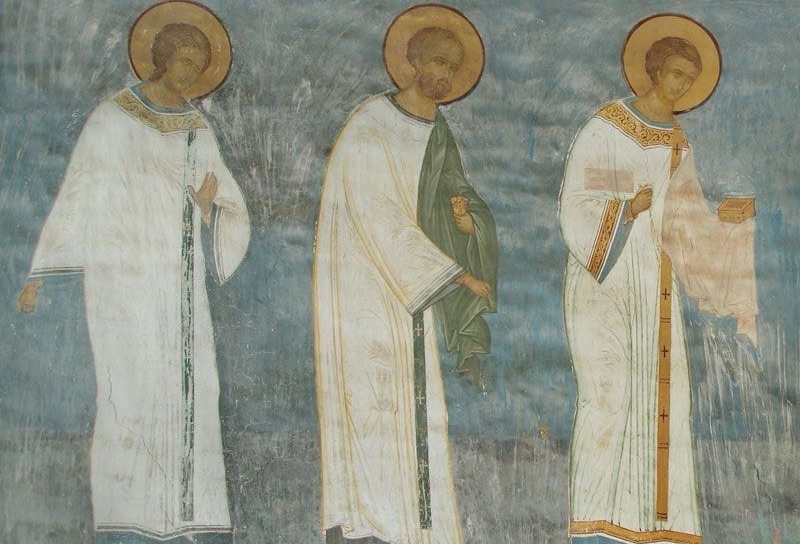
- The Tunic/Alb (Sticharion): This is a robe worn by clergy; the Deacons, Priests, and Bishops. Though, depending on the local tradition; they also may be worn by those within the minor clerical orders per the discretion of the local bishop or even patriarch. Per Josephus, tunics are traditionally made of fine linen or flax; though the material in its current form can also be silk or cotton. They are traditionally white in color; symbolizing purity.
- The Orarion / Stole: This is a sash which historically marks the office of a Deacon. Elaborately: “It is a narrow band of material, worn over the left shoulder, and hangs straight down back and front; sometimes, before being left free to hang down in front, it is passed below the right arm, then attached once more to the left shoulder, and so hung down in front. While reciting prayers [Diaconal Commands], the deacon holds it in his hand. At the time of Communion, it is crossed round the body.” (1) It is also believed by some to have been used by Deacons as a handkerchief to wipe the mouth of communicants.
[Note: This vestment is related to the Priest vestment called the ‘Epitrachelion’. This is where the Coptic sister church gets the name ‘Badrachil’ from for the stoles worn by Deacons and inferior clerics. The Epitrachelion is “The form of the stole worn by the priest in the Eastern Church. It is a long strip of material fastened in front and decorated with crosses and a fringe. It is to be distinguished from the orarion which is the liturgical garment of the deacon.”] (2).
Comparing the Old Testament to Canon Law
Both of these vestments have biblical roots. These were only worn by the Levitical ministers of the Old Testament; and were reserved strictly for liturgical services.
Proof:
These are the garments they shall make: a breastplate, an ephod, a full-length robe, a skillfully woven tunic with a fringe, a turban, and a sash. So they shall make holy garments for Aaron your brother and his sons, so they may minister to Me as priests. (Exodus 28:4).
He put the tunic on him, girded him with the belt, clothed him with the robe, and put the ephod (3) on him; and he girded him with the intricately woven band of the ephod, and with it tied the ephod on him. (Leviticus 8:7).
He shall put the holy linen tunic and the linen trousers on his body; he shall be girded with a linen sash, and with the linen turban he shall be attired. These are holy garments. Therefore he shall wash his body in water and put them on. (Leviticus 16:4).
Likewise do we see this system respected in the New Testament Canonical Laws:
“Let the Deacon who is considered among them to be the one who is most diligent and most judicious; let him be chosen to be the receiver of strangers in the house which is the inn of the Church; let him be at all times clad in white garments, having only a stole upon his shoulder.” — The Didascalia, Chapter III. (Note: this is considered to be apart of the Biblical Canon per the Tewahedo Tradition).
“The robes of the priests in which they sanctify are whitewashed, and they are placed in the treasuries in the holy place until the time when they come to the altar, and find them placed in the treasury of the holy place in which the pots are kept, as the prophet Ezekiel commanded.” — Canons of Pope Athanasius II, Canon 28
“The garments in which he is sanctified do not go outside the church, but are in the places where the church’s servants are, or the places where the books are. Clothes worthy of the priesthood, especially at the altar. White garments not painted in colours, descending on their feet.” — The Canons of St. Basil of Caesarea, Canon 96. [Note: This is also quoted in Fetha Nagest, Chapter XII, On the Mass].
“And every time a bishop gets from the sacraments, the deacons and priests gather to him while they are dressed in white clothes more beautiful than all the people, and they shine more with their good deeds more than the color of the clothes.” – Coptic Canons of St. Hippolytus , Canon 37.
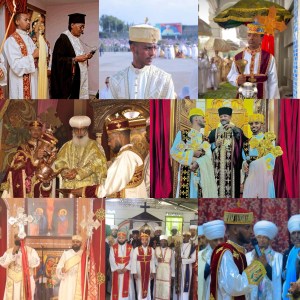
The Orthodox Church forbade laity and inferior clerics from wearing the said vestments in the councils and canons the Church:
“Neither Anagnostis nor singers may wear the chasuble (tunic) while they read [and sing]…” (4)
“The readers and singers have no right to wear an orarium, and to read or sing thus [habited].” (5)
The Diaconal Crown
You may have noticed that none of the canons speak about the current use of the crown by both Priests and Deacons. Unlike the Syriac Jacobite tradition, they are absent from the Alexandrian prayers of ordination; despite other vestments being referenced (such as the orarion for Deacons). But there are clues from history as to why this may be.
Though it is debated by historians, it is believed that Priests and Deacons were once forbidden from covering their heads during liturgical prayers (cf. 1 Corinthians 11:4). Nevertheless, an isolated tradition existed within 11th century Scetis (Northern Egypt) where priests and deacons began to wear headdresses during the liturgy. This is believed to be influenced by the aforementioned Syriac tradition which existed in the area. (6) Yet, Mikhail suggests that it has possibly later become widespread for urban Coptic clergy by the 12th century. This would explain the ban of their use by Pope Gabriel II ibn Turayk. (7)
Nevertheless, the British historian Alfred Butler believes that the Patriarchal / Episcopal Mitre may be the ancestor of the Presbyterial and Diaconal headdress within the Alexandrian Rite. In his famous The Ancient Coptic Churches of Egypt, he maintains that the Alexandrian Church’s use of the mitre can be seen as early as the early 5th century; by which the Pillar of Orthodoxy, St. Cyril of Alexandria, had worn it at the Ecumenical Council of Ephesus in 431 A.D. (8) The anciency of the Mitre within Alexandria is evident given that it is shared by both the Orthodox Miaphysites and the Melkite schismatics; to which it would be unlikely that either party would borrow from one another given their rivalry.
Butler further explains how in the ancient world that the crown, being a kingly headdress, is a ‘ symbol of sovereign power’ (9) This would justify its use for Patriarchs and Bishops not because they are monarchs, but because they are elders and princes of the Church (cf. Revelations 4:4).
Furthermore, a certain 12th century Bishop, Farag Allah Akhmimi, described how sacerdotal vestments were adored with crosses. (10) This matters since Butler observed that certain caps were used by priests and deacons in the Coptic Church during his time; which was made of crimson velvet and embroidered with large crosses which had small stars in between its 4 branches.
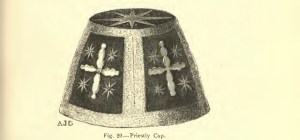
In his words:
“But in every case the predominant impression is that the cap is adorned with small crosses, precisely as described in the twelfth century. I have no doubt at all that the vestment was originally a priest s cap exclusively- such as existed in our English ritual of old, though traces of it are not common in our monuments;and as the use of the shamlah prevailed more and more, was relegated to deacons, just as the priestly mode of wearing the stole seems to have descended even to sub-deacons. Indeed it is very probable that the priestly cap itself is a descendant from the earlier episcopal crown: and the mere fact that priests were able to wear in the twelfth century the cap adorned with small crosses obviously a head-dress of some splendor constitutes in itself a powerful argument for the antiquity of the Coptic mitre.” (11)
A thing that we need to consider, with regard to these facts, is that the Deacon and the Priest both share in the ministry of their Bishop. Hence, it would make sense that they would inherit similar vestments as insignia to their God-given authority, faculties, and share in his Priesthood. Take into account the following statements from Church Law:
“Strive therefore, O bishops, together with the deacons, to be right with the Lord… Let the bishops and the deacons, then, be of one mind; and do you shepherd the people diligently with one accord. For you ought both to be one body, father and son; for you are in the likeness of the Lordship. And let the deacon make known all things to the bishop, even as Christ to His Father. But what things he can, let the deacon order, and all the rest let the bishop judge. Yet let the deacon be the hearing of the bishop, and his mouth and his heart and his soul; for when you are both of one mind, through your agreement there will be peace also in the Church.” (12)
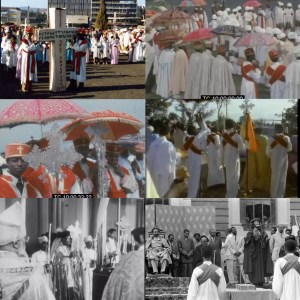
The Order’s Role to Set Order on behalf of the Bishop:
“And if anyone be found sitting out of his place, let the deacon who is within reprove him and make him to rise up and sit in a place that is meet for him. For our Lord likened the Church to a fold; for as we see the dumb animals, oxen and sheep and goats, lie down and rise up, and feed and chew the cud, according to their families, and nonE of them separate itself from its kind; and (see) the wild beasts also severally range with their like upon the mountains: so likewise in the Church ought those who are young to sit apart, if there be room, and if not to stand up; and those who are advanced in years to sit apart. And let the children stand on one side, or let their fathers and mothers take them to them; and let them stand up. And let the young girls also sit apart; but if there be no room, let them stand up behind the women. And let the young women who are married and have children stand apart, and the aged women and widows sit apart. And let the deacon see that each of them on entering goes to his place, that no one may sit out of his place. And let the deacon also see that no one whispers, or falls asleep, or laughs, or makes signs. For so it should be, that with decency and decorum they watch in the Church, with ears attentive to the word of the Lord… But if, while younger men or women sit, an older man or woman should rise and give up their place, do thou, O deacon, scan those who sit, and see which man or woman of them is younger than the rest, and make them stand up, and cause him to sit who had risen and given up his place; and him whom thou hast caused to stand up, lead away and make him to stand behind his neighbours: that others also may be trained and learn to give place to those more honourable than themselves.” (13)
Note: As stated above, the Stole was raised during moments of the liturgy in the early Church to collect the attention of the congregants and to provide instruction; which we now know as the Diaconal Commands of the Liturgy. i.e. ‘Stand up for Prayer, Pray for (X), Look towards the East, Let us Attend, Go Forth ye Catechumens, etc.’ This explains why the canons limited the stoles to the Deacons, with the exception of their helpers the sub deacons when worn in a distinct fashion; lest anyone try to usurp an authority they did not have from the Church and their Bishop].
“Therefore, appoint for yourselves bishops and deacons worthy of the Lord, men meek, and not lovers of money, (1 Timothy 3:4) and truthful and proven; for they also render to you the service of prophets and teachers. Despise them not therefore, for they are your honoured ones, together with the prophets and teachers.” (14)
[A Deacon is] ‘to carry out the orders of the Bishop” (15)
“Deacons shall be blameless, just like the Bishop, and shall be greatly honored and perfect in all their services of the Church. The Deacon who serves the Bishop shall be pure in all his work without any reproach, as if he were serving Christ; nor shall he do anything by his own will, without the consent of his father who is the bishop and who commands him in everything. Priests and Deacons shall be with you, O Bishop, when you render judgements…” (16)
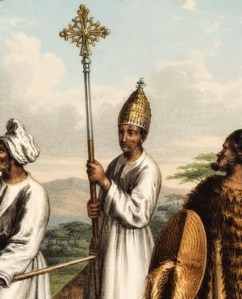
Now, considering that the Ethiopian and Eritrean Orthodox Churches were under the Coptic Church’s authority for roughly 1,625 years; there is potential that this likewise influenced the current use of the crown for Priests and Deacons respectfully within the Tewahedo rite. This is personally my theory on the matter. Despite this, I am open to correction and edification.
Summary: We have seen that the Tunic, Stole, and Crown are, objectively speaking, priestly vestments reserved for the Divine Liturgy and other sacred services. Though some of the vestments were initially characteristics of the Bishop and even Priests; the Deacons have the faculties to wear similar vestments as the Church has defined in her canons and through the wisdom of the fathers. These act as insignia of the authority which they have been granted, and their priestly rank by which they have inherited through the laying on of hands; i.e. ordination. The appropriation of said vestments by laity, therefore, are a disconnect from Apostolic Order and should be discouraged if one reverences their intentional use and symbolism. They are not festive costumes or badges of honor, but rather, icons of responsibility, accountability, and mandatory humility. For the stole worn by the Deacon convey their necessity to take up the cross of Christ; hence why it is worn on the shoulder or even crossed on their back. If fastened while divided in the front, it likewise symbolizes the towel by which Christ wasted the feet of the Apostles, including His traitor Judas. This, then, reminds the deacon of his necessity to forgive, and wash the feet of all he served. And the crown can be likened to that which was fastened to our Lord’s head: the crown of thorns; an instrument of torture and suffering. Let those who pride themselves in wearing said vestments examine and determine if they could handle such dreadful responsibilities. For none of this can be done by one’s own efforts; but only by the Grace of God. A special grace is given to the clergy to handle these responsibilities through the laying on of hands that they might exercise their office responsibly and without reproach. If one lacks the sacramental graces to exercise the clerical offices, cannot we then conclude that such an attempt would only result in self infliction and spiritual suicide? (cf. Numbers 16; Jude 1:6).
Your Brother,
Diakon Azarias.
Footnotes:
1. Cross, F. L. (1974). The oxford dictionary of the Christian Church. Oxford University Press. Pg. 1001-1002.
2. Cross, F. L. Pg. 466.
3. cf. Epitrachelion.
4. Fetha Nagest. Chapter VIII, Section III.
5. Council of Ladocia, Canon 23.
6. Mikhail, Ramez. Towards a History of Liturgical Vestments in the Coptic Rite: I – Minor Orders, Deacons, and Presbyters, Pg. 60.
7. Mikhail, Ramez. Pg. 63-64.
8. Butler, A. J. (1884). The Ancient Coptic Churches of Egypt (Volume II. ). Oxford University Press. Pg. 201.
9. Butler, A.J. Pg. 205.
10. Butler, A.J. Pg. 209.
11. Butler, A.J. Pg. 211.
12. Didascalia, Chapter XI. An Exhortation to Bishops and Deacons.
13. Didascalia, Chapter XII.
14. Didachae, Chapter XV.
15. Fetha Nagest, Chapter VII: II.
16. Fetha Nagest, Chapter VII:III.

