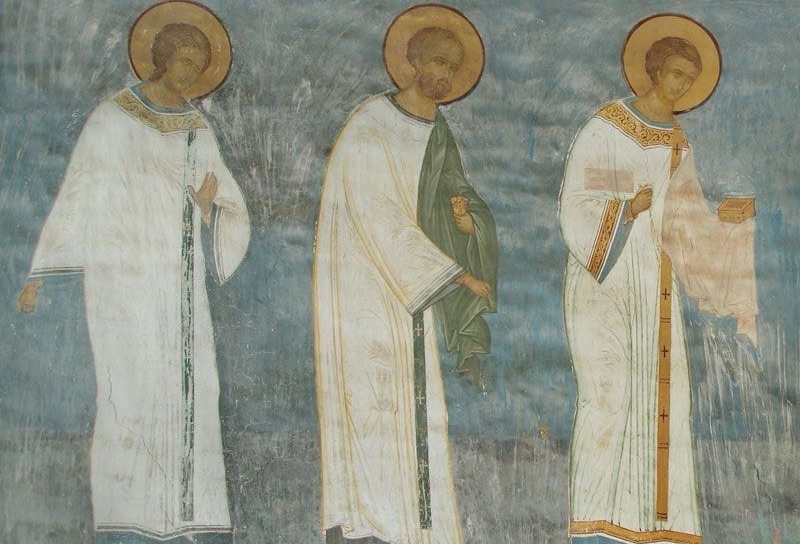
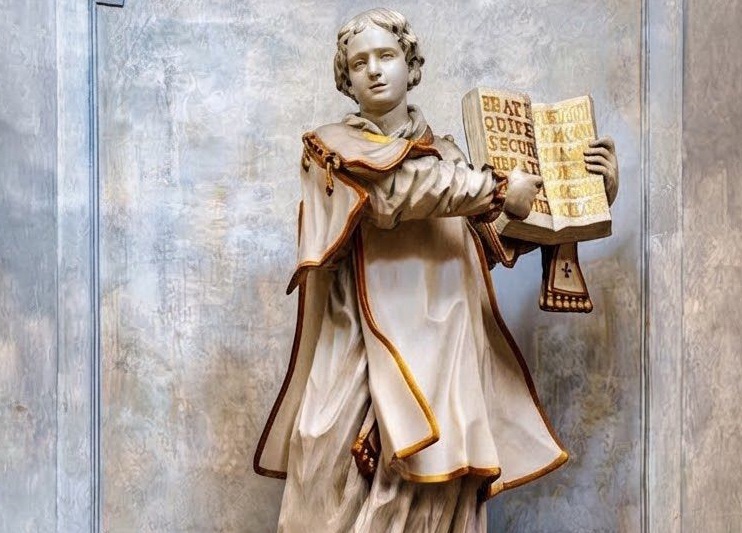
‘Take Up Your Cross & Follow Me’: The Story of my Vocation to the Diaconate

Etymologically, the term ‘vocation’ originates from the Latin word ‘vocatio’; i.e.  ‘to call, a summons’. Everybody to some extent has a vocation, perhaps even more than one; be it to marriage, celibacy, religious life, or sacerdotal ministry. 

“And now, thus says the Lord God who made you, O Jacob, and who formed you, O Israel: “Fear not, for I redeemed you. I called you by your name, for you are Mine.”  — Isaiah 43:1. 

When speaking on the general calling of the early Christians, the catechism of the Coptic Orthodox Church stated:

“They lived in the world, but they were not of the world. They had a special vocation to sanctify the world by the work of God through them and within them: “For God called us not for uncleanness, but in sanctification” (1 Thess. 4:7) and “as He who called you is holy, you also be holy in all your conduct, because it is written, ‘be holy, for I am holy’” (1 Pet. 1:15–16).”

Under examination it is evident that God, to Him be Glory, calls us to holiness through different paths individually for our union with Him and sanctity. Each and every single member of the Body has been given gifts to minister before God and to their neighbor in love (Eph 4:11). These gifts which come down from heaven are by God Himself (James 1:17). Though they may be distinct, one is not superior to the other; as they all contribute to the expansion of God’s Kingdom when exercised in accordance to His Holy Will (1 Cor 12:14-18).

Personally, I have discovered my vocation at a very young age; though my understanding of it developed gradually. In context, I was not raised in the ancient Apostolic Christian tradition. Rather, I was born and raised Protestant, more specifically; Pentecostal (COGIC) by a devout African American Christian family which also has some Cape Verdean roots. Nevertheless, my mother had enrolled me in a Roman Catholic school at four years old called St. Josephs. 

Continue reading “‘Take Up Your Cross & Follow Me’: The Story of my Vocation to the Diaconate”

The Heresy of Macro-Evolution: A Response from the Fathers

The Apostle Peter warned: “Be sober, be vigilant; because your adversary the devil walks about like a roaring lion, seeking whom he may devour” (1 Peter 5:8).

By what did the sacred writer mean to be sober and vigilant; save being alert and on guard against enticement that comes from so great a deceiver? An ancient enemy which only seeks the ruin and destruction of souls, as evident in his initial trickery with our first parents Adam and Eve? As divine inspiration tells us, the devil had deceived Eve into believing that she would not disobey God by breaking the first law given to man, and that she would obtain knowledge that would make her ‘god-like’ (Genesis 3:4-5), despite already having the virtue of being made in God’s image and likeness. Therefore, the race of mankind was gifted with immortality, incorruptability, and rationality which all of the other visible creatures lacked.

Yet, as we know, the consequence of sin and death came into the world as a result. Seeing that he was successful in this ancient trick, he likewise continues in his ancient attempt to destroy man by attacking the faith of Christians through a series of vain philosophies and sciences; a device which was successful in capturing the belief of those that we now call atheists, rationalists, modernists, naturalists, and the like.

Continue reading “The Heresy of Macro-Evolution: A Response from the Fathers”

Why Christ Entered the Waters: A Doctrinal Study of Revelation and Fulfillment

When our Lord traveled from Galilee to the River Jordan , His cousin St. John the Baptist was preaching the necessity of repentance. Those that accepted the message of St. John would be baptized in water while also publicly confessing their sins (Mt 3:5-6). The rite of immersion in water was something which was shared with a certain Jewish sect known as the Essenes. Though debated, some scholars believe that St. John the Baptist may have been an Essene himself with his own following, or at least influenced by them; given not only their commonality in using water, but the use of apocalyptic language.

Now, with these words in mind: the baptism by which the forerunner was administering was very limited, as it was incapable of regenerating the soul, lacking the Grace of the Holy Spirit. Hence, it was not the Christian Sacrament of Holy Baptism.

To cite the Baptist directly:

“I indeed baptize you with water unto repentance, but He who is coming after me is mightier than I, whose sandals I am not worthy to carry. He will baptize you with the Holy Spirit and fire.”

– Matthew 3:11

As we know from Divine Inspiration, Jesus was not in need of repentance, as He was without Sin (c.f. 1 Peter 2:22). This explains the objection of the Baptist: “I need to be baptized by You, and are You coming to me?” (Matthew 3:14). These words alone demonstrate the sinlessness of the Lord. Yet, the Lord, in His humility, willfully condescended to the form of a sinner.

Or, to cite St. Gregory of Thaumaturgus:

“He approached him as one of the multitude, and humbled Himself among the captives though He was the Redeemer, and ranged Himself with those under judgment though He was the Judge, and joined Himself with the lost sheep though He was the Good Shepherd who on account of the straying sheep came down from heaven, and yet did not forsake His heavens, and was mingled with the tares though He was that heavenly grain that springs unsown.”

– On the Holy Theophany, or on Christ’s Baptism, Homily IV.

Continue reading “Why Christ Entered the Waters: A Doctrinal Study of Revelation and Fulfillment”