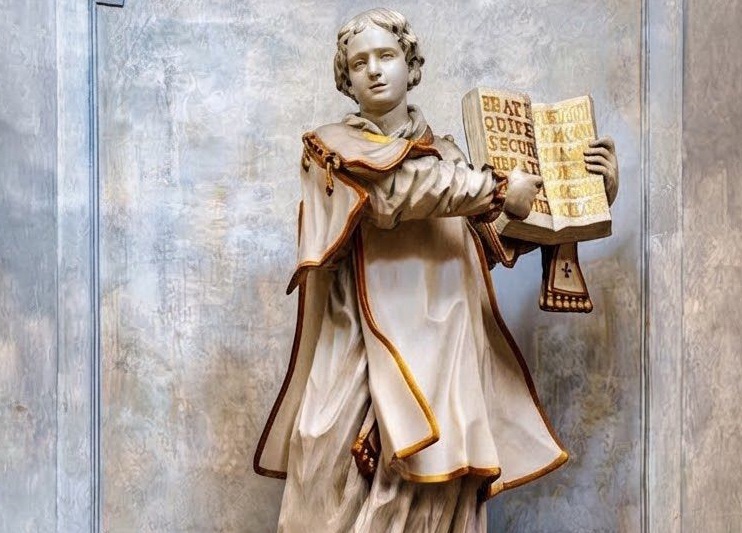
‘I am a Christian!’ — St. Euplius the Deacon, Preacher, and Martyr: A Witness of Steadfastness Against Idolatry and Heresy.

Some may be unaware of the vitalizing story of the early Christian martyr St. Euplius (304 A.D.). Tradition is silent about his early life, age, and background. Yet, we know that he was of a mature age since the Acts of Euplius testify to him as being both a ‘man’ and a Deacon (1) within Catalina, Sicily during the time of Diocletian. He was a bold preacher, evangelist, and firm defender of truth against false religion and idolatry; always keeping the four gospels on his person. This is what cost him his earthly life; but attainment of eternal glory. 

The Oxford Classic ‘The Acts of the Christian Martyrs’ explains that there are two recensions to his story: one Greek (GR) and the other Latin (LR). Both editions complement one another; as they provide details and clues which lack in the other. The examples are many; which will not be covered in its entirety in this article. 

Both versions are silent in respect to his life prior to his martyrdom; but instead immediately describe the epoch in which he openly detested Diocletian’s regime and abominable edict – that by the threat of death all should worship the idols of the state. Historical complications arise given that both versions disagree in respect to when he began challenging the governor Calvisianus outside of his council – chamber (2). Nevertheless, both agree that he willed to suffer and die for Christ. 

Continue reading “‘I am a Christian!’ — St. Euplius the Deacon, Preacher, and Martyr: A Witness of Steadfastness Against Idolatry and Heresy.”

St. Athanasius’ defense of the Christ’s Divinity and Virgin Birth against the Jews

In St. Athanasius’ treatise ‘On the Incarnation’, he writes to a certain Macarius who was a proselyte to Christianity. Being inexperienced in apologetics, St. Athanasius had instructed him through this work to guide him on the Church’s teaching regarding the Omnipotence of the Word and His Incarnation. This was a doctrine which was challenged by both Jews and Gentiles alike; as it was a radical change from what was taught by history’s greatest philosophers, and exceeded human rationality.

For this particular post, we will be examining St. Athanasius’ rebuttal of the Jews, and how he proved the Incarnation from Holy Writ.


To initiate his rebuttal, he first addressed the Jew’s skepticism of Christ’s Life, Death, and Resurrection. He opens by appealing to the Old Testament scriptures; as they are shared by both Christians and the Jews alike since both religions revere them as being God inspired and therefore: authoritative, infallible, and inerrant. 

To cite him directly:

“First, then, we will consider the Jews. Their unbelief has its refutation in the Scriptures which even themselves read; for from cover to cover the inspired Book clearly teaches these things both in its entirety and in its actual words”

~ (On the Incarnation, Chapter VI). 

Following this, he claims that the Prophets foretold Christ’s Virgin Birth; and cites prophets such like Isaiah and Moses. 

Citing the Prophet Isaiah, he said:

“Prophets foretold the marvel of the Virgin and of the Birth from her, saying, “Behold, a virgin shall conceive and bear a son, and they shall call his name ‘Emmanuel,’ which means ‘God is with us’ (Isaiah 7:14)”

~ ibid.

Continue reading “St. Athanasius’ defense of the Christ’s Divinity and Virgin Birth against the Jews”

The Early Church Fathers: Were they Miaphysite?

A common misconception about the Oriental Orthodox Church is that it’s Christology is ‘Monophysite’, meaning, that She followers the erroneous teachings of Eutyches of Constantinople that Jesus’ humanity had disappeared into His Divinity.

On the contrary, the Church teaches that Jesus Christ is Fully God and Fully Man; but One Concrete and Composite Nature from Two. This form of Christology is known as ‘Miaphysitism’, which has its basis in the teachings of the Early Church Fathers.

Below is an explanation of our Church’s Christology is more detail by His Holiness Pope Shenouda the Third, followed by a Florilegium on this dogmatic teaching.

Continue reading “The Early Church Fathers: Were they Miaphysite?”