The Hebraic and Apostolic Origins of the Eucharist: Liturgical Development in the Early Church

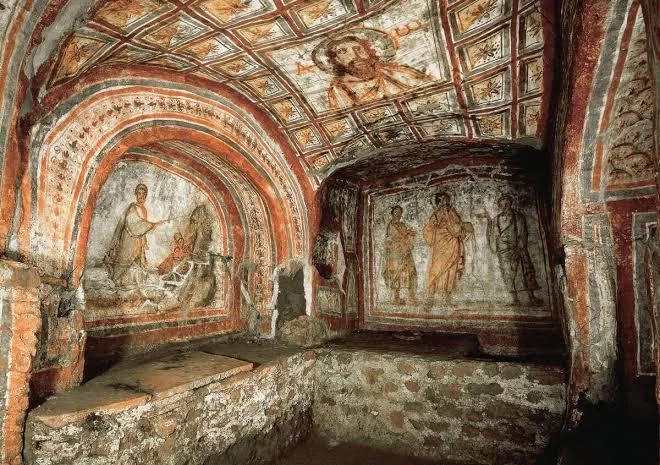
Tombs within the Roman Catacombs: The early Christians within Rome used the stone tombs of the martyrs as altars. This custom is thought to trace to the first quarter of the 2nd century. Marble tops were placed upon the tombs for the Mass to be celebrated upon. [SOURCE]

Holy writ tells us that on the night of Passover, Jesus had instituted the sacrament of the Holy Eucharist:

… took bread, blessed and broke it, and gave it to the disciples and said, ‘Take eat; this is My Body.’ Then He took the cup, and gave thanks, and gave it to them, saying, “Drink from it, all of you. For this is My blood of the new covenant, which is shed for many for the remission of sins.’

— Matthew 26:26-28.

Being that our Lord and the Apostles were Hebrews, the elements and customs used were Hebraic in nature. More elaborately, the ancient Hebrews would consider meals to be joyful occasions, which would be celebrated within their homes. Church historian Roger T. Beckwith stated that in accordance to the Mishnah:

“grace was said several times at meals, over each main dish, over bread, and over wine; and when people were eating together, most benedictions were said by one person for all, and a responsive grace was added at the end of the meal.”

— Jones, Cheslyn , Geoffrey Wainwright, Edward Yarnold SJ, and Paul Bradshaw, eds. 1992. The Study of Liturgy. Revised. Oxford University Press. Pg. 72. 

The Liturgist and scholar C.P.M. Jones is also in agreement, and even suggested that the singularity of the cup could have been something which originated with Christ Himself: 

The action and words concerning the bread precede the meal; those concerning the cup follow it. This pattern accords well with Jewish meal customs on solemn occasions. The bread-words accompany the normal action over the bread; the wine-words accompany the thanksgiving over the cup. The single, common cup, so essential to the symbolism, may not have been contemporary custom, but Jesus’ own idea.

— Jones, Cheslyn , Geoffrey Wainwright, Edward Yarnold SJ, and Paul Bradshaw. Pg. 195. 

The use of bread and wine in worship is also evident when examining the Old Testament scriptures that were reverenced by the Hebrews. This can be seen in the case of Melchizedek (Genesis 14:18) as well as within the Levitical sacrifices (Leviticus 23:13-37).

Continue reading “The Hebraic and Apostolic Origins of the Eucharist: Liturgical Development in the Early Church”

St. Athanasius’ defense of the Christ’s Divinity and Virgin Birth against the Jews

In St. Athanasius’ treatise ‘On the Incarnation’, he writes to a certain Macarius who was a proselyte to Christianity. Being inexperienced in apologetics, St. Athanasius had instructed him through this work to guide him on the Church’s teaching regarding the Omnipotence of the Word and His Incarnation. This was a doctrine which was challenged by both Jews and Gentiles alike; as it was a radical change from what was taught by history’s greatest philosophers, and exceeded human rationality.

For this particular post, we will be examining St. Athanasius’ rebuttal of the Jews, and how he proved the Incarnation from Holy Writ.


To initiate his rebuttal, he first addressed the Jew’s skepticism of Christ’s Life, Death, and Resurrection. He opens by appealing to the Old Testament scriptures; as they are shared by both Christians and the Jews alike since both religions revere them as being God inspired and therefore: authoritative, infallible, and inerrant. 

To cite him directly:

“First, then, we will consider the Jews. Their unbelief has its refutation in the Scriptures which even themselves read; for from cover to cover the inspired Book clearly teaches these things both in its entirety and in its actual words”

~ (On the Incarnation, Chapter VI). 

Following this, he claims that the Prophets foretold Christ’s Virgin Birth; and cites prophets such like Isaiah and Moses. 

Citing the Prophet Isaiah, he said:

“Prophets foretold the marvel of the Virgin and of the Birth from her, saying, “Behold, a virgin shall conceive and bear a son, and they shall call his name ‘Emmanuel,’ which means ‘God is with us’ (Isaiah 7:14)”

~ ibid.

Continue reading “St. Athanasius’ defense of the Christ’s Divinity and Virgin Birth against the Jews”

Is the Eucharist only a Symbol? The Testimony of Abba Daniel the Pharanite

This is what Abba Daniel, the Pharanite, said, ‘Our Father Abba Arsenius told us of an inhabitant of Scetis, of notable life and of simple faith; through his naivete he was deceived and said, “The bread which we receive is not really the body of Christ, but a symbol.”

Two old men having learnt that he had uttered this saying, knowing that he was outstanding in his way of life, knew that he had not spoken through malice, but through simplicity. So they came to find him and said, “Father, we have heard a proposition contrary to the faith on the part of someone who says that the bread which we receive is not really the body of Christ, but a symbol.”

The old man said, “It is I who have said that.” Then the old men exhorted him saying, “Do not hold this position, Father, but hold one in conformity with that which the catholic Church has given us. We believe, for our part, that the bread itself is the body of Christ and that the cup itself is his blood and this in all truth and not a symbol. But as in the beginning, God formed man in his image, taking the dust of the earth, without anyone being able to say that it is not the image of God, even though it is not seen to be so; thus it is with the bread of which he said that it is his body; and so we believe that it is really the body of Christ.”

Continue reading “Is the Eucharist only a Symbol? The Testimony of Abba Daniel the Pharanite”