The Oriental Orthodox Church has two categories of clerics: the Major and Minor Orders. The Major Orders are those ranks by which a man receives the sacrament of Holy Orders / Priesthood. The three levels of the Priesthood are the Bishop, Presbyter, and Deacon. These ranks are conferred by a canonical and valid Orthodox Bishop through the laying on of hands.
Pope Shenouda III:
“We see that non of the elected were authorised to commence their work until the apostles had laid their hands on them. Even the deaconship, no one can carry out its duties without canonical ordination.”
— The Priesthood, Pg. 42.
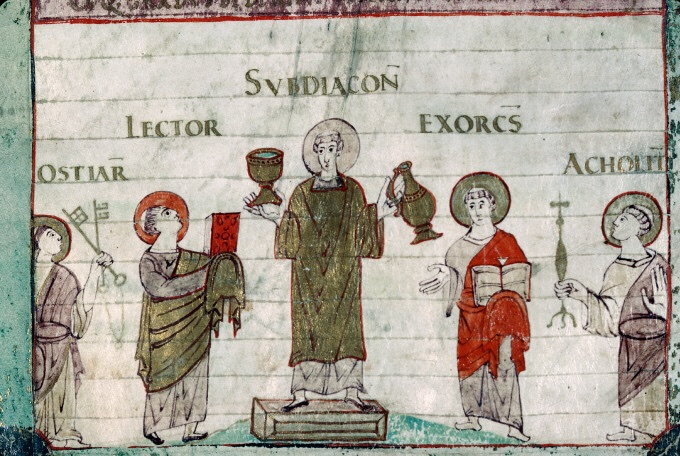
The Minor Orders are non-priestly ranks. In order words, they are not conferred by the laying on of hands as they are not of apostolic origin; but are nevertheless ancient ecclesial offices which developed following the death of the Apostles for the service of the Church. The Minor Orders of the Oriental Orthodox Church are: Door Keeper, Reader, Exorcist, Candle Bearer, and Sub Deacon. Yet, some of these minor ranks only exist in certain jurisdictions.
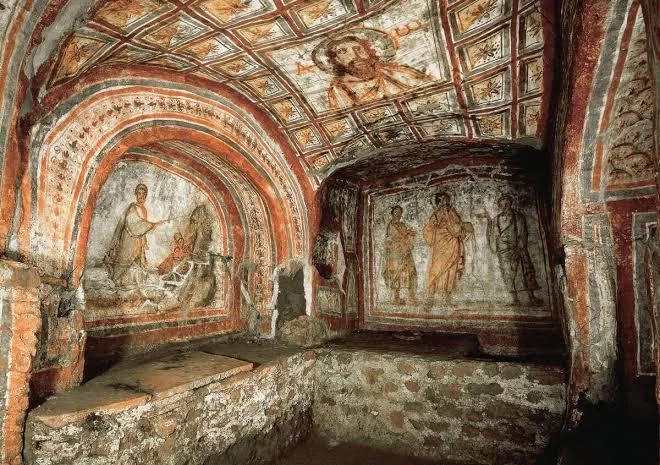
Tombs within the Roman Catacombs: The early Christians within Rome used the stone tombs of the martyrs as altars. This custom is thought to trace to the first quarter of the 2nd century. Marble tops were placed upon the tombs for the Mass to be celebrated upon. [SOURCE]
Holy writ tells us that on the night of Passover, Jesus had instituted the sacrament of the Holy Eucharist:
… took bread, blessed and broke it, and gave it to the disciples and said, ‘Take eat; this is My Body.’ Then He took the cup, and gave thanks, and gave it to them, saying, “Drink from it, all of you. For this is My blood of the new covenant, which is shed for many for the remission of sins.’
— Matthew 26:26-28.
Being that our Lord and the Apostles were Hebrews, the elements and customs used were Hebraic in nature. More elaborately, the ancient Hebrews would consider meals to be joyful occasions, which would be celebrated within their homes. Church historian Roger T. Beckwith stated that in accordance to the Mishnah:
“grace was said several times at meals, over each main dish, over bread, and over wine; and when people were eating together, most benedictions were said by one person for all, and a responsive grace was added at the end of the meal.”
— Jones, Cheslyn , Geoffrey Wainwright, Edward Yarnold SJ, and Paul Bradshaw, eds. 1992. The Study of Liturgy. Revised. Oxford University Press. Pg. 72.
The Liturgist and scholar C.P.M. Jones is also in agreement, and even suggested that the singularity of the cup could have been something which originated with Christ Himself:
The action and words concerning the bread precede the meal; those concerning the cup follow it. This pattern accords well with Jewish meal customs on solemn occasions. The bread-words accompany the normal action over the bread; the wine-words accompany the thanksgiving over the cup. The single, common cup, so essential to the symbolism, may not have been contemporary custom, but Jesus’ own idea.
— Jones, Cheslyn , Geoffrey Wainwright, Edward Yarnold SJ, and Paul Bradshaw. Pg. 195.
The use of bread and wine in worship is also evident when examining the Old Testament scriptures that were reverenced by the Hebrews. This can be seen in the case of Melchizedek (Genesis 14:18) as well as within the Levitical sacrifices (Leviticus 23:13-37).