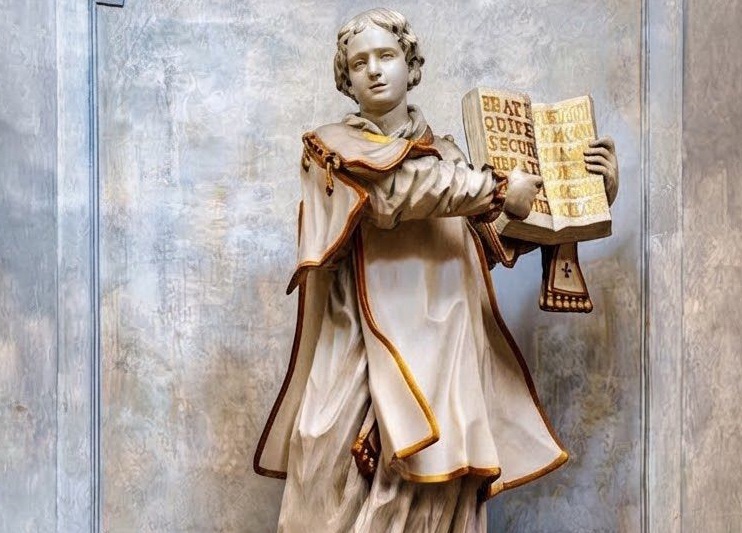
Some may be unaware of the vitalizing story of the early Christian martyr St. Euplius (304 A.D.). Tradition is silent about his early life, age, and background. Yet, we know that he was of a mature age since the Acts of Euplius testify to him as being both a ‘man’ and a Deacon (1) within Catalina, Sicily during the time of Diocletian. He was a bold preacher, evangelist, and firm defender of truth against false religion and idolatry; always keeping the four gospels on his person. This is what cost him his earthly life; but attainment of eternal glory.
The Oxford Classic ‘The Acts of the Christian Martyrs’ explains that there are two recensions to his story: one Greek (GR) and the other Latin (LR). Both editions complement one another; as they provide details and clues which lack in the other. The examples are many; which will not be covered in its entirety in this article.
Both versions are silent in respect to his life prior to his martyrdom; but instead immediately describe the epoch in which he openly detested Diocletian’s regime and abominable edict – that by the threat of death all should worship the idols of the state. Historical complications arise given that both versions disagree in respect to when he began challenging the governor Calvisianus outside of his council – chamber (2). Nevertheless, both agree that he willed to suffer and die for Christ.
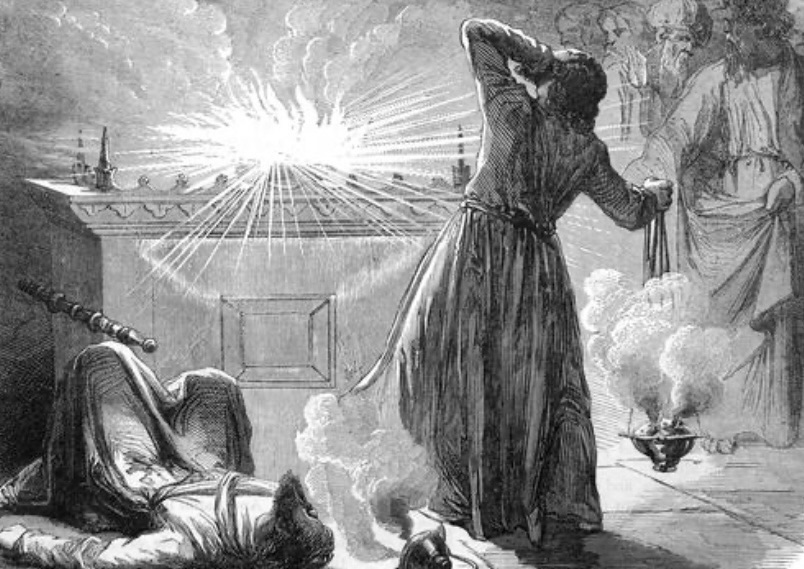
The Punishment of Nadab and Abihu (Leviticus 10:1).
I recently had a discussion with my brother Deacons about reverence for the sacred. More precisely, the Church; especially the Holy of Holies (Bete Mekdes). Being that we are ordained servants of the Altar responsible for guarding its reverence, we agreed that immense care should implemented. Especially given that this is the most sacred part of the Church by which our Lord truly becomes present in the Holy Eucharist.
We then discussed what we have observed in many churches, even beyond the Ethiopian and Eritrean Orthodox Tewahedo tradition, within our Oriental Orthodox communion; that some servants of the altar, be they clerics or lay acolytes, do not revere the sacred, but rather tragically treat it casually. This is either due to poor formation, lack of understanding, or perhaps even negligence; though I am in no position to judge.
In all fairness, there is also a crisis of premature ordinations, which includes young boys, who are not catechized or properly informed on the responsibilities of their office. In many instances, the service is either forced by parents and the church community, with the expectations being that if their son is ordained to some clerical office in the Church; they will not leave it. There’s also expectations that this will also “keep them busy” since it gives them tasks to do during the long liturgy hours, but this is a very heterodox approach to clerical offices; especially to those of the major orders.
This mindset is also a departure from Apostolic Tradition and Patristic Discipline. It is also spiritually dangerous, especially when discretion is not exercised prior to formal appointments and ordinations: be they acolytes, readers, sub deacons, or deacons. But this is not the discussion of this post, nor am I frowning upon liturgical participation from young males as long as they’re reverent (for even I started out as a simple altar boy prior to my conversion to Oriental Orthodox in Traditional Roman Catholic and Eastern Catholic circles).
As you may be aware, I am currently enrolled in a Masters of Theology Program for the Oriental Orthodox Church. Strangely enough, just after this discussion with my brother deacons, I was given an assignment the following week regarding the historic preparatory stages that clerics were bound to follow prior to not only serving the Divine Liturgy, but entering the altar itself. To many, what was enforced would be considered to be either a disconnect from modern conformity, a culture shock, or perhaps even outdated.
Nevertheless, I believe that it is worth to revisit what the fathers taught on this matter: as their instructions were not executed arbitrarily, but with discernment and biblical reference. At any rate , below is a modified version of my essay for school addressing the basic principals of reverence, which will take more than one post to cover God willing. I pray that it is beneficial to those that serve the altar; and that it ignites a burning love and zeal within them for Christ in the Holy Eucharist and the sanctuary. I must also add that this post is not intended to sow fear, but rather, holy reverence.
In the name of the Father, the Son, and of the Holy Spirit, one God. Amen.
The Kingdom of Heaven is at hand. This line from St. John the Baptist has been weighing heavily on my heart lately. I’m writing this on March 11th, 2026. The world right now is consumed by division, not just in the United States but in the entirety of the world. This division began in the garden. It has been rampant. I never understood until the veil was recently lifted for me. Satan’s grip on the world is much tighter than I anticipated. Our church has been fighting heresy for so long, but the true heresy that we have lost sight of is within our hearts.
My journey only had one goal, and that was to understand God with my brain. I thought that if I understood God in my head, it would lead me to Him. But Saint Cyril of Alexandria recently spoke to me through his writings and humbled me. As I was preparing my notes and breakdown of the Gospel of John, I was humbled.
“For it is not the part of a mind that loves truth to indulge in restless curiosity and to busy itself about words beyond what is fitting, but rather to receive with simplicity the things that are spoken by God.” — St. Cyril of Alexandria, Commentary on the Gospel of John, Book I
He warns that those who seek answers instead of truth will not only fail to find the answers but will not receive the truth, which is Christ Jesus.
It troubles me, all this death surrounding us, from the passing of the leader of Iran to a recent preacher, Mhir Mhir Zelalem. I thought I understood death. I thought it was something that just comes and goes. Luckily, our Lord and Savior Jesus Christ broke down the door of eternal emptiness. But now something was not right.