I recently had a discussion with my brother Deacons about reverence for the sacred. More precisely, the Church; especially the Holy of Holies (Bete Mekdes). Being that we are ordained servants of the Altar responsible for guarding its reverence, we agreed that immense care should implemented. Especially given that this is the most sacred part of the Church by which our Lord truly becomes present in the Holy Eucharist.
We then discussed what we have observed in many churches, even beyond the Ethiopian and Eritrean Orthodox Tewahedo tradition, within our Oriental Orthodox communion; that some servants of the altar, be they clerics or lay acolytes, do not revere the sacred, but rather tragically treat it casually. This is either due to poor formation, lack of understanding, or perhaps even negligence; though I am in no position to judge.
In all fairness, there is also a crisis of premature ordinations, which includes young boys, who are not catechized or properly informed on the responsibilities of their office. In many instances, the service is either forced by parents and the church community, with the expectations being that if their son is ordained to some clerical office in the Church; they will not leave it. There’s also expectations that this will also “keep them busy” since it gives them tasks to do during the long liturgy hours, but this is a very heterodox approach to clerical offices; especially to those of the major orders.
This mindset is also a departure from Apostolic Tradition and Patristic Discipline. It is also spiritually dangerous, especially when discretion is not exercised prior to formal appointments and ordinations: be they acolytes, readers, sub deacons, or deacons. But this is not the discussion of this post, nor am I frowning upon liturgical participation from young males as long as they’re reverent (for even I started out as a simple altar boy prior to my conversion to Oriental Orthodox in Traditional Roman Catholic and Eastern Catholic circles).
As you may be aware, I am currently enrolled in a Masters of Theology Program for the Oriental Orthodox Church. Strangely enough, just after this discussion with my brother deacons, I was given an assignment the following week regarding the historic preparatory stages that clerics were bound to follow prior to not only serving the Divine Liturgy, but entering the altar itself. To many, what was enforced would be considered to be either a disconnect from modern conformity, a culture shock, or perhaps even outdated.
Nevertheless, I believe that it is worth to revisit what the fathers taught on this matter: as their instructions were not executed arbitrarily, but with discernment and biblical reference. At any rate , below is a modified version of my essay for school addressing the basic principals of reverence, which will take more than one post to cover God willing. I pray that it is beneficial to those that serve the altar; and that it ignites a burning love and zeal within them for Christ in the Holy Eucharist and the sanctuary. I must also add that this post is not intended to sow fear, but rather, holy reverence.
Prayer has been defined by the church fathers as being “the communion of the intellect with God” (1). To the Orthodox, the highest form of prayer gifted to mankind is the Divine Liturgy. It is here where the Catechism of the Coptic Orthodox Church explains that “the believer, along with his heavenly friends, sets off to Golgotha where he sees his soul’s heavenly Groom, offering His blood as a dowry”, (2) as it is here where our Lord Jesus Christ, through the ministry of the priesthood that He established (John 20:21-23), offers Himself up through the Holy Eucharist. For though their appearance may be bread and wine, they transform into His true Body and Blood sacramntally (Matthew 25:26-28).
St. John Chrysostom explains:
Until now, Christ, who is attached to us, prepares the table Himself and sanctifies it. For it is not man who transforms the offering into His Body and Blood, but Christ Himself who was crucified for us. The priest utters the words, but God’s power and grace accomplish the sanctification. Christ says, ‘This is My Body’ and the oblations are sanctified.
— Catechism of the Coptic Orthodox Church. Vol. 2. St. George Coptic Orthodox Church, Sporting, Alexandria, and Queen St. Mary and Prince Tadros Coptic Orthodox Church. Pg. 611.
So far from what was covered, you will notice that this sacred act, i.e. the Divine Liturgy, is sacrificial in nature; especially with the use of terms such as ‘offering’, ‘table’, and even ‘Golgotha’. All of these call our attention to what our Lord accomplished at Calvary for our very salvation. More elaborately does St. Paul call the table (cf. 1 Corinthians 10:21), “an altar from which those who serve the tabernacle have no right to eat” (Hebrews 13:10), which stresses the superiority of Christ’s priesthood to that of old (Hebrews 10:1).
This understanding of the Divine Liturgy being sacrificial and a participation into Christ’s death is evident in the Apostle’s words:
“For as often as you eat this bread and drink this cup, you proclaim the Lord’s death till He comes again”
— 1 Corinthians 11:26.
Considering that it has been established that the Lord is truly and literally present in the Holy Eucharist, the very Creator and Lord of sabaoth; then it is rational to regard heaven as truly coming within our midst. When catechizing newly baptized Christians, St. Augustine spoke the following:
“Is the altar heavenly? How so? Because nothing bodily is on it, but all that is spiritual… The Church is heavenly, she is nothing but heaven.”
— St. Augustine of Hippo, Sermon 829. To the Newly Baptized.
Thus, the golden mouthed preacher called the altar a “fountain” which “went out of paradise” (3). When commenting on the fact that the liturgy is heavenly, he further spoke of it as where we “ascend directly to heaven… we become ourselves in heaven” (4).
Just as the Bible tells us that God’s throne is in heaven, and that heavenly beings worship before it (Revelations 7:11), so does the Church regard the altar as such. Thus, the Catechism additionally says: “We should consider ourselves as standing before the throne of God” (5). St. John Chrysostom says that it is “as if man is transferred to heaven itself, to stand before the King’s throne and to fly with the seraphim” (6).
On the grounds that the Divine Liturgy truly brings us into the presence of Christ, Who the angels fear, reverence, and worship; acknowledging Him being the holiest of all (Rev4:8;15:4) as He created all things (Rev 4:11), reverence for the Eucharist in Orthodoxy is not optional, but mandatory. Hence, St. Paul warned against unworthy reception from those that do not discern the Lord’s Body; threatening damnation:
For he who eats and drinks in an unworthy manner eats and drinks judgment to himself, not discerning the Lord’s body. For this reason many are weak and sick among you, and many sleep.
— 1 Corinthians 11:29-30.
Thus, we are to approach the crown of the sacraments with awe, humility, and repentance; as this is required for our very salvation and our attainment of eternal life. This warning of the Apostle was not simply limited to the laity, but much more to the servants of the Altar; the Bishops, Priests, and Deacons.
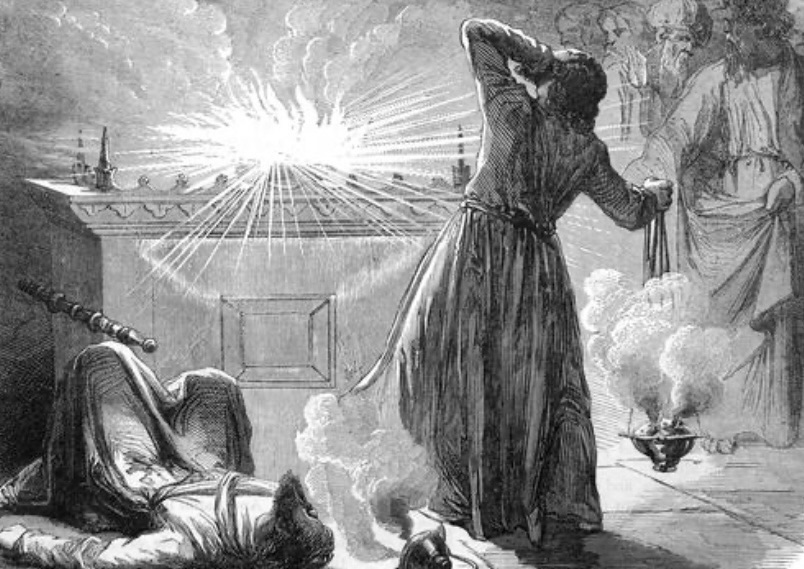
Now Nadab and Abihu, Aaron’s sons, each took his censer and put fire in it, put incense on it, and offered strange fire before the Lord, which He had not commanded them. So fire went out from the Lord and devoured them, and they died before the Lord.
— Leviticus 10:1-2.
Thus, taking into account the consequences of irreverence exemplified in the Old Testament, such as in the case of Nadab and Abihu who had a tragic end, being consumed by fire as a direct punishment from God for offering strange fire within the Sinai Desert (Lev 10:1;Num 3:4; 26:61), the Church Fathers took necessary precautions through stages of preparation; some of which were codified.
The first stage, at least within the Alexandrian tradition, was the baking and preparation of the sacrificial elements of bread and wine to be used for the Liturgy. This was to be done in silence while reciting psalms, and with a pure heart (7) free from anger, resentment, and the like.
Therefore if you bring your gift to the altar, and there remember that your brother has something against you, leave your gift there before the altar, and go your way. First be reconciled to your brother, and then come and offer your gift.
— Matthew 5:23-24.
In the words of His Holiness Pope Gabriel V:
“The priest must first clear his thoughts and conditions inside and out… not to be angry or upset with anyone. If the priest does not have a good heart and mind for his people… then God does not accept his request for his people.”
— Pope Gabriel V, The Ritual Order, 61.
Through the second stage, the priest is called to examine the lambs and wine made, and discern if it may be used for the Liturgy so that the sacrifice is unblemished (Ex 12:5; 1 Peter 1:19). Thus, the canons of Al Magmou Al-Safawy Le Ibn Al-Assal, also known within the Ethiopic tradition as Fetha Nagest, instructs that gifts to be offered must be “free from any fault” (8).
The Church considers offering blemished sacrifices to be equivalent to what the sons of Aaron offered as previously mentioned, warning that a curse should come rather than a blessing due to blasphemy (9).
This is not random, nor accidental, as God said:
Although you should bring fine wheat flour, it is vain. Incense is an abomination to Me
— Is 1:13.
Following the two initial preparation stages, the clergy are likewise called to vest in priestly garments that are appropriate for the Liturgy. This has a biblical foundation per Exodus 28. This is because it is a visible testimony of readiness for the celebration of the sacrifice, a testament of their own faith, and even internal purity which I will touch on momentarily. Hence, God said:
Thus, Aaron and his sons shall wear them when they come into the tabernacle of testimony or when they come near the altar of the holy place to minister as priests, so they not bring guilt upon themselves so as to die.
— Exodus 28:38.
Though vestments in the Christian Church gradually developed, as the clergy in the Pre-Nicene era wore normal clothes of their time that resembled that of the great people of their day (such as emperors and consuls) to signal the importance of the office that the person possessed, canons were instituted.
This is evident per the Canons of Hippolytus, Canon 37:
“And every time a bishop gets from the sacraments, the deacons and priests gather to him while they are dressed in white clothes more beautiful than all the people”. In addition, it stressed that “they shine more with their good deeds more than the color of their clothes.”
Under examination, you will see that the white clothes described are also consistent with the wedding garment that the Lord spoke of (Matthew 22:11-12), which is the white robe of salvation (Revelations 6:11; 7:14).
Furthermore, we can see that the fathers had in mind that we are to not merely vest externally, but internally through living a spiritual life rooted in holiness through Christ. We are to live a sacramental life in the bosom of the Church. Hence, even this calls us clerics to regular repentance prior to even entering the altar and serving. Just as blemished oblations and foreign sacrifices are not to be brought into the altar and offered, neither shall we enter with an unclean heart filled with pride, ego, impurity, grudge, and the like.
Instead, we must repent daily that we may enter worthily. For if the liturgy is heaven on earth; and if nothing unclean can enter (Revelations 21:27); how can we enter the altar unclean? Without reverence? With lack of love and care for God? Without respect for the Holy things, even the Eucharist (God forbid!)? We must ask: if we were to die at this moment, would God permit us to enter paradise, or would we be excluded due to our unrepentant sins?
If not, then with what audacity do we enter the altar unworthily, and additionally, serve the liturgy and partaking of the Blessed Sacrament without examination and repentance? And with what great boldness do many feel an entitlement to enter and serve, and even treat the altar area as a hangout spot, or a sleeping area, or even a place to gossip and use profanity as I’ve unfortunately witnessed in some churches. Of what great judgement awaiting such blasphemy and even lack of care for the sacred mysteries for which we are called to be stewards (1 Cor 4:1)! Can we imagine this being permitted in the Old Testament, where one’s life was threatened simply by entering the Holy of Holies? God have mercy on us.
Words from the 27th Canon of Athanasius:
If a deacon quarrel in the sanctuary (haikal) or speak a bad or vain word or one wherewith he mocketh any man, he shall be put forth a week, fasting till even and praying’.
And he saith, in the 37th Canon : 5 ‘No one of the deacons shall talk while he hath the cup.’ And Basil saith, in the 79th Canon, If a priest laugh: he shall be burned with unquenchable fire.
St. Basil:
A clergyman should not talk in the sanctuary more than what is necessary. Aaron had golden bells attached to his garment, for fear of the angels. For us, at the altar, the Psalms ought to replace the golden bells of Aaron … no one ought to utter a word in the sanctuary or around the altar, but they should rather designate a place outside to eat and to break the bread there. And if they came to place the bread (on the altar) and the youngest divides it, let there be no grumbling among the clergy, nor let anyone watch him who divides. No one is to offend another.”
Let us take heed to the Apostolic Canons, which expands upon the gravity of the sacradotal offices tied to the altar:
“… and the little that is left from the sacrifice, so let the priests and deacons be careful that nothing remains of it, and they should be very careful so that there is not much left of it, and they will have a great judgment, like the sons of Aaron and the sons of Eli who were destroyed by the Holy Spirit because they dishonored the sacrifice of the Lord. How much more those who despise the body and blood of Christ, thinking that what they eat is carnal food, not spiritual? This we command you, O bishops, priests, and deacons, for the service of the Holy Sacraments” – Canon 1.52.21.
Before we approach, let us cleanse our hearts from filth and wickedness through the tears of repentance. This can also be practiced externally not only in this fashion, but even through physical washing as practiced by the fathers. For prior to entering the altar, and even the church, they would wash their feet. Likewise, let us wash our souls, with the Grace of God, which has tracked within itself the filth of this world. For it is only through His mercy that we could enter (Ps 5:8).
Wherefore fear the altar and honour it, that it be not approached with small reverence, but in purity and fear. For the altar is a spirit and not animal, as I have formerly told you; and every soul which draweth nigh it while yet in impurity shall pray for purity: this is their purity.
— Canons of St. Athanasius, Canon 77.
In conclusion, the Divine Liturgy is not simply a prayer gathering or a simple meal, but rather, it is union with Christ and heaven itself since He truly becomes present in the Holy Eucharist. This was taught within the Scriptures, and preserved by the Church Fathers. Granted, precautions were taken by them through the implementation of canons to prevent liturgical abuse and the like; recalling the punishment of Nadab and Abihu who offered strange fire through negligence and disobedience. Hence, prior to the celebration of the Liturgy, the clergy were called to follow a system of preparation not simply out of rigidity, but reverence for the sacred.
Additional words from Fr. Athanasius al-Makary:
“The reader will not find in the works of the fathers—no matter how extensively he reads—what the biography of a priest should be in order to deserve the service of the Holy Altar. This is detailed in the canons of Athanasius, Patriarch of Alexandria. In short, these canons state that no one should approach the service of the altar and the holy altar unless they are as pure as the holy place itself. Those who served the holy altar with uncleanness or inaction did not die a righteous death; those who despised the altar died a wicked death.
Woe to him who approaches the altar when it is unclean. However, those who serve the altar worthily are blessed by God, and their faces are made more beautiful than others, like Moses. They become examples for those who serve the altar with purity. If one cannot be meek, they should stay away to avoid being burned, for the altar’s fire cannot be quenched, as God stated that the altar’s fire is not quenched.
For this reason, the altar was feared and glorified. One must approach it with purity and fear, as all souls that come to Him while unclean are asked about their purity, and the holy altar itself purifies them.
Priests were chosen to be purer than all the people because they pray for the people and ask the Lord to forgive their sins. If a priest sins like the people, who will pray on their behalf? A people whose priests are unclean have no prayer that ascends to God. If the Lord did not spare the priests who sinned in the Old Testament, what will the Lord do to the priests who sin in His holy place in the Church of the New Testament?
Woe to the priest who approaches the altar while he is unclean. Priests must serve the altar in purity, and those close to God must purify themselves, lest the Lord destroy some of them.” – Athanasius al-Makary. 2024. The Divine Liturgy – the Mystery of the Kingdom – Book 1. Theology & Academy Press. 136.
1 – St. Evagrius the Solitary. 1, On Prayer, Section 2-3. Translated by G.E.H. Palmer, Philip Sherrard, and Bishop Kallistos Ware. 2012. Philokalia—the Eastern Christian Spiritual Texts. Turner Publishing Company. Pg. 71.
2 – Fr. Tadros Y . Malaty. 2023. Catechism of the Coptic Orthodox Church. V ol. 2. St.George Coptic Orthodox Church, Sporting, Alexandria, and Queen St. Mary and Prince Tadros Coptic Orthodox Church. Pg.599.
3 – St. John Chrysostom, Homilies on John 46.4 (NPNF I/14:165) amended. Quoted in Catechism of the Coptic Orthodox Church. V ol. 2. St. George Coptic Orthodox Church, Sporting, Alexandria, and Queen St. Mary and Prince Tadros Coptic Orthodox Church. Pg. 598.
4 – St. John Chrysostom, Homilies on Ephesians 3 (NPNF I/13:65) amended. Quoted in Catechism of the Coptic Orthodox Church. V ol. 2. St. George Coptic Orthodox Church, Sporting, Alexandria, and Queen St. Mary and Prince Tadros Coptic Orthodox Church. Pg. 599
5 – Fr. Tadros Y . Malaty. 2023. Catechism of the Coptic Orthodox Church. Vol. 2. St.George Coptic Orthodox Church, Sporting, Alexandria, and Queen St. Mary and Prince Tadros Coptic Orthodox Church. Pg.602.
6 – Fr. Tadros Yacoub Malaty, Christ in the Eucharist. 2nd ed. (Sporting, Alexandria: St.George’s Coptic Orthodox Church, 1973): pp. 440–441.
7 – Athanasius al-Makary. 2024. The Divine Liturgy – the Mystery of the Kingdom – Book 1. Theology & Academy Press. Pg. 132
8 – Al Magmou Al-Safawy Le Ibn Al-Assal: The Collection Of Safey Ibn Al-Assal (Safey The Son Of The Honey Meaker) A Collection Of Church And Civil Laws. Translated by Dr. William A Hanna. Chapter 13, Canon 13.
9 – Canons of Pope Athanasius II, Canon I. Quoted in The Divine Liturgy – the Mystery of the Kingdom – Book 1. Theology & Academy Press. Pg. 139

