The Diaconate: Servanthood, Character, and Apostolic Order — Pt. 1.

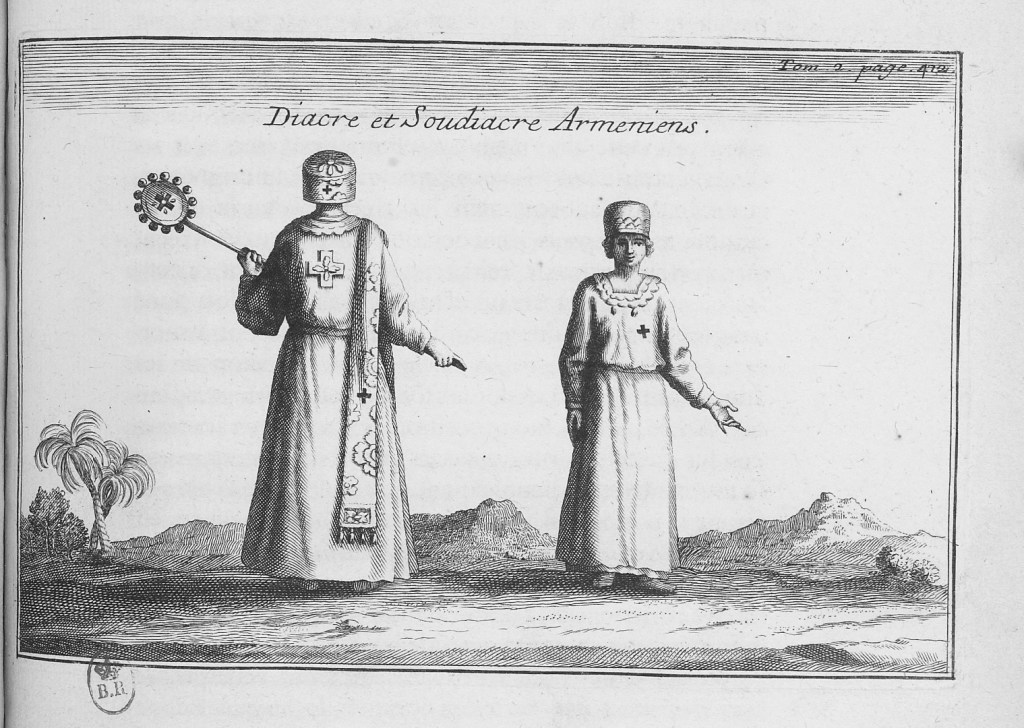
Illustration of Armenian Deacon and Subdeacon by Joseph Pitton de Tournefort (1656-1708)

Considering that there is a lack of understanding amongst many of the faithful regarding what the office of the Deacon entails, and what his responsibilities are, I’ve discerned to write on this matter for clarification. This is for both my own reflection as a Deacon and for the potential benefit of my readers; though my understanding of this great office is limited and fallible.

The Diaconate is understood by the Church as being the first rank of the Major Orders of the Clergy. The word Deacon (Greek: διάκονος / diakonos) means ‘an attendant, a minister, a servant’. More explicitly does the word ‘Diakonos’ properly mean, per linguistic scholars: “‘to kick up dust,’ as one running an errand.” (1) Thereby, the Deacon is ordained to serve the Church – the Body of Christ.

The tasks of the Diaconate to minister to the people was at first the responsibility of the Apostles. But to alleviate a workload that was interfering with their mission to “give ourselves continually to prayer and to the ministry of the word” (Acts 6:4) as “It is not desirable that we should leave the word of God and serve tables” (Acts 6:2), the Apostles commanded the faithful to “seek out from among you seven men of good reputation, full of the Holy Spirit and wisdom, whom we may appoint over this business” (Acts 6:3) as there was a conflict between the Hellenists and the Hebrews regarding the daily distribution of food (Acts 6:1), given that the faithful of the Church lived in common (Acts 2:44; c.f. Acts 4:32).

Continue reading “The Diaconate: Servanthood, Character, and Apostolic Order — Pt. 1.”

An Orthodox Apologia for the Intercession of Saints

Concerning the Orthodox Church’s teaching on the intercession of saints, heretics often argue that it is both idolatrous and unbiblical. When the Orthodox Christian is challenged on this matter, they are forced to respond to at least one of the following objections: ‘How could the saints hear your prayers if they are dead?’, ‘praying to saints is idolatry!”, “where is that in the Bible?”, & “the Bible says that there is only one Mediator between God and Man.”

It is important to note that the Holy Orthodox Church does not by any means disagree with the latter statement presented above, given that this comes directly from Divine Revelation itself (c.f. 1 Timothy 2:5, Heb 8:6, 9:15, 12:25, etc). Before we address the objections to the doctrine of the intercession of the saints, it is necessary to first define Christ’s role as the Mediator between God and man in detail. 

Continue reading “An Orthodox Apologia for the Intercession of Saints”

Sola Scriptura & the Private Interpretation of Scripture: Is it Orthodox?

“…that no prophecy of Scripture is of any private interpretation…” ( 2 Peter 1:20).

What exactly is the Private interpretation of scripture?

St. Basil the Great defines the private interpretation of scripture as one refusing “to follow the fathers, (and) not holding their declaration of more authority than one’s own opinion…”  (Letter to the Canonicae 52:1 [A.D. 370]).

 In other words, the one interpreting the Bible interprets it in accordance to how they want it to be understood. This is dangerous since this creates opportunities for false doctrines to arise, as the individual misinterpreting the scriptures departs from the Tradition of the Church and the Gospel message as a whole.

Continue reading “Sola Scriptura & the Private Interpretation of Scripture: Is it Orthodox?”