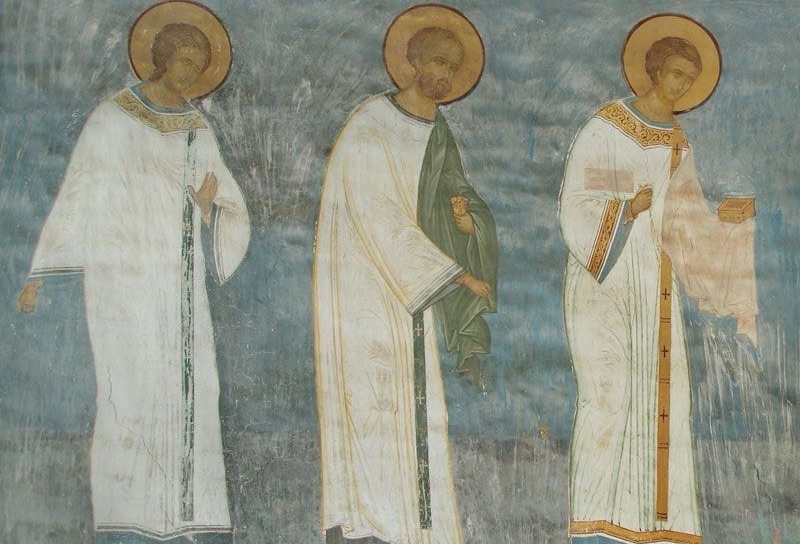
Illustration of Armenian Deacon and Subdeacon by Joseph Pitton de Tournefort (1656-1708)
Considering that there is a lack of understanding amongst many of the faithful regarding what the office of the Deacon entails, and what his responsibilities are, I’ve discerned to write on this matter for clarification. This is for both my own reflection as a Deacon and for the potential benefit of my readers; though my understanding of this great office is limited and fallible.
The Diaconate is understood by the Church as being the first rank of the Major Orders of the Clergy. The word Deacon (Greek: διάκονος / diakonos) means ‘an attendant, a minister, a servant’. More explicitly does the word ‘Diakonos’ properly mean, per linguistic scholars: “‘to kick up dust,’ as one running an errand.” (1) Thereby, the Deacon is ordained to serve the Church – the Body of Christ.
The tasks of the Diaconate to minister to the people was at first the responsibility of the Apostles. But to alleviate a workload that was interfering with their mission to “give ourselves continually to prayer and to the ministry of the word” (Acts 6:4) as “It is not desirable that we should leave the word of God and serve tables” (Acts 6:2), the Apostles commanded the faithful to “seek out from among you seven men of good reputation, full of the Holy Spirit and wisdom, whom we may appoint over this business” (Acts 6:3) as there was a conflict between the Hellenists and the Hebrews regarding the daily distribution of food (Acts 6:1), given that the faithful of the Church lived in common (Acts 2:44; c.f. Acts 4:32).
The Punishment of Nadab and Abihu (Leviticus 10:1).
I recently had a discussion with my brother Deacons about reverence for the sacred. More precisely, the Church; especially the Holy of Holies (Bete Mekdes). Being that we are ordained servants of the Altar responsible for guarding its reverence, we agreed that immense care should implemented. Especially given that this is the most sacred part of the Church by which our Lord truly becomes present in the Holy Eucharist.
We then discussed what we have observed in many churches, even beyond the Ethiopian and Eritrean Orthodox Tewahedo tradition, within our Oriental Orthodox communion; that some servants of the altar, be they clerics or lay acolytes, do not revere the sacred, but rather tragically treat it casually. This is either due to poor formation, lack of understanding, or perhaps even negligence; though I am in no position to judge.
In all fairness, there is also a crisis of premature ordinations, which includes young boys, who are not catechized or properly informed on the responsibilities of their office. In many instances, the service is either forced by parents and the church community, with the expectations being that if their son is ordained to some clerical office in the Church; they will not leave it. There’s also expectations that this will also “keep them busy” since it gives them tasks to do during the long liturgy hours, but this is a very heterodox approach to clerical offices; especially to those of the major orders.
This mindset is also a departure from Apostolic Tradition and Patristic Discipline. It is also spiritually dangerous, especially when discretion is not exercised prior to formal appointments and ordinations: be they acolytes, readers, sub deacons, or deacons. But this is not the discussion of this post, nor am I frowning upon liturgical participation from young males as long as they’re reverent (for even I started out as a simple altar boy prior to my conversion to Oriental Orthodox in Traditional Roman Catholic and Eastern Catholic circles).
As you may be aware, I am currently enrolled in a Masters of Theology Program for the Oriental Orthodox Church. Strangely enough, just after this discussion with my brother deacons, I was given an assignment the following week regarding the historic preparatory stages that clerics were bound to follow prior to not only serving the Divine Liturgy, but entering the altar itself. To many, what was enforced would be considered to be either a disconnect from modern conformity, a culture shock, or perhaps even outdated.
Nevertheless, I believe that it is worth to revisit what the fathers taught on this matter: as their instructions were not executed arbitrarily, but with discernment and biblical reference. At any rate , below is a modified version of my essay for school addressing the basic principals of reverence, which will take more than one post to cover God willing. I pray that it is beneficial to those that serve the altar; and that it ignites a burning love and zeal within them for Christ in the Holy Eucharist and the sanctuary. I must also add that this post is not intended to sow fear, but rather, holy reverence.
The Apostle Peter warned: “Be sober, be vigilant; because your adversary the devil walks about like a roaring lion, seeking whom he may devour” (1 Peter 5:8).
By what did the sacred writer mean to be sober and vigilant; save being alert and on guard against enticement that comes from so great a deceiver? An ancient enemy which only seeks the ruin and destruction of souls, as evident in his initial trickery with our first parents Adam and Eve? As divine inspiration tells us, the devil had deceived Eve into believing that she would not disobey God by breaking the first law given to man, and that she would obtain knowledge that would make her ‘god-like’ (Genesis 3:4-5), despite already having the virtue of being made in God’s image and likeness. Therefore, the race of mankind was gifted with immortality, incorruptability, and rationality which all of the other visible creatures lacked.
Yet, as we know, the consequence of sin and death came into the world as a result. Seeing that he was successful in this ancient trick, he likewise continues in his ancient attempt to destroy man by attacking the faith of Christians through a series of vain philosophies and sciences; a device which was successful in capturing the belief of those that we now call atheists, rationalists, modernists, naturalists, and the like.