Preview: The Office of the Deaconate: Apostolic Order, Spiritual Maturity, and the Misuse of a Holy Office.

Our brother Deacon Nathaniel has written a well articulate and detailed analysis on the history of the Diaconate and its current place, misuse, and even misunderstanding within the Ethiopian and Eritrean Orthodox Tewahedo Churches respectively. This can be seen on our sister channel ‘Good & Faithful’.

Preview:

“This discussion matters because the Sacrament of Holy Orders is one of the most important and vital parts of the life of the Church, which is one with the Body of Christ, lives eternally with Christ, and was established by Christ. The Church was made one with Him through His sacrifice, His teachings, and the authority given to the apostles, who carried on the mission of the Church throughout history. For 2,000 years, the offices of priesthood, deaconhood, bishop, and patriarch in the Oriental Orthodox Church have seen “changes” depending on geographical and historical reasons, these are not major changes that affect communion with other changes or shake any core belief it’s still one church but culturally separate.

I intend to do is study, pick apart, and make sense of without diving too deep where this authority comes from and why it is so important in the Church, in hopes of correcting some misunderstandings and issues found in the Church. The intention is not to gossip, judge, or make an example of anyone. Rather, what this is meant to do is, by God’s grace, bring some correction and, hopefully, some solution to a few issues that seem to have gotten worse over time.  A lot of people would agree that the office of the deaconhood has, in many ways, changed in the last ten years.

What I mean is that in some ways the changes are good, but in many ways they are not. We are seeing a significant increase in the number of people being ordained into the office at a very young age, and that can eventually lead to a very dangerous path. We are seeing a rise in deacons not understanding their role, the reverence their position holds, and how that then begins to affect things like how they speak both in and out of church. It has reached a point where people no longer respect the office.

It seems, as absurd as it may sound, oversaturated at times. There is also something that I think people often overlook, and those are what I would call the enablers, and this goes as far as the office of the bishop in that general area or archdiocese. We are seeing laymen command younger deacons with authority that they do not possess, which is unfortunate. It is not fully their own fault, because these deacons are ordained so young that those who are much older, in many cases, command and scold them while forgetting what authority these deacons have…”

For the full article, please see here.

God bless.

The Diaconate: Servanthood, Character, and Apostolic Order

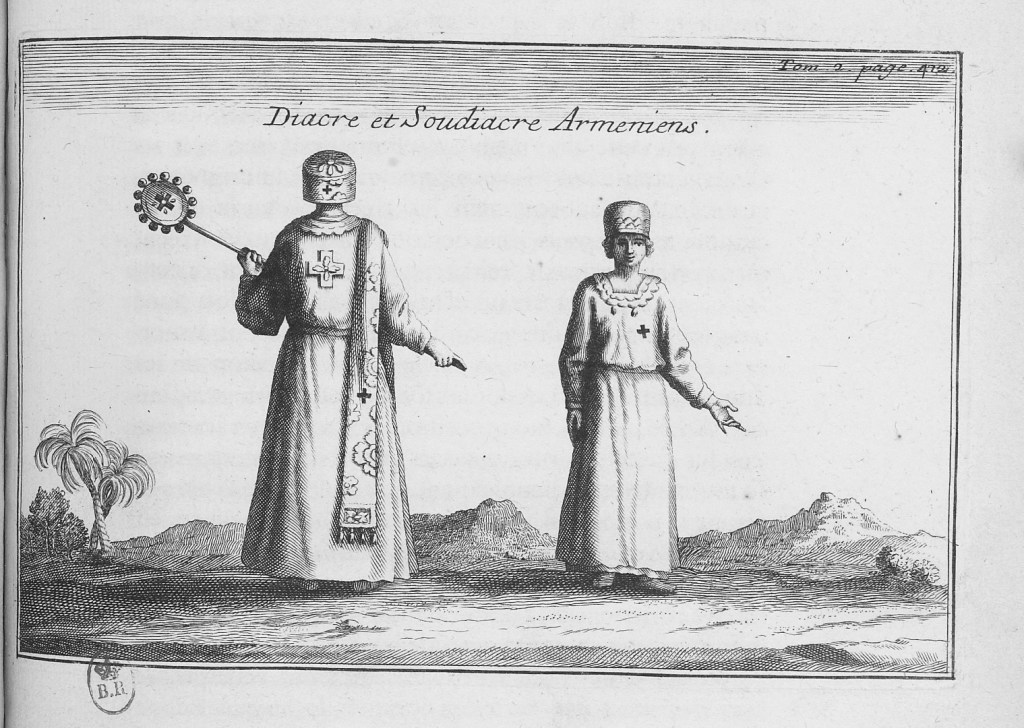
Illustration of Armenian Deacon and Subdeacon by Joseph Pitton de Tournefort (1656-1708)

Considering that there is a lack of understanding amongst many of the faithful regarding what the office of the Deacon entails, and what his responsibilities are, I’ve discerned to write on this matter for clarification. This is for both my own reflection as a Deacon and for the potential benefit of my readers; though my understanding of this great office is limited and fallible.

The Diaconate is understood by the Church as being the first rank of the Major Orders of the Clergy. The word Deacon (Greek: διάκονος / diakonos) means ‘an attendant, a minister, a servant’. More explicitly does the word ‘Diakonos’ properly mean, per linguistic scholars: “‘to kick up dust,’ as one running an errand.” (1) Thereby, the Deacon is ordained to serve the Church – the Body of Christ.

The tasks of the Diaconate to minister to the people was at first the responsibility of the Apostles. But to alleviate a workload that was interfering with their mission to “give ourselves continually to prayer and to the ministry of the word” (Acts 6:4) as “It is not desirable that we should leave the word of God and serve tables” (Acts 6:2), the Apostles commanded the faithful to “seek out from among you seven men of good reputation, full of the Holy Spirit and wisdom, whom we may appoint over this business” (Acts 6:3) as there was a conflict between the Hellenists and the Hebrews regarding the daily distribution of food (Acts 6:1), given that the faithful of the Church lived in common (Acts 2:44; c.f. Acts 4:32).

Continue reading “The Diaconate: Servanthood, Character, and Apostolic Order”

The Dormition & Assumption of the Holy Theotokos: Is It Biblical?

Today is the 21st day of the month of Tir. In the Tewahedo and Coptic Orthodox Churches, we celebrate the feast of St. Mary’s Dormition (Latin: dormitio; viz., a falling asleep).

The Orthodox Church teaches that at the very end of St. Mary’s life, and after many years of praying before the empty tomb of her beloved Son and God Jesus Christ, she was promised a glorious death. This eventually took place in the presence of Our Lord, His Angels, and the Apostles in her 60th year with the exception of St. Thomas who was preaching in India. The apostles who were present buried her body in Gethsemane, per the command of what they heard from the Holy Spirit. By the Divine intervention, St. Thomas was transported on a cloud before her deceased body in Gethsemane. He later saw the angels of God carrying St. Mary’s Body into heaven; placing her under the Tree of Life in the Eternal Garden of Paradise (c.f. Rev 22:1-5) that it may be united with her soul that was clothed in a veil of light by her Son. When he revealed what he saw to the rest of the apostles, they opened her tomb to not find her body; but to only smell a sweet fragrance. They rejoiced in this as this confirmed their faith in the Christ’s Resurrection by which we will all share in per the promise of our Lord. This is what the Apostles prayed for, hoped in, and preached to the world; despite the persecutions which came with it as they took comfort in what is to come.

But where is this event of the Assumption in the Holy Bible? Some hold to the opinion that perhaps the four gospels and the epistles were completed prior to this event. I happen to agree with this theory, especially given the Church’s Tradition which references the deaths of certain apostles — who were resurrected following their martyrdoms just to be present with the Theotokos for this moment.

Continue reading “The Dormition & Assumption of the Holy Theotokos: Is It Biblical?”