The Oriental Orthodox Church has two categories of clerics: the Major and Minor Orders. The Major Orders are those ranks by which a man receives the sacrament of Holy Orders / Priesthood. The three levels of the Priesthood are the Bishop, Presbyter, and Deacon. These ranks are conferred by a canonical and valid Orthodox Bishop through the laying on of hands.
Pope Shenouda III:
“We see that non of the elected were authorised to commence their work until the apostles had laid their hands on them. Even the deaconship, no one can carry out its duties without canonical ordination.”
— The Priesthood, Pg. 42.
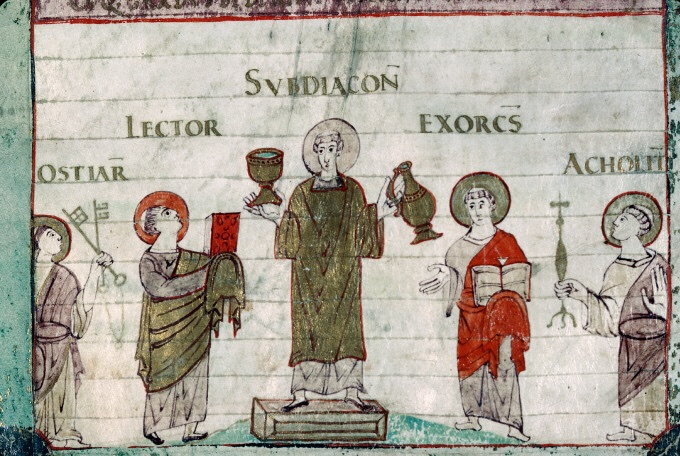
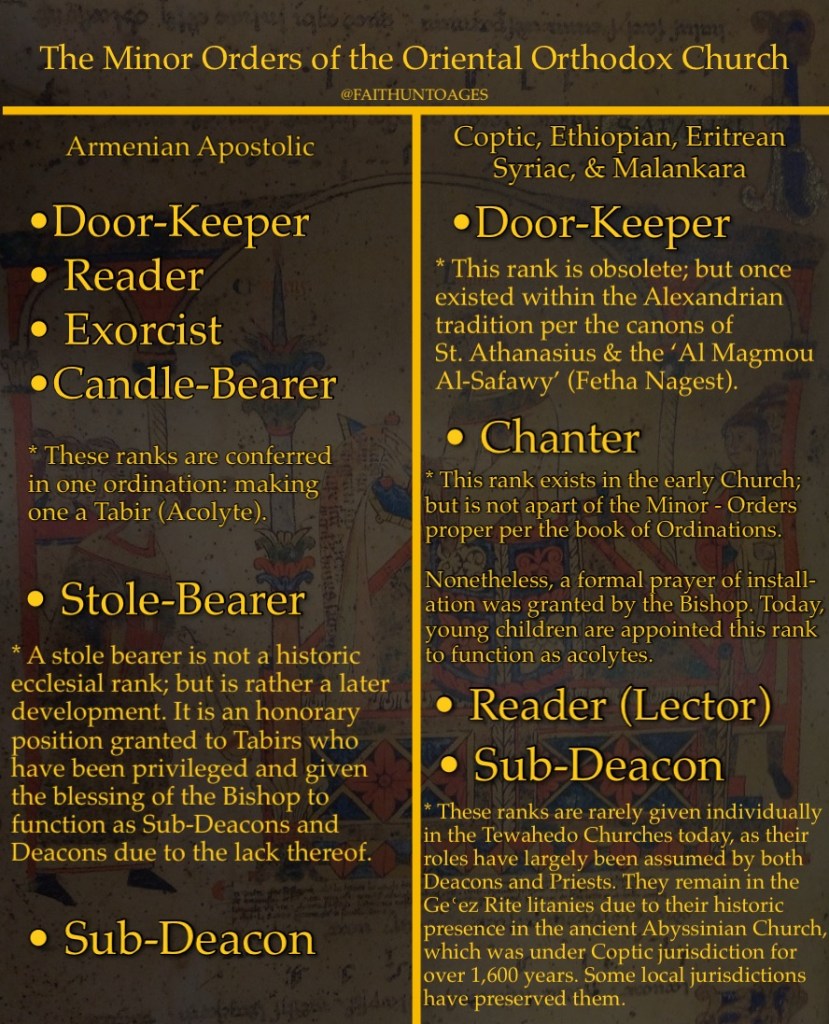
The Minor Orders are non-priestly ranks. In order words, they are not conferred by the laying on of hands as they are not of apostolic origin; but are nevertheless ancient ecclesial offices which developed following the death of the Apostles for the service of the Church. The Minor Orders of the Oriental Orthodox Church are: Door Keeper, Reader, Exorcist, Candle Bearer, and Sub Deacon. Yet, some of these minor ranks only exist in certain jurisdictions.
To add: we can find the existence of these ranks in the texts of early Christians. For instance, Eusebius says that in Rome there were:
“forty-six presbyters, seven deacons, seven sub-deacons, forty-two acolyths, fifty-two exorcists, readers, and door keepers” — Church History, Book VI.
St. Ignatius of Antioch:
“I salute the sub-deacons, the readers, the singers, the doorkeepers, the labourers, the exorcists, the confessors. I salute the keepers of the holy gates, the deaconesses in Christ.” — The Epistle of Ignatius to the Antiochians, XII.
The Minor Ranks and their Duties
Doorkeeper:
The rank of door keeper is mentioned in both the Coptic and Ethiopic Church law known as “Fetha Nagest”. It refers to them “aliflusawiyan”. This is believed to be a corruption of the word Acolyte (1). It describes their responsibility as being the guardians of the door’s on the men’s side of the Church (2).
“Doorkeepers shall stay at the entrance reserved for men and shall guard it.”
— Fetha Nagest, Chapter VIII, Section III.
“let the door be watched, lest any unbeliever, or one not yet initiated (catechumen), come in.”
— Apostolic Constitutions, Book II: Section 7
This rank has completely fallen into disuse within the Coptic, Syriac, and Malankara Churches. Instead, their duties have been assumed by the sub deacon. Yet, because it is lower than the rank of chanter, it has been absorbed by them in Coptic, Syriac, and Malankara Churches respectively given their current acolyte status. As mentioned previously, this rank is present within the Armenian Apostolic Church’s hierarchical system: but has been absorbed into the rank of Tabir. Unlike today, chanters do not wear any vestments historically within the Alexandrian tradition. Yet, within the current Coptic, Syriac, and Malankara practice; the Chanter wears a simple white tunic. For the Armenian Tabir; their colors vary depending on the feast days.
Reader
The reader was traditionally considered to be the first step rank of the priesthood (clergy) within the Alexandrian (Coptic – Ethiopic) and Antiochian (Syriac) traditions. This explains the tonsure that they receive at their time of appointment; to signify that they have entered the clerical state. This is evident by the vows which follow the ceremony:
My son, this is the first rank of the priesthood (Gk: ἱερατικόν) that you have received, you ought to learn every chapter in the Holy Books, for they are the very breath of God, which have been entrusted to you so that you will preach them to the people. This is a great act. You have to be as an illumined light on a tower-house so that you may fill and satisfy your congregation with your readings. Do not be lead into temptation, but remember always the words of the Lord saying; “Let the reader understand” (Mark 13:14). When the people see your good growth and progress in this rank, they may recommend you for the higher rank, and be proud of you and always, through Christ Jesus our Lord to whom is due all glory now and forever unto the ages of ages. Amen. (3).
This is because they historically had the role of being one of the primary teachers of the Church due to their sound understanding of scripture and were able to accurately interpret them. They were needed especially due to the high amount of illiteracy amongst the earliest Christians. They were also guardians of the Church’s holy books. Many were martyred due to their refusal to give them to the Roman Government as in the case of St. Timothy the Reader who is commemorated on Hathor 5 (Nov 14) in the Coptic Tradition. Readers are thus today called to catechists, knowledgeable of Church doctrine, the scriptures, and the exegesis of the church father’s; that he may instruct the faithful.
The Canons of St. Athanasius:
“The readers are not bound to the service of the subdeacons, but shall give themselves unto their books. And the reader shall be honoured, because that out of his mouth cometh the holy word” (Canon 35).
Given their duty and clerical responsibilities (4), the Didascalia requested that the laity not only provide a salary for the priests and Deacon, but for the Readers (Lectors).
“But if anyone wish to honour the presbyters also, let him give them a double (portion), as to the deacons; for they ought to be honoured as the Apostles, and as the counsellors of the bishop, and as the crown of the Church; for they are the moderators and councillors of the Church. But if there be also a lector, let him too receive with the presbyters. To every order, therefore, let every one of the laity pay the honour which is befitting him, with gifts and presents and with the respect due to his worldly condition.” – CHAPTER IX.
St. Cyprian, when talking about the clerical state of the reader, likewise said:
“And since it behooved me to write by clergy, while I know that very many of ours are absent, and the few that are there are hardly sufficient for the ministry of the daily duty, it was necessary to appoint [ἀπόκειμαι] some new ones, who might be sent. Know, then, that I have made Saturus a reader, and Optatus, the confessor, a sub-deacon; whom already, by the general advice, we had made next to the clergy, in having entrusted to Saturus on Easter-day, once and again, the reading; and when with the teacher-presbyters we were carefully trying readers—in appointing Optatus from among the readers to be a teacher of the hearers;—examining, first of all, whether all things were found fitting in them, which ought to be found in such as were in preparation for the clerical office. Nothing new, therefore, has been done by me in your absence; but what, on the general advice of all of us had been begun, has, upon urgent necessity, been accomplished. I bid you, beloved brethren, ever heartily farewell; and remember me. Fare ye well” – Epistle 23
In the Coptic Canon law document Al Magmou Al-Safawy Le Ibn Al-Assal (What Ethiopians call ‘Fetha Nagest) it regards the rank as one which must be taken with extreme care and gravity:
“The Apostles said (Apostles 14): The Aghnostos rank is given to one after he is tested and he should not talk much, should not be driven to drinking, should not joke a round. He should have a good reputation, lover of good deeds, and hurries to the meetings of the congregation in which the name of the Lord is mentioned, and be obedient and a good reader knowing that the best place to be is when one does according to what he reads because if one fills the ears of the listeners with the word of what they ought and ought not to do and does not know (do according to) what is reading he is transgressing in front of God.”
In the Coptic tradition, The reader today wears a white tunic which is currently overlaid by an orarion/ stole that forms a cross on his back, with it wrapped around the front as a belt, and with both ends hanging from over his shoulders. In the Syriac & Malankara tradition, the tunic is overlaid with a stole in the shape of a cross that is formed on the back while the two straps in the front cross over each-other diagonally.
Exorcist:
The exorcising of demons was apart of the ministry of the Lord Jesus Christ (Mark 1:39). Likewise did He share this role with His Apostles:
“Heal the sick, cleanse the lepers, raise the dead, cast out demons. Freely you have received, freely give.”
— Matthew 10:8.
Per Tertullian, he explains that this role was not limited to the clergy but was also done by laity (6):
“With what mouth will a Christian frankincense-seller, if he shall pass through temples, with what mouth will he spit down upon and blow out the smoking altars, for which himself has made provision? With what consistency will he exorcise his own foster-children, to whom he affords his own house as store-room? Indeed, if he shall have ejected a demon, let him not congratulate himself on his faith, for he has not ejected an enemy; he ought to have had his prayer easily granted by one whom he is daily feeding.”
— On Idolatry, XI.
Origen:
“If, then, the Pythian priestess is beside herself when she prophesies, what spirit must that be which fills her mind and clouds her judgment with darkness, unless it be of the same order with those demons which many Christians cast out of persons possessed with them? And this, we may observe, they do without the use of any curious arts of magic, or incantations, but merely by prayer and simple adjurations which the plainest person can use.”
—Against Celsus VII.4
As time progressed, this had developed into a clerical order which was unique to the Western Church prior to the schism; though the Armenians have obtained this rank within their orders due to later Latin influence.
An official rite of ordination for the exorcist had been established at the Council of Carthage of 398. A.D. which said:
“Receive with earnestness the exorcisms: whether thou be breathed upon or exorcised, the act is to thee salvation”
— Procat. § 9.
Sub-Deacon
The Sub Deacon shares the same responsibilities of the previous ranks, but are also formally appointed to assistant the Deacon in his service: both within and outside the altar.
Within the Church setting this includes: preparing the censor, lighting the candles of the Church (which was also the duty of the ancient candle-bearer rank in the Armenian Church), and guarding the Church from heretics and heresy. Thus, in ancient times, Sub Deacons would stay by the doors to make sure that heretics and animals did not enter (a task which overlapped with the doorkeeper as discussed previously).
The Canons of St. Athanasius:
“If the subdeacon give not good heed unto the church, so that the dogs (heretics) and heathen enter in, while he driveth them not out neither forbidden them, then doth he sin” (Canon 11).
This is addressed in the vow given to him:
“Assist the priest and the deacon in the service. Watch the doors of the Church, which is the House of God. Do not permit any cattle or dogs or heretics to enter. During the Holy service when the deacon says; “No catechumens are to stand in the Church, nor a non partaker to receive the Holy mysteries,” be sure to guard the Church safely for you have been entrusted to touch the Holy vessels that are used in the Holy service” — Coptic Rite.
Outside the Church, Sub-Deacons assisted the Deacons in their administrative and charitable services. This is outlined in the canons of St. Hippolytus:
Each of the deacons and sub-deacons shall serve the bishop. The bishop shall be told who are the sick, so that if it seems good to him, he may visit them. For the sick are greatly comforted that the high priest remembers them.
— Canon 34
The Sub Deacons wear the same vestments as the Readers in the Coptic Tradition (5). In the Syriac and Malankara Rites, a white tunic is also worn and is overlaid with a stole which wraps under the arm and over the left shoulder. In the Armenian Tradition; the orarion is worn over the left arm.
(1). Cf. Footnotes of The Fetha Nagest by Abba Paulos, Pg 56.
(2). The sections of the Church were divided by gender. For instance: ‘Let the younger women also sit by themselves, if there be a place for them; but if there be not, let them stand behind the women. Let those women which are married, and have children, be placed by themselves; but let the virgins, and the widows, and the elder women, stand or sit before all the rest; and let the deacon be the disposer of the places, that every one of those that comes in may go to his proper place, and may not sit at the entrance’ (Apostolic Constitutions, Book II: Section 7). The women side was guarded by the deaconesses: “Let the deaconesses also stand at those of the women, like shipmen…” (Ibid).
(3). The Book of ORDINATIONS and CONSECRATIONS For The Coptic Orthodox Church. Translation, Compilation, and Design by Fr. Markos R Hanna, Pg. 12.
(4). The English Liturgy Book of the Ethiopian Orthodox Church, published by Tensae Publishing House, has footnotes which are in agreement; for page 54 informally regards them as: “Those who have attained the first stage of [sic] diaconate. (readers).” Interestingly, and though not an authority of our church, the Roman Catholic theologian Heinrich Joseph Dominicus Denzinger shares similar words: “Ordines diaconatu minores: subdiaconatus, lectoratus et qui apud Syros adhue est, non conferuntur per manus impositionem apudJacobitas, Copios et syros; sed episcopus atraque manu ordinandi tempora tangil, quasi eum ad officium assumens.” (~ Ritus Orientalium, Coptorum, Syrorum Et Armenorum, Inadministrandis Sacramentis, Pg. 134).
(5). In the local council of Ladocia it declared that “The subdeacon has no right to wear an orarium, nor to leave the doors… The readers and singers have no right to wear an orarium, and to read or sing thus [habited]” (Canons 22-23). Yet, there is not evidence of this canon being enforced within the Alexandrian Church in its entirety. “The prohibition of the Council of Laodicea seems never to have affected the Church of Alexandria; for in the Tukian Pontifical there is a rubric directing the investiture of the subdeacon with the orarion at ordination” (Alfred Butler: Ancient Coptic Churches, Vol II. Pg. 136).
(6). Disclaimer: This must be done with caution! The Church had formally appointed the prayers of appointment to avoid spiritual harm to those that were not well equipped for or blessed by the Church to perform exorcisms. Additionally, Phillip Schaff explains: “The power of casting out devils, promised by our Lord, and exercised by Apostles, and by Philip the Deacon and Evangelist, was long regarded in the early Church as a direct gift still bestowed by the Holy Ghost, apart from any human ordinance. Justin Martyr, Tertullian, Origen, all speak of exorcism as being practised by laymen, even by soldiers, and women, by means of prayer and invocation of the name of Jesus. Accordingly “an Exorcist is not ordained, for it is a gift of the spontaneous benevolence and grace of God through Christ by visitation of the Holy Ghost. For he who has received the gift of healing is declared by revelation from God, the grace which is in him being manifest to all”. (Philip Schaff, ed., A Select Library of the Nicene and Post-Nicene Fathers of the Christian Church, Second Series, vol. 7, Cyril of Jerusalem, Gregory Nazianzen, trans. Edwin Hamilton Gifford (Grand Rapids, MI: Eerdmans, 1983), “Catechetical Lecture III,” §3, note 6).

