
The Church’s Indefectibility
If we regard the account of Apostolic and Patristic witness to be credible, and therefore true; then we shall acknowledge that both regarded the Church as Christ’s Mystical Body. St. Paul: “… Him is who is the head – Christ – from Whom the whole Body, joined and knit together…” (Ephesians 4:15-16, OSB); “And He is the head of the Body, the Church…” (Colossians 1:18).
The Church is also the spouse of Christ, and as His spouse, She is one flesh with Him (cf. Genesis 2:24). So, just as Christ is pure, spotless, and without blemish (Heb 4:15; 9:14) His Church, being His Body, is likewise thus since He is her head.
Describing her chastity, St. Augustine likened her to the Theotokos and Ever- Virgin Mary with the following words:
“Surpassing all the sons of men in beauty, He (Jesus), the Son of Holy Mary and Spouse of Holy Church, has made it a mother for us and kept it a virgin for Himself.” 1
In sequence, he continues:
The church is like Mary; her perfection was never defiled, and her fertility was never corrupted. What Mary was made worthy of in the flesh, the church received it spiritually. The only exception to that is that Mary gave birth to one son (Jesus Christ) but the church gave birth to many children for them to be gathered together in the one body in the one (Christ). 2
Since Christ is ‘the Way, the Truth, and the Life’ (John 14:6); His Holy Body, the Church, can never fail in leading her children to eternal life; for the graces of the sacraments and pure instruction (dogmas) flow from her. As the Pauline Epistle to Timothy says “The Church of the living God, the Pillar and ground of the truth” (1 Timothy 3:15).
As the Pillar and ground of truth, the Church is incapable of leading souls astray and teaching heresy; for Christ promised that the gates of hades shall not prevail against her for all time (Matthew 16:18). As St. David prophesied: “He has strengthened the bars of your gates” (Psalms 147:13).
In the Church’s tradition, the said prophecy of the Psalter pertains to the St. Mary’s two-fold virginity. Likewise does it pertain to Holy Mother Church; for she is ever faithful to the Lord and incapable of betraying our Lord through fornication with falsehood and wickedness.
Hence, in full confidence, we can trust that she is infallible on matters of faith and morals; and that her teachings are pure and true — all of which were declared by Holy Writ, the Apostolic Tradition, and the Three Holy Ecumenical Councils. Granted, her dogmas are spotless, pure, and incorruptible – as they come from Christ through His Apostles. She is, for these reasons, the teacher of the universe.
The Catechism of the Church explains:
The apostles received the teaching of the Lord as divine truth and preserved it… Our Lord Jesus confirmed the infallibility of the Church from perversion when He promised His disciples, “I am with you always, even to the end of the age” (Matt. 28:20). He also promised to send the Holy Spirit, “But the Helper, the Holy Spirit, whom the Father will send in My name, He will teach you all things, and bring to your remembrance all things that I said to you” (John 14:26). Such promises confirm that the gates of Hades shall not prevail against it (Matt. 16:18). 3
This is not to suggest that all of her members are perfect and incapable of sinning or falling into error. Nor is it a suggestion that they are infallible. Rather, this strictly applies only to the Church as Christ’s living Body of earth; which is a true living organism.
The Great Commission
From the very inception of the Church, she was called to witness to the Gospel of Jesus Christ to all nations; that they may be converted and receive sacramental graces.
Our Blessed Lord commanded His Apostles to:
“Go therefore and make disciples of all nations, baptizing them in the Name of the Father, the Son, and the Holy Spirit, teaching them to observe all things that I have commanded you…” (Matthew 20:19-20).
In obedience to our Lord’s commandment, the Apostles have traveled to various nations of the ancient world and, though facing many hardships, were successful in converting many souls to Christianity. Within many famous cities were Apostolic Sees established, such as Rome, Antioch, Jerusalem, and Alexandria; which were governed by the Apostles who not only edified the faithful, but supervised the ministry as they also appointed ministers to assist them.
Tertullian explains:
Come now, you who would indulge a better curiosity, if you would apply it to the business of your salvation, run over the apostolic churches, in which the very thrones of the apostles are still pre-eminent in their places in which their own authentic writingsare read, uttering the voice and representing the face of each of them severally. Achaia is very near you, (in which) you find Corinth. Since you are not far from Macedonia, you have Philippi; (and there too) you have the Thessalonians. Since you are able to cross to Asia, you get Ephesus. Since, moreover, you are close upon Italy, you have Rome, from which there comes even into our own hands the very authority (of apostles themselves)… See what she has learned, what taught, what fellowship has had with even (our) churches in Africa! One Lord God does she acknowledge, the Creator of the universe, and Christ Jesus (born) of the Virgin Mary, the Son of God the Creator; and the Resurrection of the flesh; the law and the prophets she unites in one volume with the writings of evangelists and apostles, from which she drinks in her faith. This she seals with the water (of baptism), arrays with the Holy Ghost, feeds with the Eucharist, cheers with martyrdom, and against such a discipline thus (maintained) she admits no gainsayer. 4.
Despite where the Apostles went, and regardless of locality; the Gospel was one and the same. Distance between local churches (lowercase c) did not prevent the members of Christ’s Body from being One Church; who all shared a common faith and sacramental worship through the Holy Eucharist as Tertullian explained.
St. Cyprian of Carthage is also in agreement. He explains this with accuracy when using the analogy of grains for the Eucharist:
When the Lord called the bread, which is the result of the union of many grains of wheat, his body, he referred to our people who bore it, as they became united. And when he called the wine, which is the fruit of the juice of many grains and clusters, his blood, he meant his flock, which is bound together by the mingling of the multitude into a unity together. (Epistle 75).
The equivalent also applies to differences in local culture which belonged to the many nations. With baptism of their bodies also came their particular cultures for the good use of the Church. This explains the Church’s diversity in liturgies, rites, customs, hymnology, traditions, and iconography in each self governing Orthodox church today.
The ancients believed that:
Unity of the Church is built on the basis of her one faith, her one order and framework. Although diversity of cultures exists and the impact of such diversity on some rituals such as iconography and hymnology, the Church bears one theological and spiritual thought. 5.
Though he later fell into error, Origen had the mind of the Church when he taught:
“The whole sacrifice (the Passover lamb) is eaten in one house, and no meat is taken from it outside. This means that one housereceives salvation in Christ, that is, the Church throughout the world.”6.
St. Irenaeus further comments:
The Church, though dispersed throughout the whole world, even to the ends of the earth, has received from the apostles and their disciples this faith: [She believes] in one God, the Father Almighty, Maker of heaven, and earth, and the sea, and all things that are in them; and in one Christ Jesus, the Son of God, who became incarnate for our salvation; and in the Holy Spirit, who proclaimed through the prophets the dispensations of God, and the advents, and the birth from a virgin, and the passion, and the resurrection from the dead, and the ascension into heaven in the flesh of the beloved Christ Jesus, our Lord… For, although the languages of the world are dissimilar, yet the import of the tradition is one and the same. For the Churches which have been planted in Germany do not believe or hand down anything different, nor do those in Spain, nor those in Gaul, nor those in the East, nor those in Egypt, nor those in Libya, nor those which have been established in the central regions of the world. 7
Likewise, St. Jerome:
“It is not the case that there is one church at Rome and another in all the world beside. Gaul and Britain, Africa and Persia, India and the East worship one Christ and observe one rule of truth.” 8
Allow me to also provide an analogy. Alaska and Hawaii are not connected to the mainland of the United States, yet are nevertheless equally states of the country in spite of them having their own distinct culture, history, and even climate.
Hence, the Church is One not because of uniformity of culture and lowercase t traditions (local customs that are not of Apostolic origin); but because Christ is her head, and all of her members share a common acceptance of dogmas and communion. This One Church of Christ is the Oriental Orthodox Church, which is comprised of the Coptic, Ethiopian, Eritrean, Armenian, Syriac, and Malankara Orthodox Churches.
Jurisdictional Wars and Schismatic Rhetoric
Recently, there has been discussion amongst the laity of the Ethiopian Orthodox Tewahedo Church whether it would be permissible to visit the sister churches and still remain in good standing with the Church. Though this may sound preposterous, context is needed. Certain clergyman have been teaching and promoting the heresy of Ethnophyletism from the pulpit.
Ethnophyletism is the practice of organizing local church jurisdictions along tribal, linguistic, or national lines rather than standard geographic and spiritual principles. In other words, the concept prioritizes nationality, culture, or tribe ahead of ecclesial unity; and divides the church based on local cultural and ethnic lines. It also promotes a sense of superiority; and critiques the ancient and local customs of another autocephalous church — within their own communion — through the lens of their own tradition and deems that since they are different culturally, then it must be heretical. Hence, things which are cultural as deemed as dogmatic.
One of such examples of many, that I found appalling, were the words of a certain Tewahedo clergyman who said the following regarding the Coptic Church’s practice of not completely veiling the Eucharist as done within the Tewahedo Tradition. With profound boldness and assurance he cried:
“Sister churches, like Egypt, do not cover the Holy Communion. Egypt has lost her traditions; she resembles the burning ancient city of Sodom; its baffles me that you look to her as a role model… she is married to the (Roman) Catholic Church.”
These words are problematic for obvious reasons, as they suggest not only that a jurisdiction which is equally apart of Christ’s Body is capable of failing (which we already established above that she cannot), but it also equates it with the punishment of Sodom, and furthermore, vainly charges her with being an offspring of a heretical sect. The charges are reeked with indiscrimination, smite, cenodoxia, detraction, and calumny. In the words of St. Jude: “These are sensual persons, who cause divisions, not having the Spirit of God” (Jude 1:19). We will now examine Church History to examine this error and put it to nought.
Neo – Arian Ecclesiology
His Holiness, Pope St. Alexander I, the 19th Patriarch of Alexandria founded by St. Mark the Evangelist by the commission of St. Peter the Chief Apostle, had once warned the following regarding the enemies of the Church. Speaking of the Arians, he said to Alexander of Byzantium:
“… they had the audacity to tear apart the seamless garment of Christ, which even the soldiers did not dare to divide (cf. John 19:23-24).”9 Likewise did the pontiff warn that such people “compromise the apostolic rule”10, namely: “that there should be no schism in the Body” (1 Corinthians 12:25).” He further says that such persons: “Light the fire of the devilish work against Christ under themselves”11. So, those who promote slandering their sister church tragically put themselves in jeopardy of an even graver punishment; as it promotes separation. Not to also mention that the charge of error; ridiculously suggesting that not veiling the Eucharist is equivalent to Sodom’s punishment (which was for sexual immorality against nature), can also easily be applied to the earliest church from which we descend from which I will later expand upon.
In that same letter did the Patriarch warn that Arius, and those whom shared his blasphemous view that the Eternal Word, Jesus Christ, did not always exist, was created out of nothing like everything else, and was subject to change; even capable of committing evil – were spreading their cancer throughout the church and were successful in perverting the minds of laity and clergy alike. Verbatim: “Of necessity they continue by saying that His Nature is changeable, able to do evil or good.”12
Now, given that we had already established that the Church is the spouse of Christ; our mother, pure, undefiled, virginal, infallible, and perfectly faithful for all time to the Lord Jesus Christ; and given that the Church is His Pure Body; can we rightly conclude that she is capable of change as well? Capable of forgetting her mission to save souls? Capable of committing sin, and leading her children into sin? Capable of teaching heresy, and the like? Could one rightly, in good conscience, equate her rituals, despite the local tradition, to that of punishment for sins against nature and sexual immorality as did Sodom? Sins created by man? Despite the Coptic Church courageously withstanding Rome’s departure from truth, acceptance of heresy, and promotion of Sodomy? Hence, why the Copts withdrew dialogue with them?13
How, then, could she be ranked as being a daughter of schismatics and heretics? The Lord’s Spirit which flows through the Church is not merely created that it may change; as the Church is Christ’s Body Himself and belongs to Him. Why, then, teach the flock such absurdity; tempting them to rebel against their fellow brethren?
Hear the words of St. Cyprian:
“The spouse of Christ cannot be adulterous; she is uncorrupted and pure. She knows one home; she guards with chaste modesty the sanctity of one couch”. 14
Let us heed to the words of the Lord:
“Woe unto that man by whom the offense comes” (Matthew 18:7), and “Whoever causes one of these little ones who believe in Me to sin, it would be better for him if a millstone were hung around his neck, and he were drowned in the depth of the sea. (Matthew 18:6).
Schism as Separation from Christ
To additionally comment on the severe gravity of schism, let us elaborate on its definition. Schism (Greek: Schisma) literally means: “A split, division, tear”. 15 In fact, St. Paul had used a similar word when he said to the Church in Corinth:
“I hear that when you come together, as a Church, there are divisions (Schismata)16 among you…” (1 Corinthians 11:18).
This was not, by any stretch of the imagination, a compliment, but a rebuke and a call to repentance. Furthermore, although I accuse not the said proponent of division ( and similar persons who share the same attitude) of formal schism, the gravity of their message harms unity in the Church and opens the door to division within the seamless garment of Christ.
And so now, I appeal to St. Jerome who defined that: “Schismatics are those who set themselves apart from the Church and the Bishop”. 17 So severe is this that St. Cyprian warned that schismatics, as well as heretics, cannot share in eternal life.
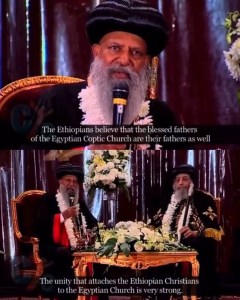
Why is this all relevant? Because, the most chief of Bishops of the Ethiopian Orthodox Church, His Holiness Patriarch Mathias I, said the following regarding the Coptic Church when speaking with Pope Tewodros II: “The unity that attaches the Ethiopian Christians to the Egyptian Church is very strong. The Ethiopians believe that the blessed fathers of the Egyptian Coptic Church are their fathers as well.”
Additionally, His Holiness Abune Paulos and His Holiness Pope Shenouda III have both agreed in writing, with their signatures, that there should be between the Ethiopian and Coptic Churches:
“1. Exchange of visits of Patriarchs, Metropolitans, Bishops, Priests, Monks, Professors, Students, and Deacons should be encouraged.
2. Theological education.
3. Christian education: Sunday Schools, Youth, and Family Programes”. 18
If the Patriarchs of the Church revere the Coptic Orthodox Sister Church; and even encourages fellowship with her through a variety of programs, would not the Patriarchs, according to the Presbyter, be enabling sacrilege and also deserve Sodom’s punishments? What of those that participate in concelebrations? God forbid. It is the responsibility of the priest, and all clergyman, to preach the same Orthodox faith as handed down by Christ, the Apostles, the Patristics, and the Three Ecumenical Councils, and one’s bishop per Church law. “For whatever is more than these is from the evil one.” (Matthew 5:37). Thus, if the hierarchs of the Church regard the sister church’s as equally Orthodox – who also fully understand their local customs – then the same must apply those in subject to them.
Any suggestion by this cleric, or anyone for that matter, who encourages separation; or even discourages their flock from praying with and visiting the sister churches with the warning that the would allegedly be “led astray”, puts themselves in grave danger of risking their salvation due to not only tearing apart the Church; but by disobedience to what the hierarchy have ratified.
I propose the question for said detractors: Does a drop of blood, when it travels from the heart through the arteries to the vein and to a vessel cease to be a part of the Body? In what way, shape, or form then can the children of the Church be separated from Christ while remaining in full communion with her while traveling to other limbs which equally administer the sacraments and teach the holy dogmas? Is salvation limited to only those within Ethiopia? If so, which Ecumenical Council decreed this? What fathers and scriptures teach such absurdity? Why then attempt to scatter the Phalanx of God that Satan may prosper?
St. John Chrysostom:
“For nothing so especially makes persons easily vanquished and subdued in temptations, as isolation. For, tell me, scatter a phalanx in war, and the enemy will need no trouble, but will take them prisoners, coming on them separately, and thereby the more helpless.”19
Do you not know that Satan is destroyed by the Church’s unity?
St. Ignatius of Theophorus:
Take heed, then, often to come together to give thanks to God, and show forth His praise. For when you assemble frequently in the same place, the powers of Satan are destroyed, and the destruction at which he aims is prevented by the unity of your faith. 20
If the Church is the Ark of Salvation, could we dare say that those on the upper deck are no longer on the ship since they are not in the middle? Cannot her children take refuge in her despite the location?
St. John Chrysostom: “The Church is your hope, your salvation, your refuge”. 21
Likewise, cannot the children meet the Lord in any jurisdiction? Have we forgotten the Church’s mission? That she is not merely an institution of cultural preservation? But rather:
“the goal of the house of the Lord is for the people to meet God, their Savior. This is the main and only mission of the Church. Every worship and activity, done in the Church, must have the salvation of humanity as its main goal.” 22
Let us now examine in more detail why the presbyter’s vain suggestion can also apply to the early Church.
Visibility of the Altar in the Early Church
I want to first issue a disclaimer: I am not promoting liturgical change within the Ethiopian Orthodox Church, nor am I in favor of our Church abandoning her liturgical customs by any means. In fact, I am in favor of preserving them and continuing the practice of veiling the Holy Eucharist for a variety of reasons. Thus, may any thought, suggestion, or accusation of ‘Teshadiso’ by Donatists be immediately terminated.
Nevertheless, history will prove, as well as the fathers, that this was a pious development and does not compromise Church Dogma. In fact, let us begin by first examine the words of St. John Chrysostom of the matter:
“How many now say, ‘I would wish to see His form, the mark, His clothes, His shoes. Lo! You see Him, you touch Him, you eat Him. And you indeed desire to see His clothes, but He gives Himself to you not to see only, but to also touch, and eat, and receive within You.” 23
And another:
“When you see the table set before you, say to yourself: ‘Because of this Body am I no longer earth and ashes, no longer a prisoner, but free; because of this I hope for heaven, and to receive the good things therein, the portion of the angels, converse with Christ; this Body…” 24
And lastly:
“When we see the Lord as a sacrifice placed on the altar, and the congregation being cleansed by the Precious Blood…” 25
Take into consideration that St. John Chrysostom was the Archbishop of Byzantium / Constantinople. Within the early Byzantine Church, the congregation had full visibility to the liturgical activities at the altar; hence why in the golden mouth preacher’s homilies to the faithful he referenced seeing the Lord in the Eucharist.
Though the sanctuary was separate from the nave, it was by a “low-screen, about waist high, which encloses the altar area…” This is known as a chancel screen, which had the primary purpose of controlling the laity from entering the altar area given that a crowd of them would enclose it to see the liturgies and the rites conducted. 26
Furthermore, scholars also explain that, just prior to the Ecumenical Council of Nicea:
The bishop sat on the chair behind the altar, on the eastern side, facing the people, with the altar between them. The priests sat around it in a semi- circle. Each person brought a little bread and perhaps some wine in a flask to the church. In Rome, orphans, students of the school of melodies supported by the Pope, served water mixed with wine in the cup. This was the initial premise. At that time, the deacons prepared the offerings and arranged them on the altar towards the people. The bishop would then rise and approach the altar from the eastern side, flanked by deacons, with priests surrounding and behind it. The bishop presented his offering of bread and wine on the altar before the congregation, and the priests likely did the same. 27
And if this is not convincing enough, archeology will prove that the Altar was completely visible to the faithful, as in the case of the Third Century Church of Dura Europa. Below is a diagram of its structure.
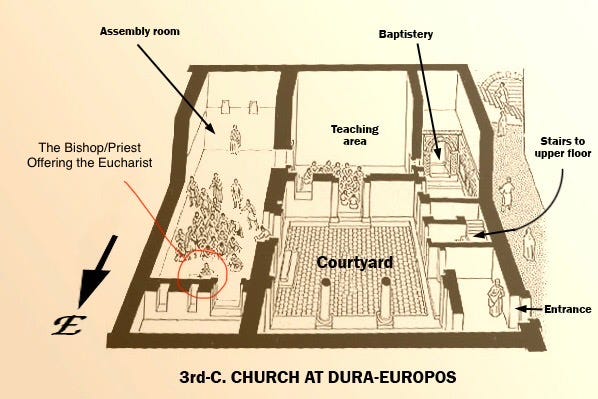
With these points in mind, can we conclude that they, likewise, resembled ‘the burning ancient city of Sodom”? The very earliest Orthodox Christians who were forced to worship in secret, within houses, as their lives were on the line; yet were courageous to not only preserve their faith; but even face martyrdom!
Granted, these are just a few examples of many more that are for another essay. As a faithful son of the Church, and in love, I humbly entreat our beloved fathers, and my brother deacons, and even the laity, to come to repentance on this matter; as such vanity only harms the body of Christ and does unity no good. Such words lack love, and the Spirit of Christian fellowship and fraternity. Let us close with the words from Tslote Haymanot:
“We repudiate all the words of heretics and all schisms and transgressions of the law, because they are for us impure.”
Sibhat leAb, weWeld, weMenfis Kidus; Ahudu Amlak. Amen.
Footnotes:
1 — Augustine, Sermon on the Liturgical Seasons; 195.2. Cited in: Malaty, Fr. T. Y. (2023). Catechism of the Coptic Orthodox Church (Vol. 1). St. George Coptic Orthodox Church, Sporting, Alexandria, and Queen St. Mary and Prince Tadros Coptic Orthodox Church. Pg. 436.
2 — Augustine, 195.5. Cited in: Malaty, Fr. T. Y. (2023). Catechism of the Coptic Orthodox Church (Vol. 1). St. George Coptic Orthodox Church, Sporting, Alexandria, and Queen St. Mary and Prince Tadros Coptic Orthodox Church. Pg. 436.
3 — Malaty, Fr. T. Y. (2023). Catechism of the Coptic Orthodox Church (Vol. 1). St. George Coptic Orthodox Church, Sporting, Alexandria, and Queen St. Mary and Prince Tadros Coptic Orthodox Church. Book 3:1:473. Pg. 385-386.
4 — De praescriptionibus adversus haereticos, chapter XX.
5 — Malaty, Fr. T. Y. (2023). Catechism of the Coptic Orthodox Church (Vol. 1). St. George Coptic Orthodox Church, Sporting, Alexandria, and Queen St. Mary and Prince Tadros Coptic Orthodox Church. Book 3:1:467. Pg. 381.
6 — An anonymous Paschal homily in the tradition of Origen; Thomas Halton, The Church (Message of the Fathers of the Church, vol. 4) (Wilmington, Del.: M. Glazier, 1985): p. 87.
7 — Irenaeius. Against Heresies (Book I, Chapter X). Translated by Alexander Roberts and William Rambaut. From Ante-Nicene Fathers, Vol. 1. Edited by Alexander Roberts, James Donaldson, and A. Cleveland Coxe. (Buffalo, NY: Christian Literature Publishing Co., 1885.) Revised and edited for New Advent by Kevin Knight. <https://www.newadvent.org/fathers/0103110.htm>.
8 — Jerome. Letter 146. Translated by W.H. Fremantle, G. Lewis and W.G. Martley. From Nicene and Post-Nicene Fathers, Second Series, Vol. 6. Edited by Philip Schaff and Henry Wace. (Buffalo, NY: Christian Literature Publishing Co., 1893.) Revised and edited for New Advent by Kevin Knight. <https://www.newadvent.org/fathers/3001146.htm>.
9 — Alexander’s Letter to Alexander of Byzantium; Section V. A.D.323-324.
10 — Alexander’s Letter to Alexander of Byzantium; Section IX. A.D.323-324.
11 — Alexander’s Letter to Alexander of Byzantium; Section IX. A.D.323-324.
12 —Alexander’s Letter to Alexander of Byzantium; Section IX. A.D.323-324.
13 —https://copticorthodox.church/en/2024/03/07/general-session-of-the-holy-synod-2024-in-logos/
14 — Cyprian of Carthage, On the Unity of the Catholic Church 1.6. (ANF 5:423). Malaty, Fr. T. Y. (2023). Catechism of the Coptic Orthodox Church (Vol. 1). St. George Coptic Orthodox Church, Sporting, Alexandria, and Queen St. Mary and Prince Tadros Coptic Orthodox Church. Book 3:6:547. Pg. 439.
15 — https://biblehub.com/greek/4978.htm
16 — https://biblehub.com/interlinear/1_corinthians/11-18.htm
17 — Jerome, PL 26:633. Cited in: Malaty, Fr. T. Y. (2023). Catechism of the Coptic Orthodox Church (Vol. 1). St. George Coptic Orthodox Church, Sporting, Alexandria, and Queen St. Mary and Prince Tadros Coptic Orthodox Church. Book 3:1:463. Pg. 379.
18 — Protocol Between The Coptic Orthodox Church (COC) And The Ethiopian Orthodox Tewhido Church (EOTC), April 1994. https://www.tewahedo.dk/litt/orthodox-ecumenical/commondec2008eng-Protocol-between-the-Coptic-Orthodox-Church-and-the-Ethiopian-Orthodox-Tewahedo-Church.pdf
19 — Homilies On Hebrews 30.2 (NPNF I/14:503).
20 — St. Ignatius of Antioch, Epistle to the Ephesians 13 (LCL 24:233).
21 — St. John Chrysostom, Homily 2 on Eutropius (NPNF I/9:256).
22 — Malaty, Fr. T. Y. (2023). Catechism of the Coptic Orthodox Church (Vol. 1). St. George Coptic Orthodox Church, Sporting, Alexandria, and Queen St. Mary and Prince Tadros Coptic Orthodox Church. Pg. 425.
23 — St. John Chrysostom. Homily on Matthew, 82.4.
24 — St. John Chrysostom. Homily on 1 Corinthians, 24.7.
25 — St. John Chrysostom. Homily on Ephesians 3.
26 — The Origin of the Iconostasis in Early Christian Churches in The Holy Land. Fanny Vito. https://actual-art.org/files/sb/07/Vitto.pdf
27 — Athanasius al-Makary. 2024. The Divine Liturgy – the Mystery of the Kingdom – Book 1. Theology & Academy Press. Pg. 126.

