In Orthodoxy, the Divine Liturgy is regarded as being Heaven on Earth. This is because Jesus Christ, truly and actuality, becomes present on the Altar in the Sacrament of the Holy Eucharist.
“When we see the Lord as a sacrifice placed on the altar, the priest praying over the sacrifice, and the congregation being cleansed by the precious blood, can you say that you are still standing with men on earth? … Did you not ascend directly to heaven?”
— St. John Chrysostom, Homilies on Ephesians 3.
Because of this, the various Liturgical Families of the Orthodox Church (Armenian, Coptic, Syriac, Tewahedo, etc.) use symbols in various forms to direct our attention to this mystical reality. Hence, the use of incense, candles, iconography, vestments, chanting, and the like to capture our senses.
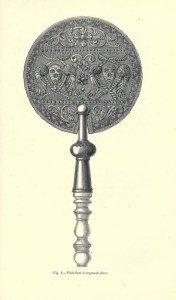
An ancient custom from the 1st – 4th century that was preserved amongst our sister churches the Armenians, Syrians, and Jacobites that we lost within the Coptic and Tewahedo tradition is the use of the Ripidion in the Altar (Though some Coptic Churches do process with them and currently use either a lefafa or a small flag as their substitute). The Ripidion is a liturgical fan usually made of metal and decorated with an image of the seraphim or cherubim to symbolize their presence since, again, Jesus is truly present in the Holy Eucharist on the altar. In some traditions, such as the Armenian, Syrian, and Malankara; small bells encircle the fan and are manipulated to swiftly ring during certain portions of the liturgy to symbolize the sound of the wings of the said heavenly beings (Ez 1:24).
This imagery is biblical. When the Prophet Isaiah had a vision of God on His throne in Glory, he saw as follows:
“Around Him stood seraphim; each one had six wings: with two he covered his face, with two he covered his feet, and with two he flew. And one cried to another and said, “Holy, holy, holy is the Lord of hosts; the whole earth is full of His glory.”
— Isaiah 6:2-3.
In addition, their use in the liturgy is ancient. They were initially made of either cloth or feathers, and were used by Deacons to swap away flies from the Holy Mysteries.
Hence, the Apostolic Constitutions commanded that:
“two of the deacons, on each side of the altar, hold a fan, made up of thin membranes, or of the feathers of the peacock, or of fine cloth, and let them silently drive away the small animals that fly about, that they may not come near to the cups.”
— Book VIII, XII.
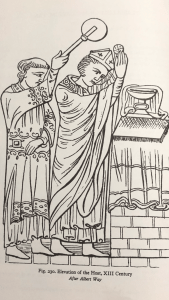
Their current use can also be seen within the Byzantine Rite by Deacons, Sub Deacons, and similar liturgical ministers during the small and great entrances. They are also elevated above the Deacon or Priest’s head diagonally during the reading of the Gospel. Yet, per locality, this custom may differ. Though not common today, they were also used within the Latin Tradition at the beginning of the 6th century, though this was abandoned by the 14th century.
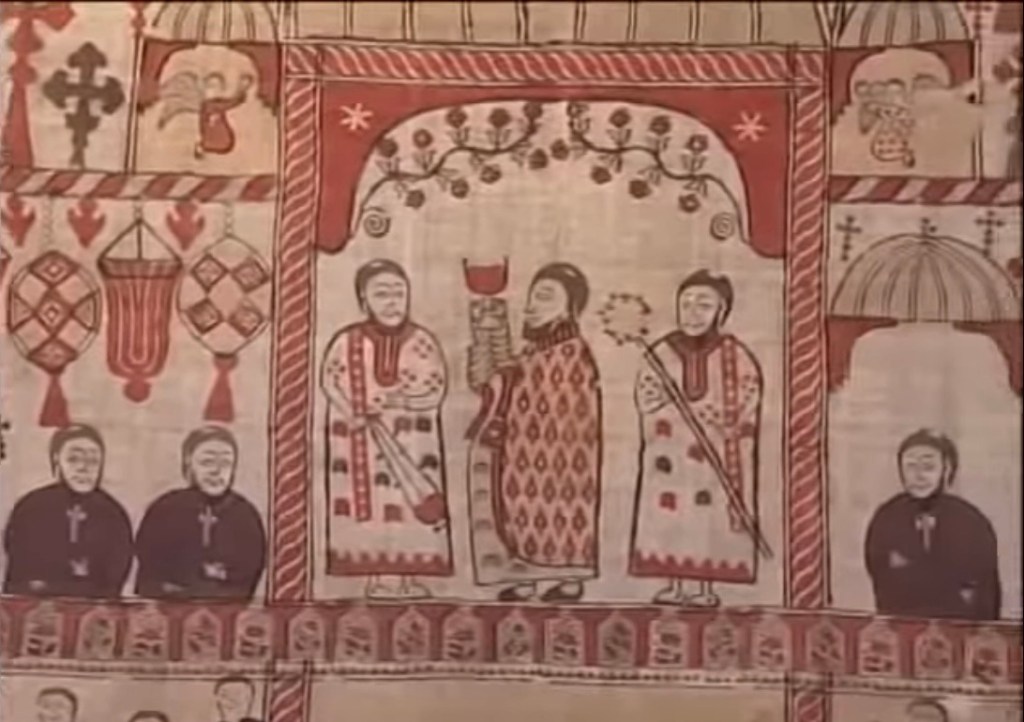
There is evidence of their existence within the Alexandrian Tradition as well. For instance, the Alexandrian Canons of St. Athanasius instruct:
A deacon shall not draw nigh the altar when an older than he is there ; but they shall always hold fans in their hands while the body is divided, continuing the while in prayer. And when the division is ended, one shall always stay behind and fan with the bumis wherewith he is clothed, from beginning to end of the offering (anaphora).
— Canon 39.
These can likewise be found in the Canons of Le Ibn Al-Assal, also known as the ‘Fetha Nagest’ in the Ethiopic tradition:
“The bishop will perform the liturgy while he is standing at the altar and the curtain open and the priests and deacons inside the altar room around him moving fans on the symbol of the wings of the two Cherubim (in the holy of holies of the temple). Two deacons should stand near the altar with a hand fan waving it to keep the flies away lest any of it falls in the cup!”
— Chapter 12, Canons 19-20.
As to when they fell into disuse in this context, or whether they were used universally within the Alexandrian Tradition is something worthy of investigation.
Additionally, the custom of Deacons offering incense on behalf of the priest has fallen into disuse in the vast majority of the Alexandrian (Coptic / Tewahedo) tradition; with the exception of the Coptic Church in Jerusalem. Universally, this custom still exists amongst the Armenians, Syrians, and Malankara. Outside of the Oriental Orthodox Church, this is likewise practiced within the Byzantine, Latin, and even Assyrian (Nestorian) traditions.
When commenting on the Jacobite liturgy, a certain George Bishop explained its symbolism:
The censer, which the deacon takes about the whole nave, signifies the care of God for all, and the condescension and sweet savour of Christ. The return again of the censer to the sanctuary signifies the fixedness and unwaveringness of the divine care, which remains as it is, without diminution; even as a lamp, which is not diminished by the taking from; it of many (lights).
— Two Commentaries on the Jacobite Liturgy, Page 16.
Evidence of this being the prerogative of Archdeacons within the Alexandrian tradition can be found within the Canons of St. Athanasius:
“At all incense(-offering) that is offered up in the holy place, morning and evening, especially at the divine anaphora, before the Gospel (lesson), the archdeacon shall take in his hand v a censer and fill it with coals and shall stand before the altar overagainst the Gospel (book) and into it shall be put for him the incense and he shall cause it to rise up until the Gospel be read. Then he shall go with the censer before the Gospel into the inner part of the holy place. It is not that the Lord hath need at all of incense. Nay, but man shall remember the incense of the ages of light, where (is) no hateful smell before the Lord, the God of the living, where (are) hymns of praise.”
— Canon 106.
Commenting on this, Coptic Professor Maged S. A. Mikhail (Deacon Severus) explains:
“… the norm until approximately the tenth century was for the deacon to read the Gospel, but as priests began to share in that role, the deacon was given the censer and offered incense as the priest read the pertinent lection for that day’s service. In general, while the deacon did not place the incense in the censer, once that task was accomplished by the celebrant, deacons were allowed to hold the censer and to offer incense and prayers. This is documented from at least the late patristic era through the early modern period in various contexts, and it may be still observed in some churches in Egypt today.”
— The Deacon as Concelebrant in Coptic Rite, Pg. 108 – 109.
At any rate, because Deacons do indeed symbolize the angels, it would justify why they’d assist the priest in offering the incense. Why is this? Because holy writ tells us:
“Then another angel, having a golden censer, came and stood at the altar. He was given much incense, that he should offer it with the prayers of all the saints upon the golden altar which was before the throne. And the smoke of the incense, with the prayers of the saints, ascended before God from the angel’s hand.”
— Revelation 8:3-4.
Another:
“Around Him stood seraphim; each one had six wings: with two he covered his face, with two he covered his feet, and with two he flew. And one cried to another and said, “Holy, holy, holy is the Lord of hosts; the whole earth is full of His glory.” The lintel was lifted up by the voice of those who cried out, and the house was filled with smoke.”
— Isaiah 6:2-4.
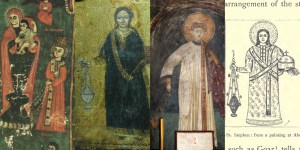
Considering these points discussed, it would explain why icons of St. Stephen and many other deacon saints are depicted holding the censor.
This concludes this post.
[Disclaimer: This post is for academic purposes only, and is not intended to argue in favor of the restoration of these practices in the Alexandrian tradition. Each Patriarch / Bishop has the prerogative to exercise discretion pertaining to what is practiced in his jurisdiction, save that it does not conflict with Church Dogma and Divine Law].

