The Dormition & Assumption of the Holy Theotokos: Is It Biblical?

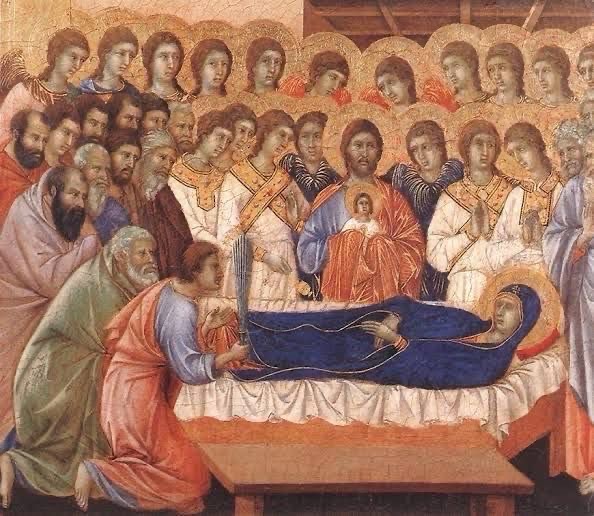
Today is the 21st day of the month of Tir. In the Tewahedo and Coptic Orthodox Churches, we celebrate the feast of St. Mary’s Dormition (Latin: dormitio; viz., a falling asleep).

The Orthodox Church teaches that at the very end of St. Mary’s life, and after many years of praying before the empty tomb of her beloved Son and God Jesus Christ, she was promised a glorious death. This eventually took place in the presence of Our Lord, His Angels, and the Apostles in her 60th year with the exception of St. Thomas who was preaching in India. The apostles who were present buried her body in Gethsemane, per the command of what they heard from the Holy Spirit. By the Divine intervention, St. Thomas was transported on a cloud before her deceased body in Gethsemane. He later saw the angels of God carrying St. Mary’s Body into heaven; placing her under the Tree of Life in the Eternal Garden of Paradise (c.f. Rev 22:1-5) that it may be united with her soul that was clothed in a veil of light by her Son. When he revealed what he saw to the rest of the apostles, they opened her tomb to not find her body; but to only smell a sweet fragrance. They rejoiced in this as this confirmed their faith in the Christ’s Resurrection by which we will all share in per the promise of our Lord. This is what the Apostles prayed for, hoped in, and preached to the world; despite the persecutions which came with it as they took comfort in what is to come.

But where is this event of the Assumption in the Holy Bible? Some hold to the opinion that perhaps the four gospels and the epistles were completed prior to this event. I happen to agree with this theory, especially given the Church’s Tradition which references the deaths of certain apostles — who were resurrected following their martyrdoms just to be present with the Theotokos for this moment.

Continue reading “The Dormition & Assumption of the Holy Theotokos: Is It Biblical?”
St. Athanasius’ defense of the Christ’s Divinity and Virgin Birth against the Jews

In St. Athanasius’ treatise ‘On the Incarnation’, he writes to a certain Macarius who was a proselyte to Christianity. Being inexperienced in apologetics, St. Athanasius had instructed him through this work to guide him on the Church’s teaching regarding the Omnipotence of the Word and His Incarnation. This was a doctrine which was challenged by both Jews and Gentiles alike; as it was a radical change from what was taught by history’s greatest philosophers, and exceeded human rationality.

For this particular post, we will be examining St. Athanasius’ rebuttal of the Jews, and how he proved the Incarnation from Holy Writ.


To initiate his rebuttal, he first addressed the Jew’s skepticism of Christ’s Life, Death, and Resurrection. He opens by appealing to the Old Testament scriptures; as they are shared by both Christians and the Jews alike since both religions revere them as being God inspired and therefore: authoritative, infallible, and inerrant. 

To cite him directly:

“First, then, we will consider the Jews. Their unbelief has its refutation in the Scriptures which even themselves read; for from cover to cover the inspired Book clearly teaches these things both in its entirety and in its actual words”

~ (On the Incarnation, Chapter VI). 

Following this, he claims that the Prophets foretold Christ’s Virgin Birth; and cites prophets such like Isaiah and Moses. 

Citing the Prophet Isaiah, he said:

“Prophets foretold the marvel of the Virgin and of the Birth from her, saying, “Behold, a virgin shall conceive and bear a son, and they shall call his name ‘Emmanuel,’ which means ‘God is with us’ (Isaiah 7:14)”

~ ibid.

Continue reading “St. Athanasius’ defense of the Christ’s Divinity and Virgin Birth against the Jews”

St. Mary’s Warning of Hell – Coptic Vision of The Theotokos

An Excerpt from the book ‘Saint Mary’s Modern Miracles’ published by ‘Pope Kyrillos VI’s Sons’ through St. Mena Monastery Press:

“It shall come to pass that before they call, I will answer; and while they are still speaking, I will hear” (Is 65:24).

Habib Farig developed a strong relationship with St. Mary and referred to her as the “Great Lady.” He would say of her that, as a mother, she knows the needs of us, her children, more than we do; he would also say that she knows what Christ has in His heart for us. He believed that having the Virgin’s presence in our lives gives us the hope to wait for the Lord’s miraculous and divine interventions. Through her intercessions, we see His Divine Power and blessings bestowed upon us.

Continue reading “St. Mary’s Warning of Hell – Coptic Vision of The Theotokos”