An Apologia for Iconography

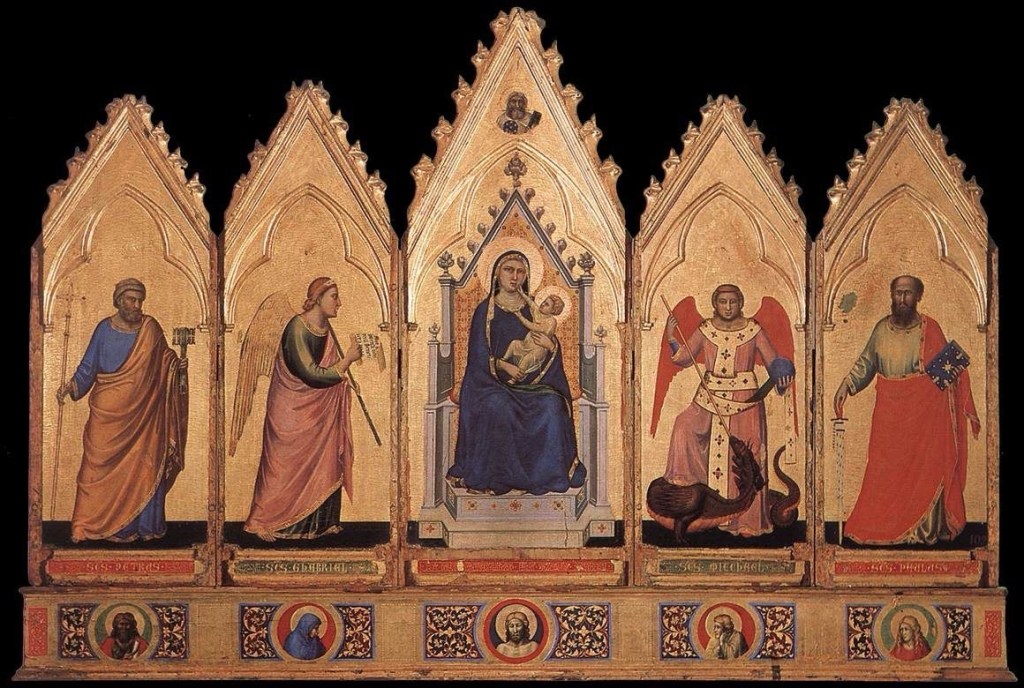
Iconography constitutes a defining element of Orthodox ecclesiastical architecture. The holy icons can be found on walls, ceilings, domes, windows; and are even on liturgical vestments of priests and deacons, the curtain before the altar, bibles & gospel books, and the holy vessels. The icons vary in what they depict, namely; The Holy Trinity, the Incarnate Word -Jesus Christ, St. Mary, the Angels, and the various Saints canonized by the Church. They are rich in color, convey theological truths, and illustrate events from sacred scripture or the lives of the saints.

Because the Orthodox decorate their churches in this fashion, and venerate the persons depicted, charges of idolatry have been made by Non-Believers, namely; Muslims, Jews, Jehovah’s Witnesses, certain Protestant sects, and the like. In the case of the said groups who uphold the Bible to be authoritative, with the exception of Islam, they refer to Sacred Scripture and accuse the Orthodox of not following the Bible and God’s Holy Commandments. A common source for their claim is Exodus 20:2-6, which we will review in detail briefly.

It is worth noting that, for the Orthodox, the charges of idolatry are appalling and even offensive to pious ears. This is because the Church, being the Body of Christ, confesses the Holy Scriptures to be Divinely Inspired, Inerrant, and Infallible. Wherefore, to the Church, the faith revealed by God through the Bible is without compromise (c.f. 2 Timothy 3:16).

Thus, the Holy Church continues in its sacred doctrines, especially regarding there being One God: The Father, Son, and Holy Spirit, One in Essence. This was the faith by which the Apostles, Confessors, Martyrs, and Early Church Fathers diligently taught, preserved, and defended; even to the point of blood.

Granted, because the Church is careful in her reverence for the sacred scriptures and the persons who preserved the true faith that can be found within them; then she also cares for the very teachings of the same persons that handed down the spotless dogmas to us. This is what earns the Church the title: “Orthodox”. This also explains why the Church professes the Nicene-Constantinopolitan Creed every Sunday to disqualify any idea of there another God, as polytheism conflicts with Church dogma and the Gospel Message at large.

Continue reading “An Apologia for Iconography”

St. Athanasius’ defense of the Christ’s Divinity and Virgin Birth against the Jews

In St. Athanasius’ treatise ‘On the Incarnation’, he writes to a certain Macarius who was a proselyte to Christianity. Being inexperienced in apologetics, St. Athanasius had instructed him through this work to guide him on the Church’s teaching regarding the Omnipotence of the Word and His Incarnation. This was a doctrine which was challenged by both Jews and Gentiles alike; as it was a radical change from what was taught by history’s greatest philosophers, and exceeded human rationality.

For this particular post, we will be examining St. Athanasius’ rebuttal of the Jews, and how he proved the Incarnation from Holy Writ.


To initiate his rebuttal, he first addressed the Jew’s skepticism of Christ’s Life, Death, and Resurrection. He opens by appealing to the Old Testament scriptures; as they are shared by both Christians and the Jews alike since both religions revere them as being God inspired and therefore: authoritative, infallible, and inerrant. 

To cite him directly:

“First, then, we will consider the Jews. Their unbelief has its refutation in the Scriptures which even themselves read; for from cover to cover the inspired Book clearly teaches these things both in its entirety and in its actual words”

~ (On the Incarnation, Chapter VI). 

Following this, he claims that the Prophets foretold Christ’s Virgin Birth; and cites prophets such like Isaiah and Moses. 

Citing the Prophet Isaiah, he said:

“Prophets foretold the marvel of the Virgin and of the Birth from her, saying, “Behold, a virgin shall conceive and bear a son, and they shall call his name ‘Emmanuel,’ which means ‘God is with us’ (Isaiah 7:14)”

~ ibid.

Continue reading “St. Athanasius’ defense of the Christ’s Divinity and Virgin Birth against the Jews”

The Importance of Studying Scripture

St. Paul tells us: “All Scripture is given by inspiration of God, and is profitable for doctrine, for reproof, for correction, for instruction in righteousness, that the man of God may be complete, thoroughly equipped for every good work” ( 2 Timothy 3:16-17).

In light of the Apostle’s words, the study of scripture is evidently of great significance; considering if our goal is to grow in holiness and come to the knowledge of God, His love for us, and His Divine Will — i.e. our very salvation.

The Jewish scribe and prophet Jesus Ben Sirach tells us:

“How different is the man who devotes himself To the study of the law of the Most High. He will seek out the wisdom of all the ancients And be occupied with their prophecies. He will preserve the discourse of notable men And penetrate the subtleties of parables. He will seek out the hidden meanings of proverbs And be engaged in the riddles of parables. He will serve in the midst of great men And will appear before rulers. He will travel through the land of foreign nations And test the good and evil among men. He will give his heart to rising early Before the Lord who created him, And will make supplication to the Most High; And he will open his mouth in prayer And make supplication for his sins. If the great Lord wills, He will be filled with the Spirit of understanding. He will pour forth words of His wisdom, And in prayer he will give thanks to the Lord. He will direct his counsel and knowledge aright, And he will reflect on His hidden things. He will reveal instruction in his teaching And boast in the law of the Lord’s covenant.” (Wisdom of Sirach 39:1-8).

There are also several church fathers that speak on the relevance of studying scripture.

Continue reading “The Importance of Studying Scripture”