
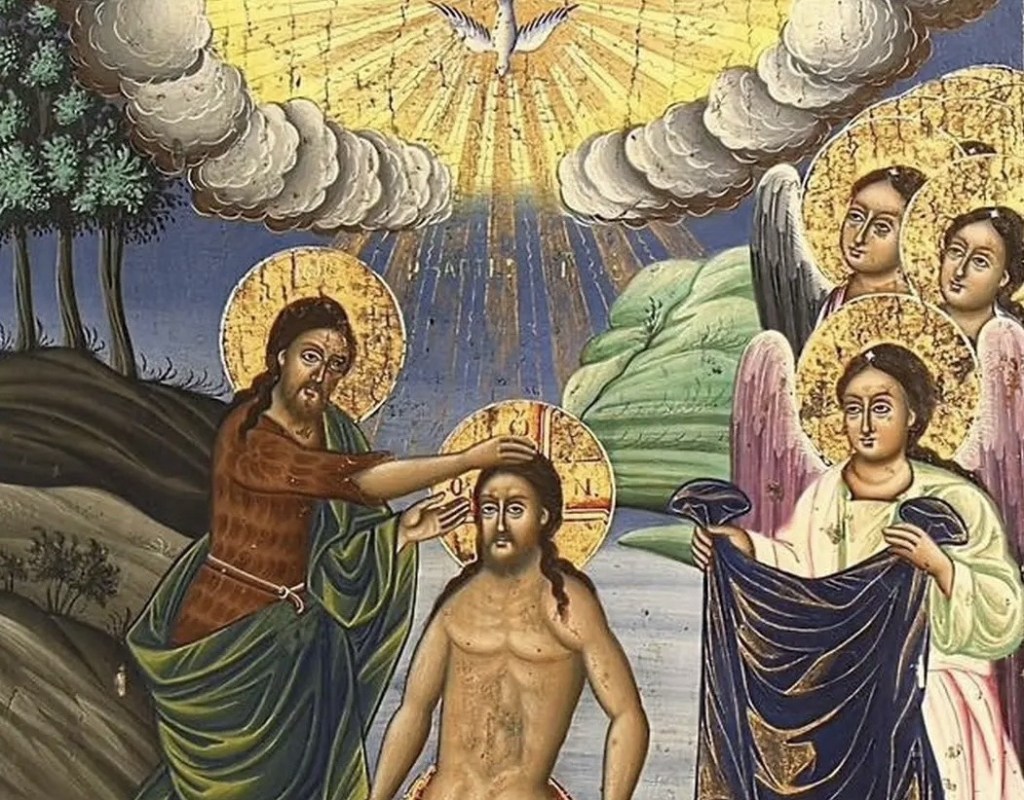
When our Lord traveled from Galilee to the River Jordan , His cousin St. John the Baptist was preaching the necessity of repentance. Those that accepted the message of St. John would be baptized in water while also publicly confessing their sins (Mt 3:5-6). The rite of immersion in water was something which was shared with a certain Jewish sect known as the Essenes. Though debated, some scholars believe that St. John the Baptist may have been an Essene himself with his own following, or at least influenced by them; given not only their commonality in using water, but the use of apocalyptic language.
Now, with these words in mind: the baptism by which the forerunner was administering was very limited, as it was incapable of regenerating the soul, lacking the Grace of the Holy Spirit. Hence, it was not the Christian Sacrament of Holy Baptism.
To cite the Baptist directly:
“I indeed baptize you with water unto repentance, but He who is coming after me is mightier than I, whose sandals I am not worthy to carry. He will baptize you with the Holy Spirit and fire.”
– Matthew 3:11
As we know from Divine Inspiration, Jesus was not in need of repentance, as He was without Sin (c.f. 1 Peter 2:22). This explains the objection of the Baptist: “I need to be baptized by You, and are You coming to me?” (Matthew 3:14). These words alone demonstrate the sinlessness of the Lord. Yet, the Lord, in His humility, willfully condescended to the form of a sinner.
Or, to cite St. Gregory of Thaumaturgus:
Continue reading “Why Christ Entered the Waters: A Doctrinal Study of Revelation and Fulfillment”“He approached him as one of the multitude, and humbled Himself among the captives though He was the Redeemer, and ranged Himself with those under judgment though He was the Judge, and joined Himself with the lost sheep though He was the Good Shepherd who on account of the straying sheep came down from heaven, and yet did not forsake His heavens, and was mingled with the tares though He was that heavenly grain that springs unsown.”
– On the Holy Theophany, or on Christ’s Baptism, Homily IV.


 Faith Unto Ages