In Orthodox Christian theology, there is a form of biblical exegesis that is used to pinpoint prophetic symbols, events, and statements which foreshadow the Word Incarnate known as Old Testament typology. Though there are multiple examples that we could examine, we will only be discussing one within this essay, namely: Noah’s Ark. The prophet Moses tells us that during the antediluvian period, God was displeased with mankind due to their accumulation of wicked deeds, practices, and thoughts. In the words of our Blessed Lord:
“I will blot out man whom I created from the face of the earth, from man to cattle, and from the creeping things to the birds of heaven, for I am grieved I made them” (Genesis 6:7).
A source of God’s outrage was that man — who was granted the gift of immortality — was tragically returning to corruption, sin, and death as a result of the fall. Therefore, man was in fact subjecting themselves to these perils and as a result was consequently perishing. St. Athanasius gave us an image of sin running rampant upon the earth when he said:
“[Man] having to begin with been inventors of wickedness and called down upon themselves death and corruption; while later on, having turned aside to wrong and exceeding all lawlessness, and stopping at no one evil but devising all manner of new evils in succession, they have become insatiable in sinning. For there were adulteries everywhere and thefts, and the whole earth was full of murders and plunderings. And as to corruption and wrong, no heed was paid to law, but all crimes were being practised everywhere, both individually and jointly. Cities were at war with cities, and nations were rising up against nations; and the whole earth was rent with civil commotions and battles; each man vying with his fellows in lawless deeds. Nor were even crimes against nature far from them…”
– On the Incarnation, 5.3-8.
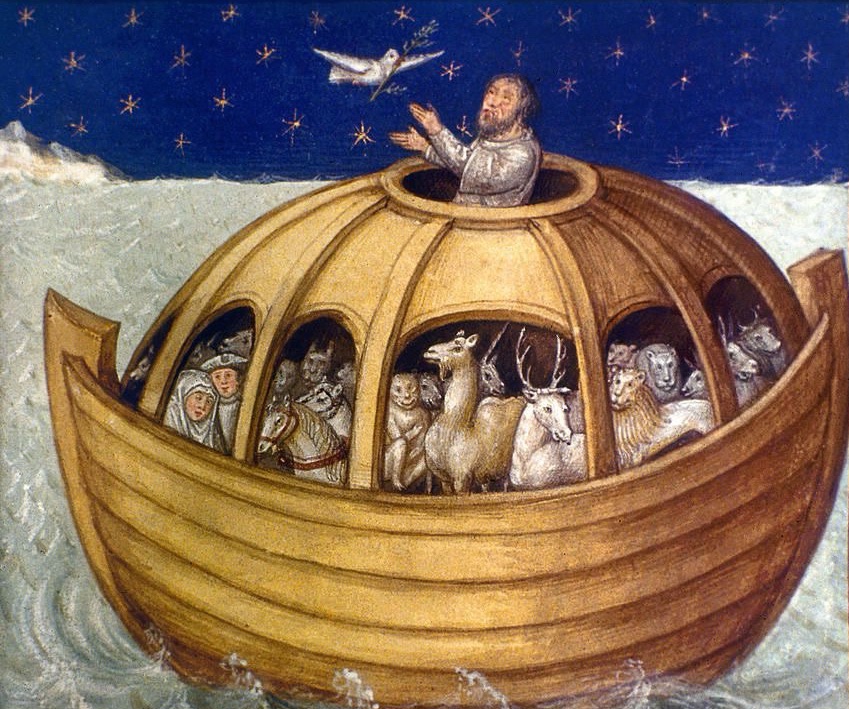
Due to God finding favor with Noah (Gen 6:8), and because the earth “was corrupt; for all flesh corrupted their way on the earth” (Genesis 6:12), He commanded Noah to make an ark for himself and his family, as well animals of each kind in pairs of male and female; as His Divine Wrath was going to be unleashed upon the earth by a flood. This ark was made of timber (Gen 6:14), which probably took at least 120 years to build (Gen 6:3; cf. Gen 7:-13). It was by the Ark which passed through the waters that all onboard were saved (Gen 7:23; cf. 1 Peter 3:20).
It is worth mentioning that the Ark was an image of God’s provision, i.e. deliverance from judgement. Considering that Noah was a preacher of righteousness in the ancient world, likely cautioning of the wrath to come (2 Peter 2:5), the Ark was a symbol of his warning. Mankind, having free will, had the option to accept or reject that salvation of wood which was in their very midst within the 120 year grace period.
Being that the Old Testament is fulfilled in the New, man had likewise been called to repentance in the earth’s final stage by the Incarnate Word, Jesus Christ, and His Apostles. He willfully took the form of a servant even though He was the Creator of all things (Phil 2:7), and carried to the cross our sins; taking a form of punishment in our place that we deserved. Yet, through His own free will He gave His Body to torture, that by His pure blood, the wood of the cross might be consecrated and save all of those that are still dead in their sins. All of this He did out of love and mercy; eager to deliver man from eternal punishment (Col 3:5-8; Rom 1:18-32; 5:9; Jn 3:36).
The Church Father Justin Martyr expands on this in his writings and not only supports the idea of the Ark being a prefiguration of the cross, but even sees Noah as being a type of Christ. He explains:
“For Christ, being the first-born of every creature, became again the chief of another race regenerated by Himself through water, and faith, and wood, containing the mystery of the cross … as was previously demonstrated by all the symbols of the deluge; I mean, that by water, faith, and wood, those who are afore-prepared, and who repent of the sins which they have committed, shall escape from the impending judgment of God.”
– Dialogue with Trypho, Chapter 138.
Evidently, the Sacrament of Baptism was within the mind of the Saint, thus his reference to being ‘regenerated…through water”. It is relevant because it was instituted by Christ who Himself sanctified the waters that we might partake in His baptism and find favor with God. As the dove came to Noah with an olive branch, showing God’s favor with him (Genesis 8:11), the Father likewise showed favor with the Son when the Holy Spirit descended upon Him like a dove (Luke 3:22). [More on this HERE]. Thus the importance of baptism which saves (1 Peter 3:21), as it is through this sacred sacrament that we “put on Christ” (Gal 3:27).
The Church Father St. Augustine likewise sees the flood narrative as not only a prefigurement of Christ, but His very Church which sails through the world:
“Moreover, inasmuch as God commanded Noah, a just man, and, as the truthful Scripture says, a man perfect in his generation,—not indeed with the perfection of the citizens of the city of God in that immortal condition in which they equal the angels, but in so far as they can be perfect in their sojourn in this world,—inasmuch as God commanded him, I say, to make an ark, in which he might be rescued from the destruction of the flood, along with his family, i.e., his wife, sons, and daughters-in-law, and along with the animals who, in obedience to God’s command, came to him into the ark: this is certainly a figure of the city of God sojourning in this world; that is to say, of the church, which is rescued by the wood on which hung the Mediator of God and men, the man Christ Jesus.”
– City of God, Chapter 26.
And another by Origen:
“Therefore Christ, the spiritual Noah, in his ark in which he frees the human race from destruction, that is, in his Church, has established in its breadth the number fifty, the number of forgiveness. For if he had not given forgiveness of sins to those who believe, the breadth of the Church would not have been spread around the world. But the number thirty of the height contains a mystery like the number three hundred. For what a hundred multiplied by three makes there, ten multiplied by three makes here. But the sum is reduced to one, the number of the total construction, because “there is one God the Father from whom are all things, and one Lord” and “one faith of the Church, one baptism, one body and one spirit” and all things hasten to the one goal of the perfection of God.”
– Homily II, On Genesis and Exodus.
+++ Glory to Jesus Christ the King of Kings!
 Faith Unto Ages