
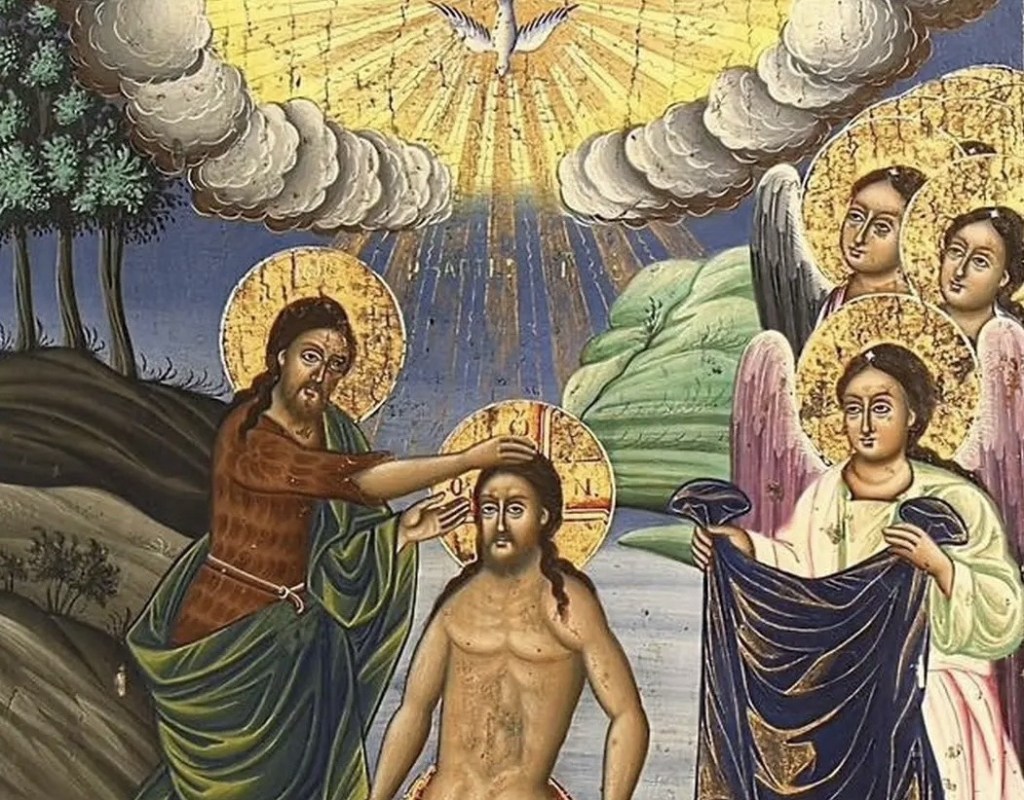
When our Lord traveled from Galilee to the River Jordan , His cousin St. John the Baptist was preaching the necessity of repentance. Those that accepted the message of St. John would be baptized in water while also publicly confessing their sins (Mt 3:5-6). The rite of immersion in water was something which was shared with a certain Jewish sect known as the Essenes. Though debated, some scholars believe that St. John the Baptist may have been an Essene himself with his own following, or at least influenced by them; given not only their commonality in using water, but the use of apocalyptic language.
Now, with these words in mind: the baptism by which the forerunner was administering was very limited, as it was incapable of regenerating the soul, lacking the Grace of the Holy Spirit. Hence, it was not the Christian Sacrament of Holy Baptism.
To cite the Baptist directly:
“I indeed baptize you with water unto repentance, but He who is coming after me is mightier than I, whose sandals I am not worthy to carry. He will baptize you with the Holy Spirit and fire.”
– Matthew 3:11
As we know from Divine Inspiration, Jesus was not in need of repentance, as He was without Sin (c.f. 1 Peter 2:22). This explains the objection of the Baptist: “I need to be baptized by You, and are You coming to me?” (Matthew 3:14). These words alone demonstrate the sinlessness of the Lord. Yet, the Lord, in His humility, willfully condescended to the form of a sinner.
Or, to cite St. Gregory of Thaumaturgus:
“He approached him as one of the multitude, and humbled Himself among the captives though He was the Redeemer, and ranged Himself with those under judgment though He was the Judge, and joined Himself with the lost sheep though He was the Good Shepherd who on account of the straying sheep came down from heaven, and yet did not forsake His heavens, and was mingled with the tares though He was that heavenly grain that springs unsown.”
– On the Holy Theophany, or on Christ’s Baptism, Homily IV.
Yet, He then commands the Baptist;
“Permit it to be so now, for thus it is fitting for us to fulfill all righteousness.”
– Matthew 3:15.
And what was it that our Lord was referencing? Those words: “fulfill all righteousness”? That which convinced the righteous baptizer? Let us now survey our Lord’s request in detail.
The Mystery of the Trinity: Christ requested baptism for the purpose of revealing the mystery of His Divinity as the Incarnate Word; that which He shared with the Father and the Holy Ghost. The Apostle Matthew therefore tells us:
“When He had been baptized, Jesus came up immediately from the water; and behold, the heavens were opened to Him, and He saw the Spirit of God descending like a dove and alighting upon Him. And suddenly a voice came from heaven, saying, “This is My beloved Son, in whom I am well pleased.”
– Matthew 3:16-17.
Commenting on this subject matter, the Church in her wisdom through her sons, the Church Fathers, tell us the following:
“On this day our Lord Jesus Christ was baptized in the River Jordan by John the Baptist. And the festival which is kept on this day is called in the tongue of the Greeks “Ipiphany,” which is, being interpreted, “the appearance of the Godhead,” because on this day appeared the mystery of the Holy Trinity… We ask our Lord Christ to cleanse us from all our sins, and to reveal the glory of His Godhead in our hearts even as He revealed it in the River Jordan.”
– The Ethiopian Orthodox Synaxarium, Tir 11.
To again reference St. Hippolytus, he demonstrates how water is an element of significant importance; exemplifying how it washes and nourishes all of the fruits of the earth. This element also took its seat above the Heavens:
“Praise Him, you heavens of heavens, And you waters above the heavens.”
– Psalms 148:4.
He then likens Christ to being the rain which came down from heaven:
“Christ, the Maker of all, came down as the rain, and was known as a spring, and diffused Himself as a river, and was baptized in the Jordan.”
– The Discourse on the Holy Theophany, 2.
This is consistent with the words of the Prophet Hosea:
“Let us know, let us pursue That we might know the Lord. We shall find Him ready as the daybreak, And He will come to us As the early and latter rain to the earth.”
– Hosea 6:3.
But for what reason did St. Hippolytus call our Lord a spring of water, save Him being not only water’s Creator; but it’s very giver? Would this not mean that He is never without water? Is He not that Living Water itself which nourishes the soul scorched by sin; granting it Eternal Life? (c.f. John 4:10,14). Is not the Living Water His Pure Spirit?
“ He who believes in Me, as the Scripture has said, out of his heart will flow rivers of living water.” But this He spoke concerning the Spirit, whom those believing in Him would receive; for the Holy Spirit was not yet given, because Jesus was not yet glorified.” – John 7:38-39.
“Of this salvation the prophets have inquired and searched carefully, who prophesied of the grace that would come to you, searching what, or what manner of time, the Spirit of Christ who was in them was indicating when He testified beforehand the sufferings of Christ and the glories that would follow.” – 1 Peter 1:10-11.
Fulfilling Old Testament Typologies: The baptism of our Lord in the Jordan also fulfills Old Testament prophecies which were illustrated in the form of symbols which pointed to Him.
- Israel crossing the Jordan: The waters divided at the Lord’s command due to His Glory being manifested through the Ark of the Covenant – which was held by Priests while the children of Israel followed. They were led into the Promised Land by God that they might take the land which belonged to them (Joshua 3:17). Likewise, the waters were divided by the command of the same Word who became Incarnate, whose Pure Body was held in the hands of John the Baptist – who was of a priestly lineage (Luke 1:8-9), something by which not even the priests of old were worthy (c.f. Matthew 3:11).
2. St. Hippolytus teaches that Jesus was also baptized so that the Father would publicly declare His love for His Son, which is why the Holy Spirit appeared in the form of a dove. Why? The saint lectures:
“For as in the ark of Noah the love of God toward man is signified by the dove, so also now the Spirit, descending in the form of a dove, bearing as it were the fruit of the olive, rested on Him to whom the witness was borne. For what reason? That the faithfulness of the Father’s voice might be made known, and that the prophetic utterance of a long time past might be ratified. And what utterance is this? “The voice of the Lord (is) on the waters, the God of glory thundered; the Lord (is) upon many waters.” (Ps 29:3). And what voice? “This is my beloved Son, in whom I am well pleased.” ‘This is He who is named the son of Joseph, and (who is) according to the divine essence my Only-begotten’”
– The Discourse on the Holy Theophany, 7.
And notice the saint’s reference “the fruit of the olive”, for it was by olive oil that kings of Israel were anointed and received the Holy Ghost during their appointment. Hence, heaven had declared Jesus to be the King of Israel, and by extension, the entire world as He is its very Creator.
“Then Samuel took the horn of olive oil and anointed him in the midst of his brothers; and the Spirit of the Lord came upon David from that day forward. So Samuel arose and went to Ramah.”
– 1 Kingdoms 16:13.
3. Our Lord had fulfilled what had took place when the nation of Israel approached the land of Marah, where the water was bitter and non-drinkable. When Moses cast the wood into the water, it was made sweet and drinkable.
“Now when they came to Marah, they could not drink the waters of Marah, for they were bitter. Therefore he named that place Bitterness. Then the people complained against Moses, saying, “What shall we drink?” So he cried to the Lord, and the Lord showed him a tree. When he cast it into the waters, the waters were made sweet. There He made a statute and an ordinance for them.“ – Exodus 15:23-25.
Likewise, Patristic thought explains how Christ had cleansed the waters of the world through His baptism as God Incarnate, that we might partake in His baptism which incorporates us into Him.
Tertullian: We see baptism blest by the water in Christ. How mighty is the grace of water, in the sight of God and His Christ, for the confirmation of baptism! – Types of the Red Sea, and the Water from the Rock, Chapter 9.
St. Ignatius of Antioch: He was born and baptized, that by His passion He might purify the water. – Epistle to the Ephesians, Chapter 18.
This concludes this post.
~ Deacon Christian Azarias
 Faith Unto Ages
One thought on “Why Christ Entered the Waters: A Doctrinal Study of Revelation and Fulfillment”
Comments are closed.