Prior to going back to Egypt to liberate the children of Israel from captivity, the Prophet Moses had an encounter with God on Mount Horeb. Seeing the glory of God being manifested through a burning bush, he fell to his face in fear of looking at God, as God had revealed to him: “I am the God of thy father, the God of Abraham, the God of Isacc, and the God of Jacob” (Exodus 3:6). God revealed to him that He was, out of His love and compassion, displeased of Israel’s bondage to captivity, and that He would deliver them and bring them to a land which is good, large, and flowing with milk and honey (Ex 3:7-9). After God had told Moses that He would send him before Pharaoh to deliver the nation of Israel, he had doubts pertaining to his capability; and also questioned how he should identify God when the Israelites were to ask of His Name. In response, the Lord told the Prophet: “I AM THAT I AM … thus you should tell the children of Israel; ‘I AM has sent me unto you’” (Ex 3:14).
This Holy Name given by God, which was revealed to Moses by His Word, emphasizes that “God is the supreme existence, and is therefore unchangeable, the thing that He made He empowered to be, but not to be supremely like Himself” (Augustine of Hippo, The City of God, Book 12, chap. 2). Because of this sacred truth, St. Moses tells us that it was “In the beginning, God created the Heavens, and the Earth” (Genesis 1:1), as He is ever eternal, infinite, without beginning, without end, and the Creator of all things and the source of their very existence out of nothing – all by the Self-Same Word (Genesis 1:3-31). St. Augustine tells us that when God created all things, “He communicated a more ample, to others a more limited existence, and thus arranged the natures by ranks” (The City of God, Book 12, chap. 2). In other words, when God created all things, He established a hierarchy; with man being the highest of all the carnal creatures, “For man is more honorable than any created thing…” (John Chrysostom. Homily 56 on the Gospel of John).
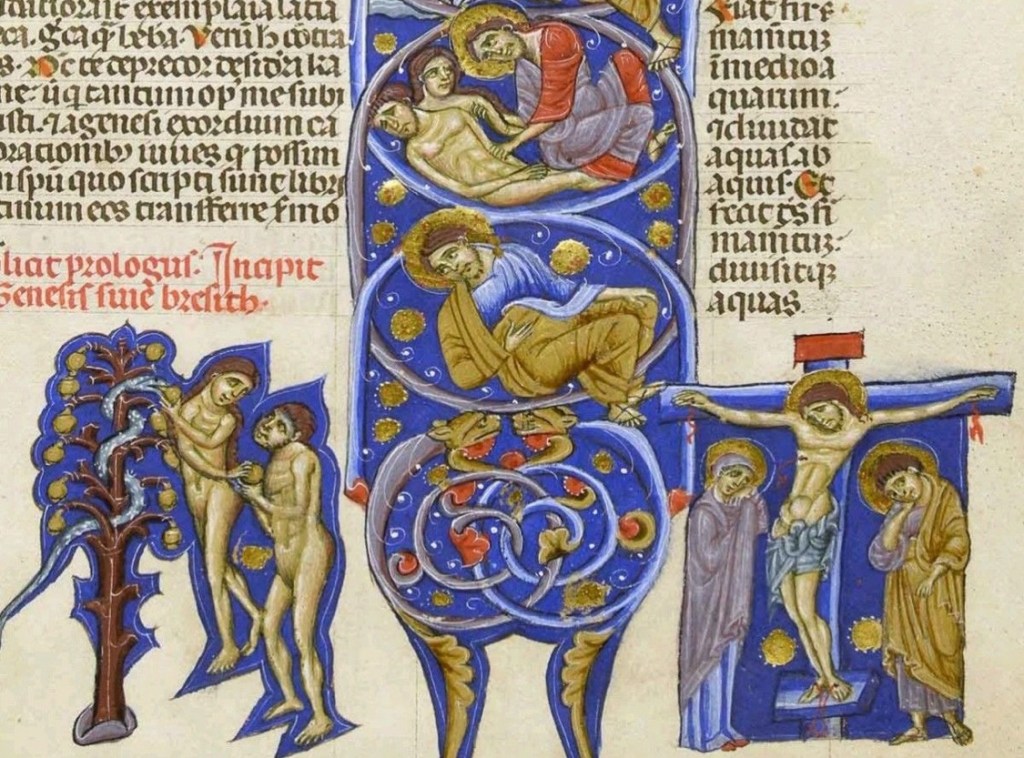
This is because Man was made in the Image and Likeness of God (Genesis 1:26-27). The father of the human race is Adam; from which came our first mother Eve (Genesis 2:21-23). Because they were both made in His Image, they were, by His Grace, made incorruptable, immortal, rational, and were granted authority over all creation below them.
To cite St. Athanasius: “He bestowed a grace which other creatures lacked–namely the impress of His own Image, a share in the reasonable being of the very Word Himself, so that, reflecting Him and themselves becoming reasonable and expressing the Mind of God even as He does, though in limited degree they might continue for ever in the blessed and only true life of the saints in paradise” (On the Incarnation, Chapter 1.3).
Given that Man is rational, God had issued a law to prevent them from losing the grace given them (Genesis 2:16-17).
St. Athanasius: “But since the will of man could turn either way, God secured this grace that He had given by making it conditional from the first upon two things–namely, a law and a place. He set them in His own paradise, and laid upon them a single prohibition. If they guarded the grace and retained the loveliness of their original innocence, then the life of paradise should be theirs, without sorrow, pain or care, and after it the assurance of immortality in heaven. But if they went astray and became vile, throwing away their birthright of beauty, then they would come under the natural law of death and live no longer in paradise, but, dying outside of it, continue in death and in corruption” (ibid).
And because Man knew the difference between right and wrong, God planted the tree of knowledge within the garden of paradise intentionally to test their obedience. To cite St. Basil the Great: “there needed to be a commandment to test our obedience” (On the Human Condition. Crestwood, N.Y., St. Vladimir’s Seminary Press, 2005. 77).
God had warned our first parents that eating of it would bring death, but as we are aware, this was disregarded by the deception of Eve by the Devil and Adam’s negligence. Consequently, the race of Adam began to perish, as they were now subject to Sin and Death; and as a result, they began to experience aging, suffering, pain, hunger, and death (Genesis 3:16-19). Man was thus, collectively, in bondage to this condition by the envy of the Devil (Wis 2:24). Though this may have seemed like a hopeless case, God had promised that His Word would be Incarnate of a woman to destroy death and sin (Genesis 3:15). The Word was the only proper candidate to redeem humanity, as He is also their Creator.
St. Athanasius: “the renewal of creation has been wrought by the Self-same Word Who made it in the beginning. There’ is thus no inconsistency between creation and salvation for the One Father has employed the same Agent for both works, effecting the salvation of the world through the same Word Who made it in the beginning” (On the Incarnation. Chapter 1:1).
Thus, the Word became Incarnate of St. Mary, a virgin, without the seed of man (Luke 1:34-35), and was born for our sake (Luke 2:11).
St. Athanasius: “He took our body, and not only so, but He took itdirectly from a spotless, stainless virgin, without the agency of human father–a pure body, untainted by intercourse with man” (On the Incarnation, Chapter 2:8).
That great apologist St. Irenaeus tells us that the Incarnation of a Virgin was a necessity, stressing that it proves that Jesus is, indeed, the promised Savior of the human race; making Him the New Adam. Commenting on the virgin birth, he writes:
“And as the protoplast himself Adam had his substance from untilled and as yet virgin soil (for God had not yet sent rain, and man had not tilled the ground (Gen 2:57)), and was formed by the hand of God, that is, by the Word of God, for all things were made by Him (John 1:3), and the Lord took dust from the earth and formed man; so did He who is the Word, recapitulating Adam in Himself, rightly receive a birth, enabling Him to gather up Adam [into Himself], from Mary, who was as yet a virgin”.
He continues:
“If then, the first Adam had a man for his father, and was born of human seed, it were reasonable to say that the Second Adam was begotten of Joseph. But if the former (Adam) was taken from the dust, and God was his Maker, it was incumbent that the latter also, making recapitulation in Himself, should be formed as man by God to have an analogy with the former (Adam), as respects of His origin” (Irenaeus. Against Heresies, III.22).
So in other words, if Adam truly had a human father, then it would make sense to say that Jesus was the biological son of Joseph. But because Adam was made from the ground without the seed of man by the Word of God, and because Jesus is called the Second, or Last Adam (1 Corinthians 15:45), then it is only logical that Jesus would also come from a Virgin and be born of her to reflect the First Adam which He created.
To further justify his argument, St. Irenaeus compares His mother, the ever Virgin Mary, the Theotokos, to Eve; to illustrate that she is truly the New Eve. He says:
“But Eve was disobedient, for she did not obey when as yet she was a virgin … having become disobedient, was made the cause of death, both to herself and the entire human race. So also did Mary, having a man betrothed [to her], and being nevertheless a virgin, by yielding obedience, became the cause of salvation, both to herself and the whole human race. And thus also it was the knot of Eve’s disobedience was loosed by the obedience of Mary. For what the virgin Eve had bound fast through unbelief, this did the virgin Mary set free through faith.”
In addition, in this same passage, he explains that because Jewish law considered a woman betrothed to the man his wife, nonetheless, she remained a virgin – as she was only under his care and did not engage in copulation. Yet, as stated previously, she still bore a child miraculously, showing that her betrodship to Joseph was a reversal, or inversion, of the first union.
Therefore, he says:
“because what is joined together could not otherwise be put asunder than by inversion of the process by which these bonds of union had arisen; so that the former ties be cancelled by the latter, that the latter may set the former again at liberty. And it has, in fact, happened that the first compact looses from the second tie, but that the second tie takes the position of the first which has been cancelled. For this reason did the Lord declare that the first should in truth be last, and the last first (Matthew 19:30)” (Irenaeus. Against Heresies, Chapter 22).
St. Irenaeus, using reductio ad absurdum rhetoric, argued that if heretics believe that Jesus was not the Second Adam, and born of a Virgin, then there was no real Incarnation of the Word. Those who reject the virgin birth “greatly error” as “they also reject the analogy [between Him and Adam]”.
Thus, he further argued:
“For if the one [who sprang] from the earth had indeed formation and substance from both the hand and workmanship of God, but the other not from the hand and workmanship of God, then He who was made after the image and likeness of the former did not, in that case, preserve the analogy of man, and He must seem an inconsistent piece of work, not having wherewith He may show His wisdom. But this is to say, that He also appeared putatively as man when He was not man, and that He was made man while taking nothing from man. For if He did not receive the substance of flesh from a human being, He neither was made man nor the Son of man; and if He was not made what we were, He did no great thing in what he suffered and endured. But this is to say, that He also appeared putatively as man when He was not man, and that He was made man while taking nothing from man. For if He did not receive the substance of flesh from a human being, He neither was made man nor the Son of man; and if He was not made what we were, He did no great thing in what He suffered and endured. He suffered and endured” (Irenaeus. Against Heresies, Chapter 22).
Therefore, again, to deny that Jesus is the Last Adam is to deny that the Incarnation took place; which deconstructs the Gospel message. For if the Word did not become Man, without change, to die in our place and to rise on the Third Day, then “your faith is vain, and you are yet in your sins” (1 Cor 15:17). On the contrary, Christ truly died and rose on the third day, in His very own human flesh, and as man, granted our race redemption. Thus, St. Paul’s words: “For since by man came death, by man also came the resurrection of the dead. For as in Adam all die, even so in Christ all shall be made alive” (1 Cor 15:21-22).
For Adam and Eve, and for us their children, this is victory for our race. For in the Incarnate Logos, our enemy, death, was destroyed (1 Corinthians 15:26). In the Ethiopian and Eritrean Orthodox Tewahedo tradition, we acclaim: “Rejoice, O Bethlehem, the land of the Prophets. For in you was born Christ, the Second Adam, so that He might bring the first Adam from the earth into Paradise and destroy the doom of death” (Ephraim the Syrian. Wudase Mariam, Monday Praises).
Through the Word Who created us, we who were “sown into corruption” have been granted the gift to be “rise in incorruption” (1 Corinthians 15:42). This is why St. Paul further said: “The first man Adam was made a living soul, the Last Adam was made a quickening Spirit” (1 Corinthians 15:45).
 Faith Unto Ages