“For those who have served well as deacons obtain for themselves a good standing and great boldness in the faith which is in Christ Jesus.” – 1 Timothy 3:13.
The word ‘Deacon’ comes from the Greek word ‘διάκονος’, meaning a servant or minister. Jesus says of the servant – “If anyone serves Me, let him follow Me; and where I am, there My servant will be also. If anyone serves Me, him My Father will honor” (John 12:26). In Orthodox theology, the Deacon is called to imitate Christ the Servant, who “did not come to be served, but to serve” (Mark 10:45).
Deacons were first mentioned in the Book of Acts, where the Apostles requested that the Church choose: “men of good reputation, full of the Holy Spirit and wisdom” (Acts 6:3). Granted, Deaconship is a calling, which is confirmed not by oneself, but the Church which elects him.
Deaconship is a call to self denial, to put away our selfish desires and wants for the needs of the Church and His sheep which He has entrusted to us to feed. It is not a position of power, an opportunity to boast, a platform for performance, a spotlight to stand on, or a place to compete with others. Rather, it is a sacred privilege to assist the priests and bishops to feed the Body of Christ, lest it go hungry.
Our holy mother, the Oriental Orthodox Church, has a hierarchal ranking system of clerics. This is not because one is superior to the other in worth, but because it is a team and a collaborative effort to serve the church in areas that she needs the most pastoral assistance. I will compare the ranking system of the churches and clarify their roles.
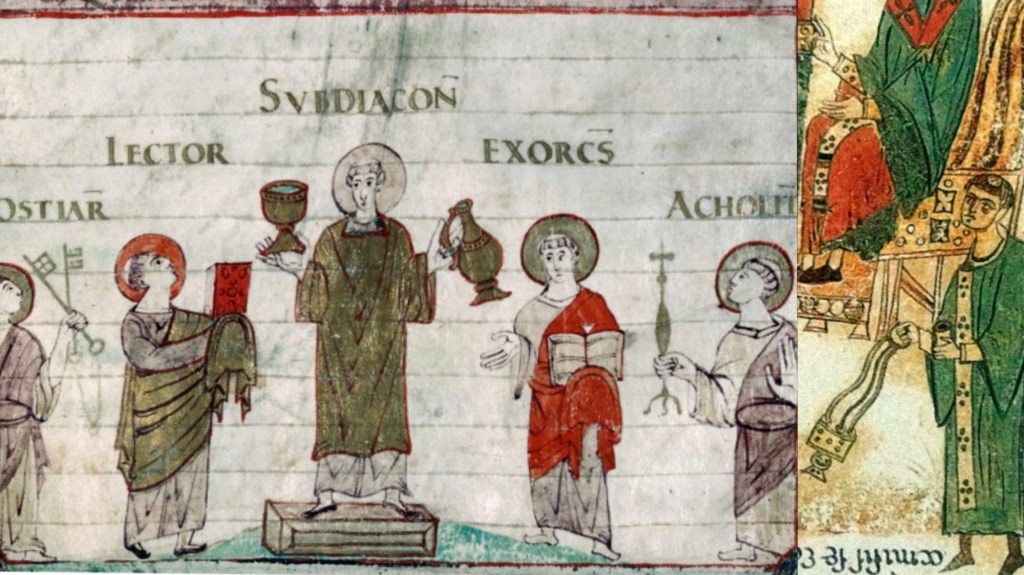
In the Coptic, Syriac, and Malankara traditions; the formal and canonical clerical ranks are the Reader, Sub Deacon, & the Deacon / Arch Deacon. These churches also share the rank of Epsaltos (Chanter), which would be the equivalent of a lay Acolyte or Altar Server.
These ranks were all existent within the Early Church. For instance, Eusebius says that in Rome there were “forty-six presbyters, seven deacons, seven sub-deacons, forty-two acolyths, fifty-two exorcists, readers, and door keepers” – (Church History, Book VI).
Chanter / Acolyte:
The rank of door keeper exists in both the Coptic and Ethiopian Church law known as “Fetha Nagest”, which refers to them “aliflusawiyan”, which is believed to be a corruption of the word Acolyte (See The Fetha Nagest by Abba Paulos, Pg 56). This rank is lower than the chanter, and has therefore been absorbed into the the rank in modern times in the Coptic, Syriac, and Malankara Churches. The rank of acolyte was preserved in the Armenian Orthodox Church’s hierarchal system – known as ‘Tabir’. The primary role of the chanter, however, is to learn the hymns to sing them to the congregation. In church, they wear a simple white tunic.
Reader
The reader was considered to be the first official stage or rank of the diaconate within the tradition of the churches mentioned above.
This is because the Church Fathers have defined this to be a formal clerical rank given that they historically had the role of being one of the primary teachers of the Scriptures in the Church, especially due to the high amount of illiteracy amongst the earliest Christians. Since the Church had this understanding, the Didascalia requested that the laity not only provide a salary for the priests and full rank deacons, but for the readers (Lectors).
“But if anyone wish to honour the presbyters also, let him give them a double (portion), as to the deacons; for they ought to be honoured as the Apostles, and as the counsellors of the bishop, and as the crown of the Church; for they are the moderators and councillors of the Church. But if there be also a lector, let him too receive with the presbyters. To every order, therefore, let every one of the laity pay the honour which is befitting him, with gifts and presents and with the respect due to his worldly condition.” – CHAPTER IX.
This is why they are tonsured at the initial part of the ordination, to symbolize entry into the clerical state.
Hence, the ordination comes with a vow in the Coptic rite which says:
“My son, this is the first rank of the priesthood (ἱερατικόν) to which you have been admitted. It is necessary for you to learn each one of the readings of the holy scriptures, the breath of God, which have been entrusted to you to instruct the people thereby.” (This is also shared with the Byzantine Chalcedonian Churches).
His Grace Bishop David of the Coptic Orthodox Diocese of New York and New England elaborates on this further:
“Each level has a special way of ordaining. So for the Epsaltos, we just make the sign of the cross three times without the laying of hands; that’s it. But then the readers, we say it is the first level of the priesthood, because priesthood is: deacon, priest, [and] bishop. So the first level – the entry into priesthood – is to become the first level of the Diakonia; to be a reader. And that’s why the tonsuring, you know, to cut the hair [is done], is because they are entering into a new thing. So we cut the hair five crosses.”
– Source: https://youtu.be/_z-Cv-u7hU0?si=y6V4G_qVxmrZ2LnD (5:48-6:42).
St. Cyprian, when talking about the clerical state of the reader, likewise said:
“And since it behooved me to write by clergy, while I know that very many of ours are absent, and the few that are there are hardly sufficient for the ministry of the daily duty, it was necessary to appoint [ἀπόκειμαι] some new ones, who might be sent. Know, then, that I have made Saturus a reader, and Optatus, the confessor, a sub-deacon; whom already, by the general advice, we had made next to the clergy, in having entrusted to Saturus on Easter-day, once and again, the reading; and when with the teacher-presbyters we were carefully trying readers—in appointing Optatus from among the readers to be a teacher of the hearers;—examining, first of all, whether all things were found fitting in them, which ought to be found in such as were in preparation for the clerical office. Nothing new, therefore, has been done by me in your absence; but what, on the general advice of all of us had been begun, has, upon urgent necessity, been accomplished. I bid you, beloved brethren, ever heartily farewell; and remember me. Fare ye well” – Epistle 23
Since the fathers had this understanding, the Liturgy book of the Ethiopian Orthodox Church, published by Tensae Publishing House, says in its footnotes on page 54: “Those who have attained the first stage of diaconate. (readers).”
Interestingly, and though not an authority of our church, the Roman Catholic theologian Heinrich Joseph Dominicus Denzinger also had this understanding:
Latin: “Ordines diaconatu minores: subdiaconatus, lectoratus et qui apud Syros adhue est, non conferuntur per manus impositionem apudJacobitas, Copios et syros; sed episcopus atraque manu ordinandi tempora tangil, quasi eum ad officium assumens.”
English: The minor orders of the diaconate—subdiaconate, lectorate, and the one that still exists among the Syrians—are not conferred by the laying on of hands among the Jacobites, Copts, and Syrians; rather, the bishop touches the ordinand’s temples with both hands, as though appointing him to the office.
~ RITUS ORIENTALIUM,COPTORUM, SYRORUM ET ARMENORUM, INADMINISTRANDIS SACRAMENTIS, 134.
In the Coptic Canon law document Al Magmou Al-Safawy Le Ibn Al-Assal (What Ethiopians call ‘Fetha Nagest) it says the following about the reader after speaking on the rank of Aghnostos (Reader):
“The Apostles said (Apostles 14): The Aghnostos rank is given to one after he is tested and he should not talk much, should not be driven to drinking, should not joke a round. He should have a good reputation, lover of good deeds, and hurries to the meetings of the congregation in which the name of the Lord is mentioned, and be obedient and a good reader knowing that the best place to be is when one does according to what he reads because if one fills the ears of the listeners with the word of what they ought and ought not to do and does not know (do according to) what is reading he is transgressing in front of God.”
From the commandment historically given to the sponsors or parents on the new deacon’s behalf:
“He has become worthy to accept this grace and continue in the deaconship along with his co-laborers in this service. He is honored to read the meaning of the apostolic books, the gospels and hymns to the people in the Church of God and to sing praises and to serve at his holy altar.” (This type of service for the altar is consistent with some of customs of the early church, where liturgical roles would overlap. This was the case of St. John Chrysostom, who was this rank and liturgically served at the altar (see here). “When … he chooses to marry, let him marry one wife and choose her from parents who are holy and worshippers, to help him run his house … May God grant him strength and make him the most humble deacon, promoting him along with the honored and faithful witness Stephen the archdeacon and head of the martyrs.”
This commandment goes at least back to the 14th century, if not more, as there were manuscripts that were found and dated back to 1364 by experts and scholars on Coptic History (See Catalogue of the Coptic and Arabic Manuscripts in the Coptic Museum, the Patriarchate, the Principal Churches of Cairo and Alexandria and the Monasteries of Egypt in 3 Volumes by Marcus Simaika Pascha, C.B.E., page 72).
Per the ancient church document ‘The Testament of Our Lord’, it says that the prayers of the bishop during the ordination were as follows:
“Thou, O N., whom Christ hath called to be a minister’? of His words, be careful, and strive that thou mayest appear approved both in this rule and in a higher degree, even by our Lord Jesus Christ; so that He in His everlasting habitations may pay thee a good reward for these things.”
Interestingly, in the version translated from Syriac into English by authors James Cooper and Arthur John Maclean, they note that the same word for ‘minister’ is the same word as ‘deacon’ (see pg. 112, foot note 7).
In the Coptic tradition, The reader wears a white tunic which is layered by an orarion/ stole that forms a cross on his back, with it wrapped around the front as a belt, and with both ends hanging from over his shoulders. In the Syriac & Malankara tradition, a cross is formed on the back and the front.
The stole is an extension of the Sadra worn by the priest, to show that he is a participate in his priesthood, though in a limited degree. Furthermore, the cross on the back is a symbol to remind the deacon to take up His cross and follow Christ through service, while the two ends in the front have a double meaning; the wings of an Angel and the towel which Jesus used to wash the feet of His Apostles. The deacon is to be an icon of Christ the servant.
Historically, deacons of this rank were guardians of the Church’s holy books, and many were martyred such as St. Timothy the Deacon and Maura who we commemorate on Hathor 5 (Nov 14) in the Coptic Tradition. He is to be a catechist, knowledgeable of Church doctrine, scripture, the church father’s commentaries; that he may instruct the faithful and protect and be on guard against heresy. He is also permitted to wash the holy vessels of the altar with a towel if serving in the altar, per the ordination prayers.
The closest equivalent this rank in the Armenian Church would be the Ooraragir (stole bearer), a clerk which was granted the privilege of wearing the orarion and performing some of the same functions as the sub deacon and full deacon.
“Under the order of deacon we find first the stole bearer (Ourarageer). He is not ordained but given the stole to use while serving in the Church. The stole bearer may serve at the altar, read the litanies and sing. When there is no deacon available he may also read the Gospelsbook. Second, there is the rank of sub-deacon (Geesasargavak) which is conferred by ordination and is a specific rank in the church. Finally, there is the deacon, sometimes called archdeacon (Sargavak), the last rank before priesthood. Only the deacon has the right to present the chalice. We address stole bearers, sub-deacons and deacons as Deeratzou.” – Source from the archived site: http://armeniandiaconate.org/styled-4/index.html.
Sub Deacon
The Sub Deacon (Assistant Deacon) shares the same responsibilities of the previous ranks, but
is also the formally appointed assistant of the Deacon. His additional duties including preparing the censor, lighting the candles of the Church, and guarding the Church from heresy. Historically, Sub Deacons would stay by the doors to make sure that heretics and animals did not enter. This is addressed in the vow given to him:
“Assist the priest and the deacon in the service. Watch the doors of the Church, which is the House of God. Do not permit any cattle or dogs or heretics to enter. During the Holy service when the deacon says; “No catechumens are to stand in the Church, nor a non partaker to receive the Holy mysteries,” be sure to guard the Church safely for you have been entrusted to touch the Holy vessels that are used in the Holy service.”
The Sub Deacons wear the same vestments as the Readers in the Coptic Tradition. In the Syriac and Malankara Rites, the stole wraps around the left shoulder over the white tunic. This is also the case for the Armenian Church depending on the jurisdiction, as some also wear the orarion over the left arm.
The Deacons and the Arch Deacons
The Deacons and Arch-Deacons are the primary assistants to the priests and ministers of the altar. They are also permitted to dispense the blood of Christ in both the Coptic and Tewahedo Traditions. However, this is forbidden in the Armenian Church, as the dispensation of the Eucharist is limited to the Priest and above. Historically, they were also responsible for church administration and charitable services. The Archdeacon also shares these roles, but is the appointed supervisor of the deacons below him. He is also considered to be the eyes and ears of the bishop.
The majority of clerics below the Presbyterate in the Ethiopian Orthodox Church and Eritrean Churches respectively hold these ranks, and are usually given at a young age. However, some jurisdictions of these Churches have instituted the minor orders discussed above.
In the Coptic Tradition, the ‘full’ Deacon wears a white tunic and typically wears the orarion which wraps under his left arm and hands over his left shoulder to symbolize carrying the cross of Christ. Like the other clerical ranks mentioned previously, this also symbolizes the wings of an Angel. He also wears a crown on his head. In the Syrian and Malankara Tradition, they wear a white tunic and a stole that hangs down directly from the left shoulder. Both customs are also shared with the Armenian Churches. The Ethiopian and Eritrean Orthodox Deacons wear embroidery chasubles with several wings to symbolize that of an Angel which is the equivalent of the orarion, and also wear a crown (Aklil).
 Faith Unto Ages