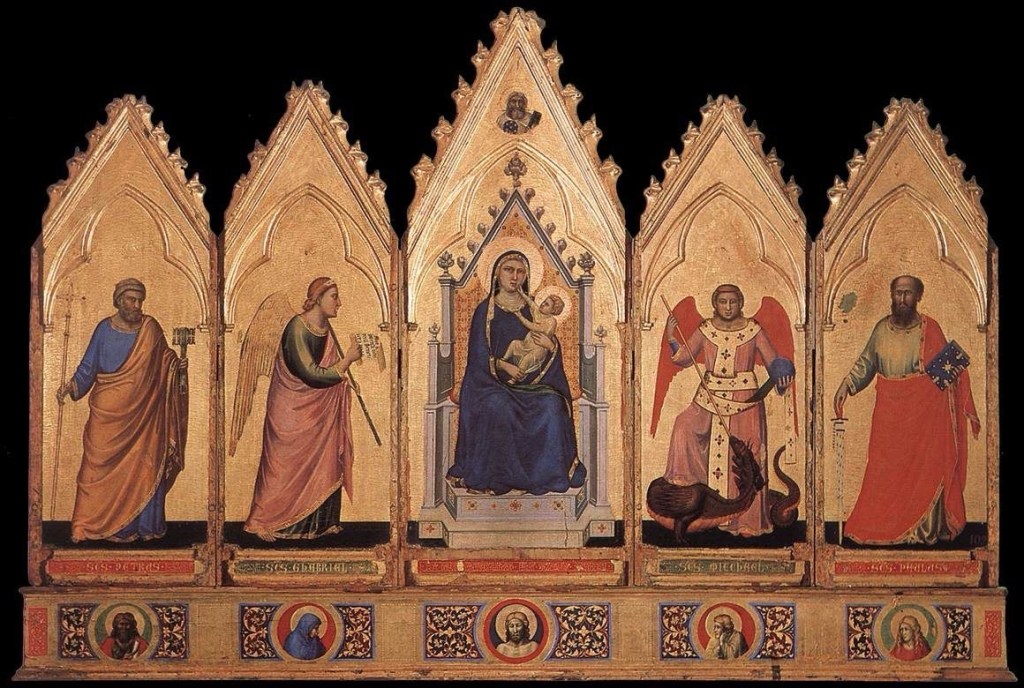
Iconography constitutes a defining element of Orthodox ecclesiastical architecture. The holy icons can be found on walls, ceilings, domes, windows; and are even on liturgical vestments of priests and deacons, the curtain before the altar, bibles & gospel books, and the holy vessels. The icons vary in what they depict, namely; The Holy Trinity, the Incarnate Word -Jesus Christ, St. Mary, the Angels, and the various Saints canonized by the Church. They are rich in color, convey theological truths, and illustrate events from sacred scripture or the lives of the saints.
Because the Orthodox decorate their churches in this fashion, and venerate the persons depicted, charges of idolatry have been made by Non-Believers, namely; Muslims, Jews, Jehovah’s Witnesses, certain Protestant sects, and the like. In the case of the said groups who uphold the Bible to be authoritative, with the exception of Islam, they refer to Sacred Scripture and accuse the Orthodox of not following the Bible and God’s Holy Commandments. A common source for their claim is Exodus 20:2-6, which we will review in detail briefly.
It is worth noting that, for the Orthodox, the charges of idolatry are appalling and even offensive to pious ears. This is because the Church, being the Body of Christ, confesses the Holy Scriptures to be Divinely Inspired, Inerrant, and Infallible. Wherefore, to the Church, the faith revealed by God through the Bible is without compromise (c.f. 2 Timothy 3:16).
Thus, the Holy Church continues in its sacred doctrines, especially regarding there being One God: The Father, Son, and Holy Spirit, One in Essence. This was the faith by which the Apostles, Confessors, Martyrs, and Early Church Fathers diligently taught, preserved, and defended; even to the point of blood.
Granted, because the Church is careful in her reverence for the sacred scriptures and the persons who preserved the true faith that can be found within them; then she also cares for the very teachings of the same persons that handed down the spotless dogmas to us. This is what earns the Church the title: “Orthodox”. This also explains why the Church professes the Nicene-Constantinopolitan Creed every Sunday to disqualify any idea of there another God, as polytheism conflicts with Church dogma and the Gospel Message at large.
In the Church’s liturgy, and within the Tewahedo Tradition in particular, the prayers declare:
“Now we see the idolatrous heathen whose idols are many and whose devils are many. But we follow the leaders to the good way as the Apostles taught us saying: it is as if The Father is the sun, the Son is the sun, and the Holy Spirit is the sun: but it is one sun of righteousness over all. The Father is fire, the Son is fire, and the Holy Spirit is fire; but it is one fire of life in the highest heaven.”
– Anaphora of St. Mary
Now, we will review Exodus 20:2-6 and examine if it condemns the use of iconography. Here, our Lord said as to Moses:
“I Am the Lord your God, who brought you out of the land of Egypt, out of the house of bondage. You shall have no other gods before Me. You shall not make for yourself an idol or a likeness of anything in heaven above, or in the earth beneath, or in the waters under the earth. You shall not bow down to them or serve them, for I, the Lord your God, am a jealous God, recompensing the sins of the fathers on the children to the third and fourth generation of those who hate Me; but showing mercy to thousands, to those who love Me and keep My commandments.”
It is worth noting that the Church, by no stretch of the imagination, ignores or disbelieves anything that comes from Divine Inspiration, especially the ordinances of God and what He commands. What the Church does dismiss, however, is exegesis of scripture that is not done through the lens of the Apostolic Tradition and historical context; for the holy Apostle Peter says:
“that no prophecy of Scripture is of any private interpretation…” ( 2 Peter 1:20).
Let us now consider the following points:
The Author: Moses is credited as being the co-author of the Pentateuch (The Law), which includes the Book of Exodus (c.f. John 1:17).
Time Period: Considering that the book records past events, it is believed to have been written during Israel’s 40 year wandering in the wilderness towards Canaan.
Audience & Purpose: The book was written to the children of Israel. As discussed in our previous article, Israel “had adopted idolatrous practices… such as [that] of the Egyptians. Hence, adoration was given to created things such as inanimate objects, animals, celestial bodies, and even fellow man — as kings were worshiped as gods”, and “The commandment given regarding the making of graven images was due to God being without form, unlike that of heathen deities who were depicted in the forms of created things already described. This is because prior to the Incarnation, the Word was “incorporeal by nature” (Athanasius, On The Incarnation, 1.3). Hence, because God wanted to prevent them from depicting His Divine Essence, and from returning to worshiping the false gods, and because He wanted to emphasize that He alone is the Creator of all things which they gravely worshiped in error: this commandment was issued.
Wording: The word used for idol in the original Hebrew is Pesel, viz. ‘To Carve’. In the Greek, it translates to eidólon, literally meaning “an image (i.e., for worship), by implication a false god” (SEE). In other words, an image specifically depicting a false god (a demon; c.f. Psalm 95:5) that was meant to be worshiped in the place of God. We see many examples of this throughout scripture, such as Exodus 32:4-8 (Golden Calf), Moloch (Amos 5:26), etc. These do not include the saints, as they are not adored, worshiped, acknowledged as deities, or revered as having any participation in the creation of all things. They are rather creatures by whom God has sanctified by His Blood & Grace; those who have cooperated with it; and finished the race (2 Tim 4:7), leaving us an example to imitate (c.f. 1 Tim 4:16; 11:1; Heb 6:12). Icons are a reminder of that reality.
Exegetical Considerstions: As discussed, context is relevant when interpreting scripture. A black and white interpretation of the scripture can lead to erroneous conclusions that scripture contradicts itself; as we will see in several other passages that God had not only commanded the making of graven images, but even approved and hallowed them.
The Ark of the Covenant: When our Lord instructed Moses to make a tabernacle for worship, He commanded that a chest be created. On this chest were two statues of cherubim angels.
“Make the ark of testimony from incorruptible wood … Then you shall make two cherubim of gold; of hammered work you shall make them at the two ends of the mercy seat. Make one cherub at one end and the other cherub at the other end; you shall make the cherubim at the two ends of it of one piece with the mercy seat.”
– Exodus 25:10,18-20.
It was before this ark by which:
“Joshua tore his clothes and fell to the ground before the face (ark) of the Lord until evening, both he and the elders of Israel, and they put dust on their heads.”
– Joshua 7:6.
Nobody would dare to accuse Joshua of idolatry for bowing before the ark which had the said imagery upon it; which shows that context also matters in relations to intent. In the same manner, such grace should also be granted to the Orthodox; who may pray, bow before, or kiss icons not because they worship paint, plaster, gold, or wood (God forbid), nor because they worship additional deities in the form of saints besides the Creator; but to venerate those being depicted; as they are temples of the Holy Ghost which is evident by the grace of God that worked through them to attain holiness.
In other words, in the case of the saints, the faithful acknowledge the presence of the Holy Spirit that was present within them as a gift from God while on earth which earned them their eternal crown in heaven; and therefore, they request for their prayers before God that He might also reward them with the very same salvation. This is biblical since those in heaven present our prayers before God (Revelations 5:8; 8:3-4). God willing, we will have another article on this matter.
The Ten Curtains of the Tabernacle: When God instructed that a separate space was to be constructed for the Holy of Holies (the area where the Ark of the Covenant is), He instructed that there be curtains made with the depictions of cherubim on them:
“Now you shall make the tabernacle with ten curtains of fine woven linen, with blue, purple, and scarlet fabric, and you shall weave them with artistic designs of cherubim … The veil shall be a divider for you between the holy place and the holy of holies.” – Exodus 26:1,33.
Again, would anybody dare charge Moses, Aaron, the Levites, and the Israelite nation at large for idolatry for carrying out what was requested by God; and would anybody dare blasphemously accuse our Lord of contradicting Himself?
The Church, being the New Israel (Galatians 6:16) likewise models the practice of scripture in her use of the iconostasis before the Holy Altar of the Lord — proving that it is biblical.
Solomon’s Temple: Within 1st Kings, Solomon is instructed by God to make a temple. Inside this temple, Solomon makes images of cherub, oxen, open flowers, lions, and palm trees.
“And the whole house he overlaid with gold, until he had finished all the house: also the whole altar that was by the oracle he overlaid with gold. And within the oracle he made two cherubims of olive tree, each ten cubits high. And five cubits was the one wing of the cherub, and five cubits the other wing of the cherub: from the uttermost part of the one wing unto the uttermost part of the other were ten cubits. And the other cherub was ten cubits: both the cherubims were of one measure and one size. The height of the one cherubwas ten cubits, and so was it of the other cherub. And he set the cherubims within the inner house: and they stretched forth the wings of the cherubims, so that the wing of the one touched the one wall, and the wing of the other cherub touched the other wall; and their wings touched one another in the midst of the house. And he overlaid the cherubims with gold. And he carved all the walls of the house round about with carved figures of cherubims and palm trees and open flowers, within and without. And the floors of the house he overlaid with gold, within and without. And for the entering of the oracle he made doors of olive tree: the lintel and side posts were a fifth part of the wall. The two doors also were of olive tree; and he carved upon them carvings of cherubimsand palm trees and open flowers, and overlaid them with gold, and spread gold upon the cherubims, and upon the palm trees. So also made he for the door of the temple posts of olive tree, a fourth part of the wall. And the two doors were of fir tree: the two leaves of the one door were folding, and the two leaves of the other door were folding. And he carved thereon cherubims and palm trees and open flowers: and covered them with gold fitted upon the carved work.
– 1 Kings 6:22-35.
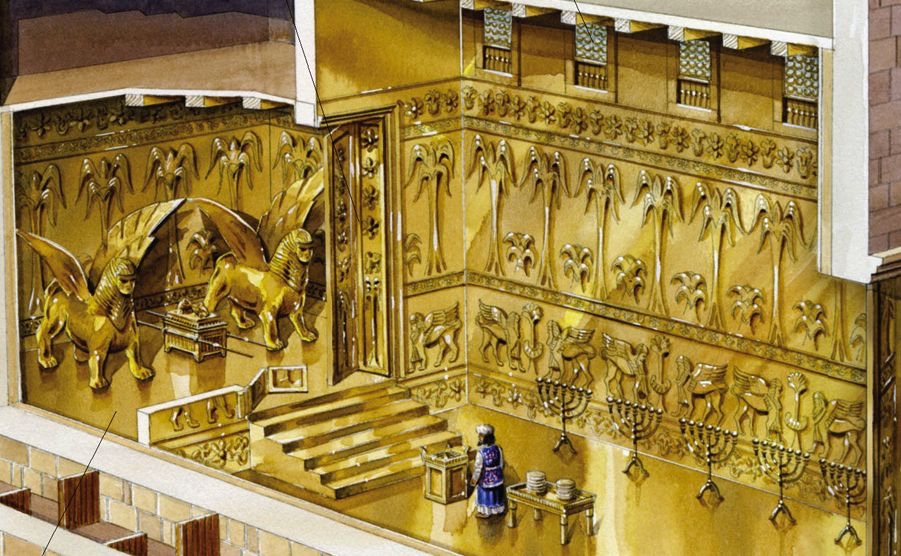
1 Kings 7:13-30 also gives more examples of images being made for the glory of God.
Note that God has later accepted and consecrated this temple (1 Kings 9:3), which goes to show that when imagery is used in its proper use; God accepts it.
The Lord said to him, “I heard your prayer and the supplication you made before Me; I have done for you everything in your prayer. I consecrated this house you built to place My name there forever, and My eyes and My heart will be there all the days.
– 1 (3) Kingdoms 9:3.
Also take into consideration that cherubs, oxen, lions, palm trees, open flowers etc. are depictions of things in both Heaven and Earth as we covered when reviewing Exodus 20; which clearly refutes the idea that all depictions are forbidden.
The use of images in the context of the scriptures mentioned above were used as visual means to emphasize a spiritual reality; that God was present among His people within His temples made by the hands of men. This ancient Jewish practice continued even into synagogues of 3rd century, such as the Dura Europa; one of the oldest existing synagogues. Again, this is what the Orthodox Church models her temples after, which is evidently supported by scripture.
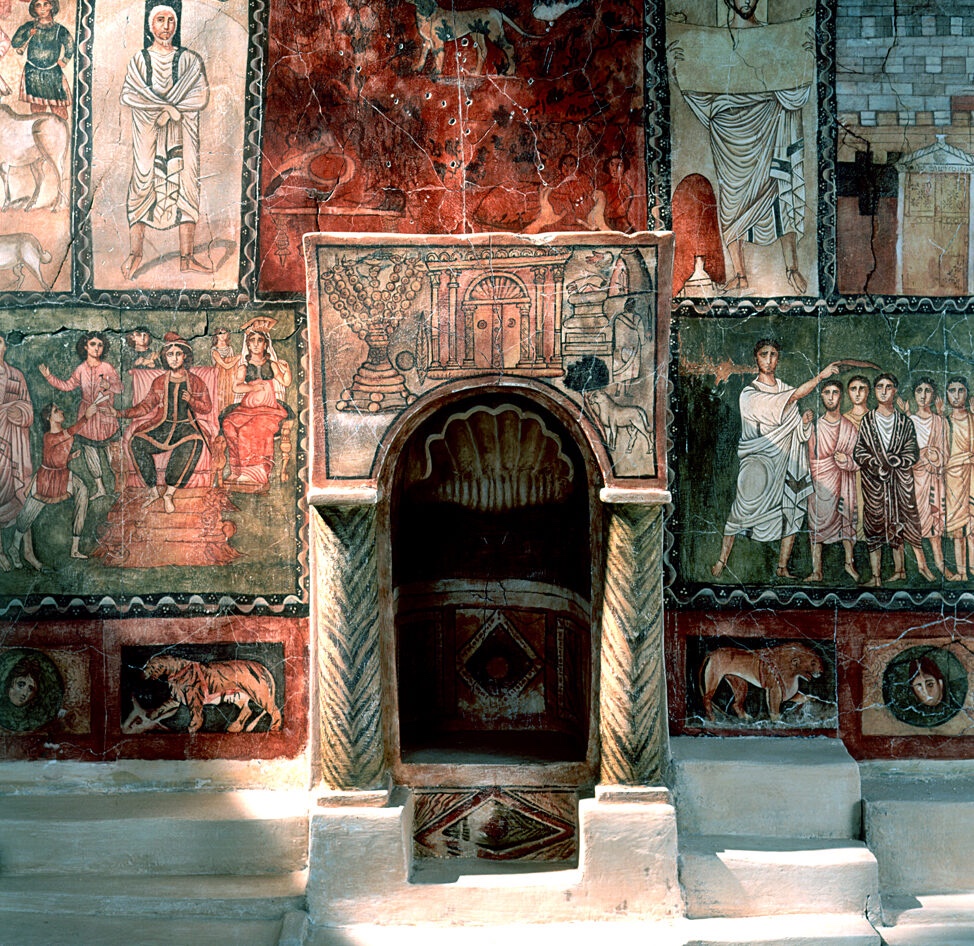
Just as the devout Hebrews did not worship the images within the temple, the Orthodox Church — being the New Israel — does not teach to worship the holy icons or the saints depicted in them per the dogmas of our holy religion handed down by Christ through the Apostles. The Church neither depicts the Divine Essence of God, but explicitly depicts Christ in His Humanity since He has become, through His Incarnation, the Image (Greek: Eikon) of the Invisible God.
“He is the image (Eikon) of the invisible God, the firstborn over all creation”
– Col 1:1.
So, because the Word was truly Incarnate in a real Body, He can be depicted; as well as everyone made in His Image (c.f. Genesis 1:26).
It must also be noted that many of the saints which are depicted within the icons were destroyers of idols themselves — many which even suffered martyrdom for resisting idolatry. Given that icons are a means to educate, tell a story, and catechize the faithful which we established already; it would be a complete betrayal to worship the one in the image (or the image itself). SEE
Just as the Tewahedo liturgy condemns idolatry; so does that of its mother Coptic Rite. For instance, during the liturgy of the word, the priest prays the following words for catechumens seeking the Orthodox faith:
“Remember, O Lord, the catechumen of your people, have mercy upon them, confirm them in Your faith and cast out of their hearts all traces of idolatry.”
To add, during the prayer of the Absolution to the Father, the priest also recites:
“If we have trespassed against You, either by the word of mouth or by action, forgive us our sins, O good Lord and lover of mankind. O Lord, absolve us and absolve all Your people from every iniquity, every curse, every denunciation, every unfaithful oath and every encounter with the heretics and idolaters.”
To quote His Grace Bishop Mettaous:
“The priest stands before the altar and the deacon brings the censer to him from the right side of the altar. The priest places five spoonfuls of incense in the censer while making the sign of the cross three times, thus consecrating the incense to the Only One Holy God (not to idols or strange gods), as it is written, “From the rising of the sun, even to its going down, My Name shall be great among the gentiles, in every place
incense shall be offered to My Name, and a pure offering” (Malachi 1:11).”– The Spirituality of the Holy Liturgy of the Coptic Orthodox Church.
Commentary from the Early Church Fathers:
St Basil the Great: I acknowledge also the holy apostles, prophets, and martyrs; and I invoke them to supplication to God, that through them, that is, through their mediation, the merciful God may be propitious to me, and that a ransom may be made and given me for my sins. Wherefore also I honor and kiss the features of their images, inasmuch as they have been handed down from the holy apostles, and are not forbidden, but are in all our churches (Letter 360 [circa A.D. 370]).
St. Cyril of Alexander: Even if we make images of pious men it is not so that we might adore them as gods but that when we see them we might be prompted to imitate them; and if we make images of Christ, it is so that our minds might wing aloft in yearning for Him (Commentary on the Psalms 113B 115:16 [ante A.D. 429]).
The Council of Ephesus: “Theodosius, the humble Christian, to the holy and Ecumenical Synod: I confess and I agree to (suntiqemai) and I receive and I salute and I venerate in the first place the spotless image of our Lord Jesus Christ, our true God, and the holy image of her who bore him without seed, the holy Mother of God, and her help and protection and intercessions each day and night as a sinner to my aid I call for, since she has confidence with Christ our God, as he was born of her. Likewise, also I receive and venerate the images of the holy and most laudable Apostles, prophets, and martyrs and the fathers and cultivators of the desert. Not indeed as gods (God forbid!) do I ask all these with my whole heart to pray for me to God, that he may grant me through their intercessions to find mercy at his hands at the day of judgment, for in this I am but showing forth more clearly the affection and love of my soul which I have borne them from the first. Likewise, also I venerate and honor and salute the relics of the Saints as of those who fought for Christ and who have received grace from him for the healing of diseases and the curing of sicknesses and the casting out of devils, as the Christian Church has received from the holy Apostles and Fathers even down to us to-day (Session 1, [A.D. 431]).
Tertullian: The brazen serpent and the golden cherubim were not violations of the Second Commandment. Their meaning. Likewise, when forbidding the similitude to be made of all things which are in heaven, and in earth, and in the waters, He declared also the reasons, as being prohibitory of all material exhibition of a latent idolatry. For He adds: “Thou shalt not bow down to them, nor serve them.” The form, however, of the brazen serpent which the Lord afterwards commanded Moses to make, afforded no pretext for idolatry, but was meant for the cure of those who were plagued with the fiery serpents? I say nothing of what was figured by this cure. Thus, too, the golden Cherubim and Seraphim were purely an ornament in the figured fashion of the ark; adapted to ornamentation for reasons totally remote from all condition of idolatry, on account of which the making a likeness is prohibited; and they are evidently not at variance with this law of prohibition, because they are not found in that form of similitude, in reference to which the prohibition is given (Against Marcion 2:22 [inter A.D. 207-212]).
This concludes this post.
 Faith Unto Ages