Throughout history, man has made attempts to explain the origin of all things. This is evident when examining the various cosmological stories of antiquity, such as in the case of the ancient Egyptians and Babylonians who attributed the birth of existence to various deities. These deities had fallen human characteristics, ambitions, and interests.
To cite Holmon’s Quicksource:
“Egyptian and Babylonian (as well as the earlier Sumerian) creation myths were inherently polytheistic, with teeming masses of powerful but flawed gods competing for the spotlight… cohabitations, base motives, and warring between the chief gods led to the incidental creation of other gods as well as the earth, sky, sea, and all living things”
– Whorton, Mark S, and Hill Roberts. Holman Quicksource Guide to Understanding Creation. Nashville, Tennessee, Holman Reference, 2008, 41-42.
These deities of the said groups were not only limited, as they wrestled “with eternal matter to fashion heaven and earth” (Whorton, 37) but were unjust and grudging against the human race. For instance, the Babylonian Enuma Elish tells that the human race was created from the blood of the defeated Kingu, who was seen as being the commander of demons, from the underworld, and an enemy to “superior” deities. Consequently, a personal and loving relationship between humanity and the gods was lacking; as they were created not only as a result of conflict, but to perform difficult labors of the gods such as building, digging, etc.
On the contrary, the Holy Scriptures speak of there being One God that is completely good, just, eternal, omnipotent, sovereign, unlimited, and sacred. As such, He was not in need of any other assistance, nor in need of pre-existent matter to create; as He made all things out of nothing by His Word. The idea of a deity needing pre-existent matter was one shared with, and perhaps adopted, by Plato.
Speaking on this error, St. Athanasius says:
“But in so saying they know not that they are investing God with weakness. For if He is not Himself the cause of the material, but makes things only of previously existing material, He proves to be weak…For He could not in any sense be called Creator unless He is Creator of the material of which the things created have in their turn been made.”
– On The Incarnation, 2.3,4.
In addition, the Church Fathers explain that God created all things, including the human race, because of His love; that all might glorify Him. Thus, Mathetes says:
“For God has loved mankind, on whose account He made the world, to whom He rendered subject all the things that are in it, to whom He gave reason and understanding, to whom alone He imparted the privilege of looking upwards to Himself, whom He formed after His own image…”
– Mathetes. Epistle to Diognetus, 10.
Because humanity had been deceived by demons to create new deities (Psalm 95:5), and then attributed creation to them, God had commissioned special men as prophets to recall mankind back to acknowledging Him alone as the One Creator. Thus, the creation narratives found throughout holy writ which can be seen throughout Genesis, Job, the Psalms, Proverbs, and even the Gospel of John. Though they were all written by different individuals (co-authors) who were recording what God had revealed to them, and though they were written in different periods of time and to different audiences, they all convey the same message and demonstrate God’s sovereignty which is evident by nature which He alone created.
St. Athanasius:
“God made provision, once more, even for this weakness of theirs, by sending a law, and prophets, men such as they knew, so that even if they were not ready to look up to heaven and know their Creator, they might have their instruction from those near at hand… So it was open to them, by looking into the height of heaven, and perceiving the harmony of creation, to know its Ruler, the Word of the Father, Who, by His own providence over all things makes known the Father to all, and to this end moves all things, that through Him all may know God.”
– On The Incarnation, 12. 2,3.
It was in this context described by the saint by which the book of Genesis was written by the prophet Moses; who was commanded by God to teach Israel as a Nation sacred laws and ordinances since they were a chosen nation due to being the physical descendants of Abraham by whom God made a covenant with.
Though they were distinguished by their neighboring nations in this regard, they were not by any stretch of the imagination sinless; as they had adopted idolatrous practices of them, such as the Egyptians. Hence, adoration was given to created things such as inanimate objects, animals, celestial bodies, and even fellow man — as kings were worshiped as gods.
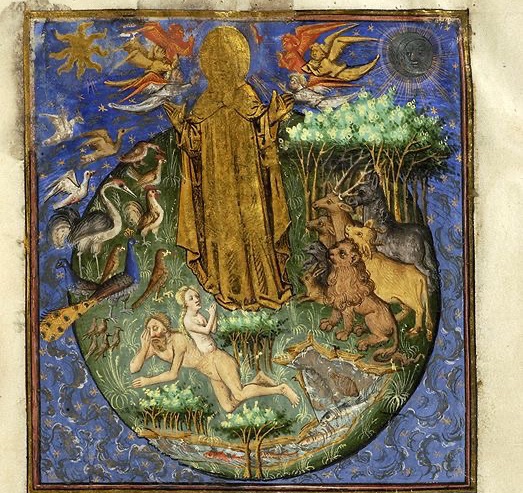
Thus, to catechize and depaganize the Israelites, Moses wrote the book of Genesis, and illustrated within the first two chapters how God made all things by His Word since they worshiped creation in error. This was, of course, also emphasized when God gave Moses the two commandments by the same Word, who instructed in the first two that “You shall have no other gods before me. You shall not make for yourself an idol or a likeness of anything in heaven above or in the earth beneath, or in the waters under the earth…” (Exodus 20:2-4).
The commandment given regarding the making of graven images was due to God being without form, unlike that of heathen deities who were depicted in the forms of created things already described. This is because prior to the Incarnation, the Word was “incorporeal by nature” (Athanasius, On The Incarnation, 1.3)
Echoing Genesis, St. John highlights in His Gospel that this same Word had created all things just as Moses testified, and by extension, that He had become Incarnate, which was done with the purpose of saving the human race which He loved, as they were made in His image.
“In the beginning God made heaven and earth. The earth was invisible and unfinished; and darkness was over the deep. The Spirit of God was hovering over the face of the water. Then God said, “Let there be light”; and there was light… Then God said, “Let Us make man in Our image, according to Our likeness. Let them have dominion over the fish of the sea, over the birds of heaven, over the cattle, and over all the earth, and over every creeping thing that moves on the earth.”- Genesis 1:1-26.
“In the beginning was the Word, and the Word was with God, and the Word was God. He was in the beginning with God. All things were made through Him, and without Him nothing was made that was made… And the Word became flesh and dwelt among us, and we beheld His glory, the glory as of the only begotten of the Father, full of grace and truth.” – John 1:1-3, 14.
This was contrary to the myths of the pagans previously discussed, “For God is good, or rather is essentially the source of goodness … whence, grudging existence to none, He has made all things out of nothing by His own Word, Jesus Christ our Lord” (Athanasius, 3.3).
At any rate, the Holy Ghost also revealed the mystery of creation in several other passages of scripture that was briefly mentioned above, such as Job 38:11 which also stresses creation by the Word.
St. David the Prophet likewise testifies to this:
“By the Word of the Lord the heavens were established, and all the hosts of them by the breath of His mouth, who gathers the waters of the sea together as a wineskin, who puts the abyss in storehouses”
– Psalm 32:6-7.
Thus, it was not unusual for the Word Incarnate to have the ability to rebuke storms of the Sea (Mark 4:39) and even walk upon it (Mark 6:49, c.f. Gen 1:2), as He is without change after taking on flesh.
“For He was not, as might be imagined, circumscribed in the body, nor, while present in the body, was He absent elsewhere; nor, while He moved the body, was the universe left void of His working and Providence…even while present in a human body and Himself quickening it, He was, without inconsistency, quickening the universe as well, and was in every process of nature, and was outside the whole, and while known from the body by His works, He was none the less manifest from the working of the universe as well.”
– Athanasius, On The Incarnation, 17.
Per St. Basil the Great, the Dogmas of our Faith can be found within the Holy Liturgies of the Church compiled by the fathers which was handed down by the Apostolic Paradosis (Tradition) (De Spiritu Sancto, 27). Thus, the Church in her wisdom prayers within the Ethiopian Orthodox Liturgy:
“One God, Father of our Lord and our Saviour Jesus Christ, Who was begotten before the creation of the world, the only begotten Son, coequal with Him, creator of all the hosts, the principalities and the dominions. Who in the last days was pleased to become man, and took flesh from our Lady Mary, the holy Virgin, without the seed of man, and grew like men yet without sin or evil, neither was guile found in his mouth.
Then He suffered, died in the flesh, rose from the dead on the third day, ascended unto heaven, to the Father Who sent him, sat down at the right hand of Power… We also believe that Christ is not in the least degree inferior because of His incarnation, but He is God, the Word, who truly became man, and reconciled mankind to God…”
This concludes this post.
 Faith Unto Ages