
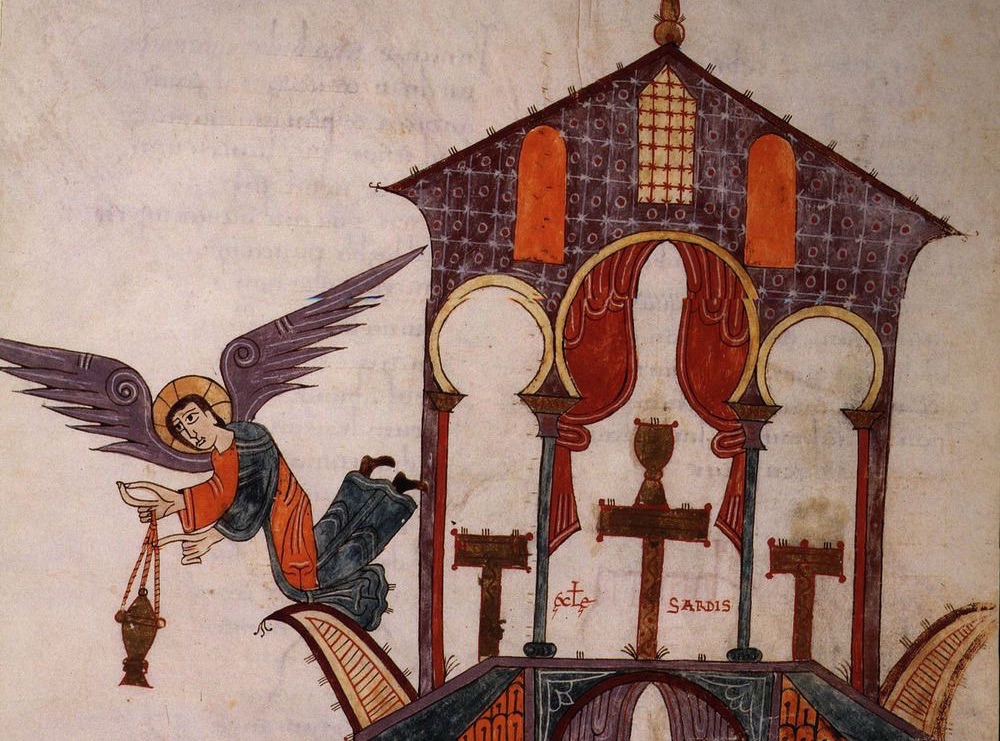
A vessel which is used within the Divine Liturgies of the Orthodox Church is the Censor. It has various other names as well, such as Thurible, Shoria, Tsena, and Poorvar.
It has its origins in the Old Testament Levitical offerings, with God commanding through Moses that Aaron “shall then take a censer full of burning coals of fire from the altar before the Lord, with his hands full of the incense compound, beaten fine, and bring it inside the veil. He shall put the incense on the fire before the Lord, that the cloud of incense may cover the mercy seat on the testimonies, lest he die” (Leviticus 16:12-13).
The Church also models the use of the censor from what can be seen even within the New Testament, as St. John the Apostle described seeing heaven: “seven angels who stand before God, and to them were given seven trumpets.
Then another angel, having a golden censer, came and stood at the altar. He was given much incense, that he should offer it with the prayers of all the saints upon the golden altar which was before the throne. And the smoke of the incense, with the prayers of the saints, ascended before God from the angel’s hand” (Revelations 8:2-4).
As Orthodox Christians, we can learn a lot from the censor. Just like the censor, we are called to offer up a sacrifice to God through prayer: “Let my prayer be set forth before You as incense, The lifting up of my hands as the evening sacrifice” (Psalms 140:2).
Yet, if we are not careful, we can become like censors that are unkept and unclean due to negligence; full of soot, ash, and muck. Censors that are not regularly cleaned will consequently offer up black clouds of smoke with an unpleasant smell, contrary to a gentle white cloud which perfumes and fragrances the whole room and pleases the senses.
I can tell you from personal experience as somebody who served the altar for over 13 years that getting the censor to be completely clean and free of residue is a very difficult task. Others that also serve in a liturgical role, such as priests, my fellow deacons, etc; will tell you that it takes a lot of effort to do so, though it’s not impossible.
Though difficult (Matthew 7:14) we are called as living censors to struggle and regularly examine ourselves, practice repentance, prayer, and watchfulness (Luke 14:36) that we may empty ourselves of our own soot, ash, and muck; that being our sinful passions and desires within us; be it pride, vanity, anger, lust, sloth, hatred, lack of forgiveness and the remembrance of faults, etc – as these all darken our prayers and produce dark clouds of smoke that do not please our Lord (Isiah 1:15).
We must take the advice of Tertullian, who said: “After the whole body has been washed and purified in baptism, there is need for purification through continuous repentance from the defilement of our hands” (On Prayer, 13).
And another from St. Basil: “On the other hand, where sin is concerned, be your own accuser (Proverbs 18:17), and do not wait for others to make the accusation. Thus, you will be like a just man who accuses himself in the first speech made in court, or like Job who was not deterred by the crowd of people in the city from declaring his personal guilt before all (Job 31:34)” – (On Humility, FOTC 9:485).
When we accuse ourselves and examine the brokenness within us, we take the example of the Publican and shun the vanity of the Pharisee – who thought he was righteous due to his deeds, yet went away condemned (Luke 18:10-14). This helps us, though hard, and by the Grace of God, to strive for the purity of our hearts – to cleanse it of all the filth of soot, ash, and muck – that we may be true vessels of pure prayer.
For “purity of heart is a prayer, more so than all the prayers which are prayed in a loud voice” – (St. Aphrahat, Demonstrations 1).
It is upon the altar of a pure heart that we have the gift to offer pure incense to the the Father, through His Son, by the work of the Holy Spirit; pure incense which is placed upon the coals of repentance and humility, being enkindled by the fire of Divine Love.
Let us, therefore, be living censors of pure prayer for the Lord by offering the sacrifice of daily repentance. Let us also offer up the sacrifice of praying for those that have hurt us as well as for those we have injured by our thoughts, words, and deeds; and praying for their very salvation.
May we accompany this with practicing works of charity pleasing to the Lord, that we may say with our father St. Gregory of Narek:
“I offer up to You, o seer of secrets, placing the fruits of my wavering mind as a savory sacrifice on the fire of a grieving soul to be delivered to You in the censer of my will. Compassionate Lord, Breathe in this offering and look more favorably on it than upon a more sumptuous sacrifice offered with rich smoke … may this unsolicited gift reach you, this sacrifice of words from the deep mystery filled chamber of my feelings, consumed in flames, fueled by whatever grace I may have within me” (Prayer 1, Speaking With God from the Heart).
Glory be to God forever, amen.
 Faith Unto Ages