Holy Scripture tells us:
Mark 9: 25-29: “When Jesus saw that the people came running together, He rebuked the unclean spirit, saying to it, “Deaf and dumb spirit, I command you, come out of him and enter him no more!” Then the spirit cried out, convulsed him greatly, and came out of him. And he became as one dead, so that many said, “He is dead.” But Jesus took him by the hand and lifted him up, and he arose. And when He had come into the house, His disciples asked Him privately, “Why could we not cast it out?”So He said to them, “This kind can come out by nothing but prayer and fasting.”
From what we can see, fasting was commanded by our Lord Himself. But why is it that fasting is needed?
- We fast to discipline our body and to control the passions of the flesh. By doing so we grow spiritually and please God by choosing Him over the lust of this passing world.
- We also fast in preparation for services and other duties in life and within the Church; just as we see with our Lord Jesus Christ who fasted before He started His ministry in Galilee. Note: In the same manner – when a priest is ordained in the Coptic Orthodox Church they spend forty days at a monastery away from the world. This is so that they prepare for the ministry spiritually and by learning the rites of the church.
- We also fast before we approach any of the blessed sacraments.
Introduction to the Great Lent
“The Great Lent is considered the holiest fast because our Lord Jesus Christ fasted it Himself. Therefore, during the Great Lent we follow the example set by our Lord Jesus Christ, Who fasted on our behalf forty days and forty nights (Mt. 4:2).” – His Eminence Metropolitan Serapion
The Church in her wisdom has designated not only one but two fasts preceding the Great Lent to prepare us for this holy journey; The first being the Jonah’s Fast, and the second week-long period of fasting prior to the start of The Great Lent. This is due to the great seriousness of holiness found in this fast. This seriousness is actually seen in contrast to other fasts. For example, in the Great Lent we are not pescatarian or vegetarian in diet but are vegan. Bearing this in mind the liturgies are scheduled at later times; providing more time to fast and pray prior to the partaking of the blessed mysteries.
The Great Lent is Apostolic and not an innovation
When we look to Canon 69 of the Canons of our Father the Apostles we read “Any bishop, priest, deacon, reader, or chanter who does not fast Great Lent or Wednesdays and Fridays shall be excommunicated, unless he has physical ailment. As for a lay person, he shall be excluded.”
The Great Lent is Ascetic. The word Ascetic comes from the Greek ascesis which means ‘struggle’.We are to participate in a period of strict abstinence (refraining from eating and drinking for a period of time) then to eat according to the treasure of the fathers a vegetarian meal- vegan in our case.
A stark difference is made between those who simply eat vegetarian without abstinence and those who abstain and then eat. The former is simply a vegetarian, the latter is one who is fasting.
The Great Lent is a time for prayer
We see in the lenten season that the times of liturgy are pushed back and are not held early in the morning. As mentioned previously, this allows more time for the faithful to fast and struggle. Not to mention, that the Church in her wisdom desires her children to pray all hours up to the Compline prayer, which cancannot be done at 5am.
Traditionally these weekday Lenten liturgies would end at sunset but the pastoral care of the church allows for them to end earlier but not before noon.
The Great Lent is for repentance
Fasting without repentance is useless and has no point. The Church in her wisdom has given us the parable of the Prodigal Son on the third Sunday of Lent for this reason. The Parable reminds us of God’s great love for those who come to him.
“All that the Father gives Me will come to Me, and the one who comes to Me I will by no means cast out.” – (John 6:37)
“For the Son of Man has come to save that which was lost.” (Matthew 18:11)
Our Lord desires for his children to come to Him. He works with and in us by His Most Holy Spirit to call us to Himself. We praise God for His many mercies and hymn to Him saying, “I have sinned, O Jesus, my Lord. I have sinned, O Jesus, my God, O my King, do not count the sins I have committed.”
The Great Lent is a time to be merciful
Working in tandem with fasting, by forsaking the physical needs we turn our attention to that of the heavenly. “Is this not the fast that I have chosen: To loose the bonds of wickedness, To undo the heavy burdens, To let the oppressed go free, And that you break every yoke? Is it not to share your bread with the hungry” – (Isaiah 58: 6,7). We think less of ourselves we feel the needs of others more!
The Great Lent is a period of reconciliation with others
“Fasting is an act of worship presented to God, and God does not accept the offering and worship of a person who quarrels with others. Instead, He asks him to go and make peace with his brother before coming to worship and present offerings in front of God’s altar. Fasting is an appropriate time to evaluate our relationship with others. As we ask God to forgive us our sins, we must also forgive those who have sinned against us.” (P.16)
Fasting and Prayer
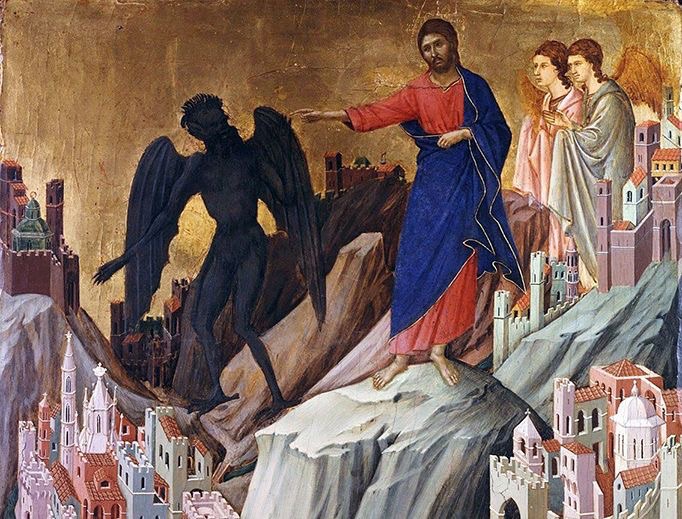
“Then Jesus was led up by the Spirit into the wilderness to be tempted by the devil. And when He had fasted forty days and forty nights, afterward He was hungry. Now when the tempter came to Him, he said, “If You are the Son of God, command that these stones become bread.”
But He answered and said, “It is written, ‘Man shall not live by bread alone, but by every word that proceeds from the mouth of God.’ ”Then the devil took Him up into the holy city, set Him on the pinnacle of the temple, and said to Him, “If You are the Son of God, throw Yourself down. For it is written:‘He shall give His angels charge over you,’and, ‘In their hands they shall bear you up,
Lest you dash your foot against a stone.’
“Jesus said to him, “It is written again, ‘You shall not tempt the Lord your God.” Again, the devil took Him up on an exceedingly high mountain, and showed Him all the kingdoms of the world and their glory. And he said to Him, “All these things I will give You if You will fall down and worship me.” Then Jesus said to him, “Away with you, Satan! For it is written, ‘You shall worship the Lord your God, and Him only you shall serve.”Then the devil left Him, and behold, angels came and ministered to Him. (Matthew 4:1-11)
Looking again to Matthew chapter four we see that our Lord was tempted by the very things in which we often find ourselves struggling with; gluttony, vanity, and idolatry. In the end we are able to escape these snares not only with humility but with the knowledge of God by studying the holy scriptures.
We also see in Matthew chapter four that the evil one is trying to use the scriptures against our Lord and Jesus Christ. But, the wicked one twisted the scriptures to his own gain and thus by the proper understanding given by our God Jesus Christ our King the enemy was defeated.
The same is so in our lives. Whenever we seek comfort or personal gain at expense of the Holy Traditions and word of God we are the same as the devil and his trickeries and we are not helping ourselves.
When we willingly submit to the Church and her teachings and allow the Lord to be our Shepherds we have life and a shield.
Fasting and Prayer is like bread and water without these we can not live. The soul benefits greatly from fasting and prayer. When we fast and deny the flesh our soul flourishes.
As we read in the fraction of the Great Lent: Fasting and prayer are those which raised Elijah to heaven and saved Daniel from the lions´ den. Fasting and prayer are those which Moses pursued until he received the Law and Commandments written with the finger of God. Fasting and prayer are those which the people of Nineveh pursued until God had mercy on them and forgave them their sins, and lifted His wrath away from them.
References
Coptic Orthodox Diocese of Los Angeles, Southern California, and Hawaii. 2010. The Great Lent: Patristic Meditations on the Sunday Gospels. N.p.: Saint Paul Brotherhood.
 Faith Unto Ages